
By: Mohamed Duale
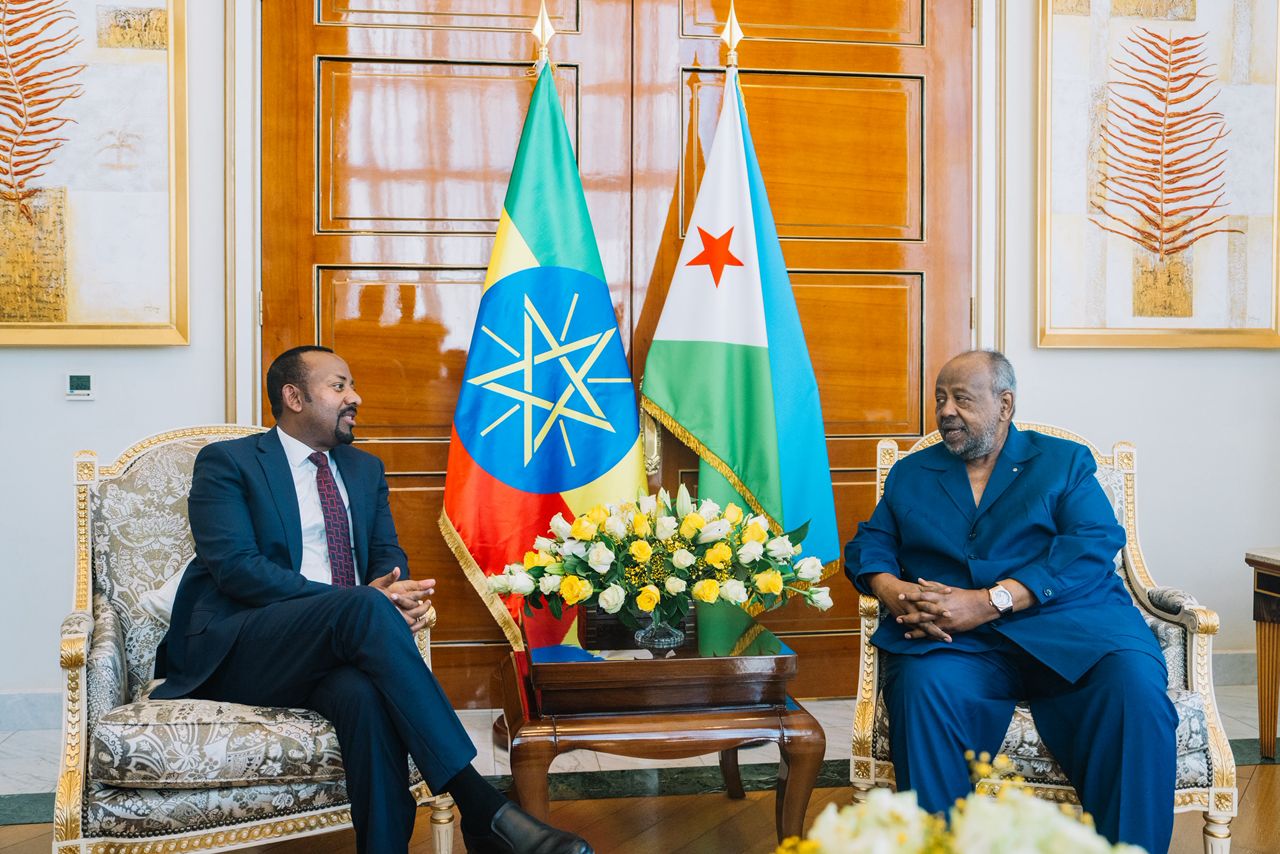
DJIBOUTI, Jan 11 (Horn Diplomat) — Ethiopian Prime Minister Abiy Ahmed arrived in Djibouti on Sunday for talks with President Ismaïl Omar Guelleh, as diplomatic tensions rise across the Horn of Africa following Israel’s formal recognition of the Republic of Somaliland.
“This morning, I arrived in Djibouti and was warmly received by President Ismaïl Omar Guelleh,” Abiy said in a statement. “Our discussions focused on geopolitical dynamics, regional peace and security, and strengthening bilateral cooperation, particularly in trade, logistics, and development.”
The visit comes at a time of heightened regional diplomacy after Israel’s decision to recognise Somaliland, which has governed itself independently since 1991, maintaining relative stability while holding multiple elections and building functioning state institutions despite lacking broad international recognition.
Since reasserting its sovereignty in 1991, Somaliland has established a functioning government, credible security institutions and a record of peaceful democratic transitions, distinguishing it from much of the wider region. Israel’s recognition has reinforced the view among Somaliland officials and supporters that the territory meets the practical and legal requirements of statehood under international norms.
The recognition has triggered swift reactions across the region.
Djibouti publicly rejected Israel’s move and reaffirmed its support for Somalia’s territorial integrity. Following Djibouti’s position, both Djibouti and Somaliland recalled their diplomatic representatives and suspended formal engagement, officials said, marking one of the lowest points in relations between the two sides in recent years.
The Government of Somaliland also revoked the operating licence of Air Djibouti, ending the carrier’s four weekly flights to Somaliland, authorities in Hargeisa said. The decision followed Djibouti’s stance against Somaliland’s recognition and its alignment with Somalia on the issue.
Ethiopia, by contrast, has not taken a public position on Israel’s recognition of Somaliland. Addis Ababa maintains strong economic and security ties with both Djibouti and Somaliland and relies heavily on regional stability to safeguard trade routes.
“Ethiopia is closely monitoring Israel’s decision to recognise Somaliland, but has not yet taken a formal position,” Ethiopia’s ambassador to Somalia said.
One issue looming over Abiy’s visit is Egypt’s quiet expansion of its strategic footprint along the Red Sea. Addis Standard reported that Egypt has reached discreet agreements to develop key seaports in Eritrea and Djibouti. The National, an Abu Dhabi-based newspaper, said the projects include upgrading Assab Port and Doraleh Port, expanding capacity, adding berths for warships and hosting limited military contingents near the Bab al-Mandeb Strait—one of the world’s most critical maritime chokepoints.
For landlocked Ethiopia, already locked in a long-running dispute with Egypt over Nile waters, the developments raise strategic concerns. Control over neighbouring ports and access routes has direct implications for Ethiopia’s trade security, regional leverage and long-term autonomy.
Against that backdrop, Somaliland’s growing international profile has sharpened focus on Ethiopia’s strategic options. Ethiopia already maintains close economic and security ties with Somaliland, particularly through Berbera Port in Somaliland, developed by DP World and increasingly used by Ethiopia to diversify its maritime access and reduce dependence on Djibouti’s ports.
“Prime Minister Abiy Ahmed’s visit to Djibouti should be seen less as a routine bilateral engagement and more as a calibrated response to a rapidly shifting regional balance following Israel’s recognition of Somaliland,” said Mohamed Guleid, a political analyst based in Hargeisa.
“Ethiopia’s silence on the recognition appears deliberate. While Addis Ababa remains heavily dependent on Djibouti’s ports, its growing use of alternative corridors through Somaliland’s Berbera port has reduced vulnerability and increased leverage,” he said.
“By engaging President Ismaïl Omar Guelleh at this moment, Abiy is signalling Ethiopia’s intent to safeguard critical trade lifelines, contain emerging regional polarisation and position itself for a post-recognition landscape in which access, stability and strategic alignment — rather than rhetoric — increasingly shape power in the Horn of Africa.”
More than 90% of Ethiopia’s imports and exports pass through Djibouti’s ports, underlining Addis Ababa’s vulnerability as competition around ports and maritime security in the Red Sea intensifies.
No agreements were announced during Abiy’s visit, but the timing underscored the growing diplomatic sensitivity in the Horn of Africa as countries respond to shifting political realities following Israel’s recognition of Somaliland and as Ethiopia weighs decisions increasingly linked to trade security, regional balance and long-term strategic autonomy.
© 2025 Horn Diplomat Media
Share this:
- Share on Facebook (Opens in new window) Facebook
- Share on X (Opens in new window) X
- Email a link to a friend (Opens in new window) Email
- Share on LinkedIn (Opens in new window) LinkedIn
- Share on Telegram (Opens in new window) Telegram
- Share on Threads (Opens in new window) Threads
- Share on WhatsApp (Opens in new window) WhatsApp
- Share on Mastodon (Opens in new window) Mastodon