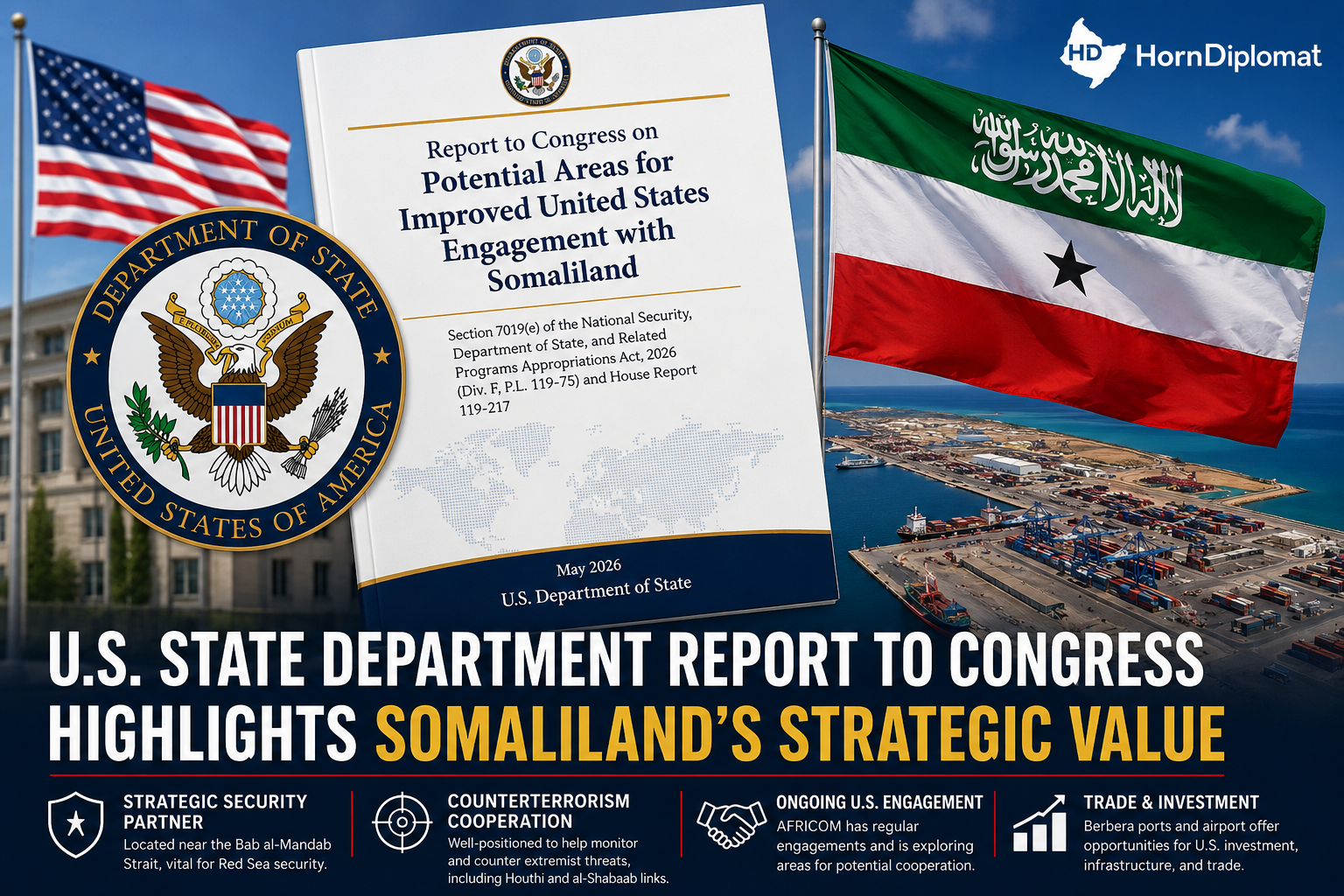
The U.S. State Department has submitted a landmark report to Congress highlighting Somaliland's strategic importance in the Horn of Africa, citing opportunities for enhanced security cooperation, trade, investment, and regional stability. photo : Horndiplomat
WASHINGTON, June 1 (Horn Diplomat) – The U.S. State Department has identified Somaliland as a potential partner for deeper cooperation on security, trade and regional stability, according to a newly released report to Congress that underscores the territory’s strategic importance along one of the world’s busiest maritime corridors.
The report, titled “Potential Areas for Improved United States Engagement with Somaliland,” was submitted to Congress under the National Security, Department of State, and Related Programs Appropriations Act, 2026. It examines opportunities for increased U.S. engagement with Somaliland while reaffirming Washington’s longstanding recognition of Somalia’s sovereignty and territorial integrity.
Despite that policy position, the report highlights several areas where the United States sees potential for enhanced cooperation with Somaliland.
“Somaliland’s strategic location near Yemen and the Bab al-Mandab Strait positions it as a potential partner on shared security interests, including freedom of commercial and military navigation from the Red Sea to the Indian Ocean,” the report states.
The Bab al-Mandab Strait is one of the world’s most critical shipping chokepoints, linking the Red Sea to the Gulf of Aden and serving as a gateway to the Suez Canal. The waterway has gained increased strategic significance amid attacks on commercial shipping by Yemen’s Houthi movement and broader security concerns across the Red Sea region.
In one of the report’s most notable assessments, the State Department said Somaliland could play a role in countering regional extremist threats.
“It is also geographically positioned to potentially assist with efforts to monitor and counter violent extremist organizations, particularly connections between Houthi terrorists and al-Shabaab, al-Qa’ida’s largest and wealthiest affiliate,” the report said.
The document further reveals ongoing military engagement between the United States and Somaliland, noting that “AFRICOM has regular engagements with Somaliland authorities and is exploring areas for potential cooperation.”
The acknowledgment provides one of the clearest public confirmations to date of continuing contacts between U.S. Africa Command and Somaliland officials on security-related matters.
Beyond security cooperation, the report identifies trade, infrastructure and investment as key areas for future engagement.
Somaliland government have encouraged American investment in sectors including minerals, infrastructure and economic development, according to the report. It notes that Somaliland’s ports could provide alternatives to other congested regional facilities and highlights the growing importance of Berbera as a regional logistics hub.
“The ongoing development of the Berbera airport and seaports into a trade and transportation hub for Somaliland and landlocked Ethiopia could create increased opportunities for U.S. investment, infrastructure, exports, and other commercial opportunities,” the report states.
Berbera Port, located on the Gulf of Aden, has undergone major expansion in recent years and is increasingly viewed as a strategic gateway connecting the Horn of Africa to global markets.
The report also details existing diplomatic engagement between the United States and Somaliland. It says Embassy Mogadishu conducts regular visits to Somaliland to discuss issues including security cooperation, humanitarian assistance and economic matters.
While the report does not recommend a change in U.S. recognition policy, analysts say its publication reflects growing interest in Washington regarding Somaliland’s strategic value amid intensifying geopolitical competition in the Horn of Africa and Red Sea region.
The congressional mandate requiring the report comes as lawmakers increasingly examine U.S. interests in the Horn of Africa, particularly in relation to maritime security, counterterrorism cooperation and regional economic connectivity.
Somaliland restored its statehood in 1991 and has since maintained its own government, security institutions, currency and democratic system while seeking broader international recognition.
The State Department’s assessment is likely to fuel further debate in Washington over the future direction of U.S. engagement with Somaliland, particularly as policymakers seek reliable regional partners to address security challenges and protect vital international trade routes stretching from the Red Sea to the Indian Ocean.
(Reporting by Horn Diplomat Desk; Editing by Desk)