President Irro and Prime Minister Netanyahu review the map of the Red Sea region, underscoring Somaliland's geostrategic importance at the crossroads of Africa, the Middle East and one of the world's busiest maritime trade routes.
By Horndiplomat Analysis Desk
HARGEISA, Aug. 19 (Horndiplomat) — A public exchange between Somalia’s parliamentary leadership and officials from Northern Cyprus is drawing renewed scrutiny over Mogadishu’s stance on sovereignty and territorial integrity, while prompting questions about whether the Republic of Cyprus should reassess its position on Somaliland.
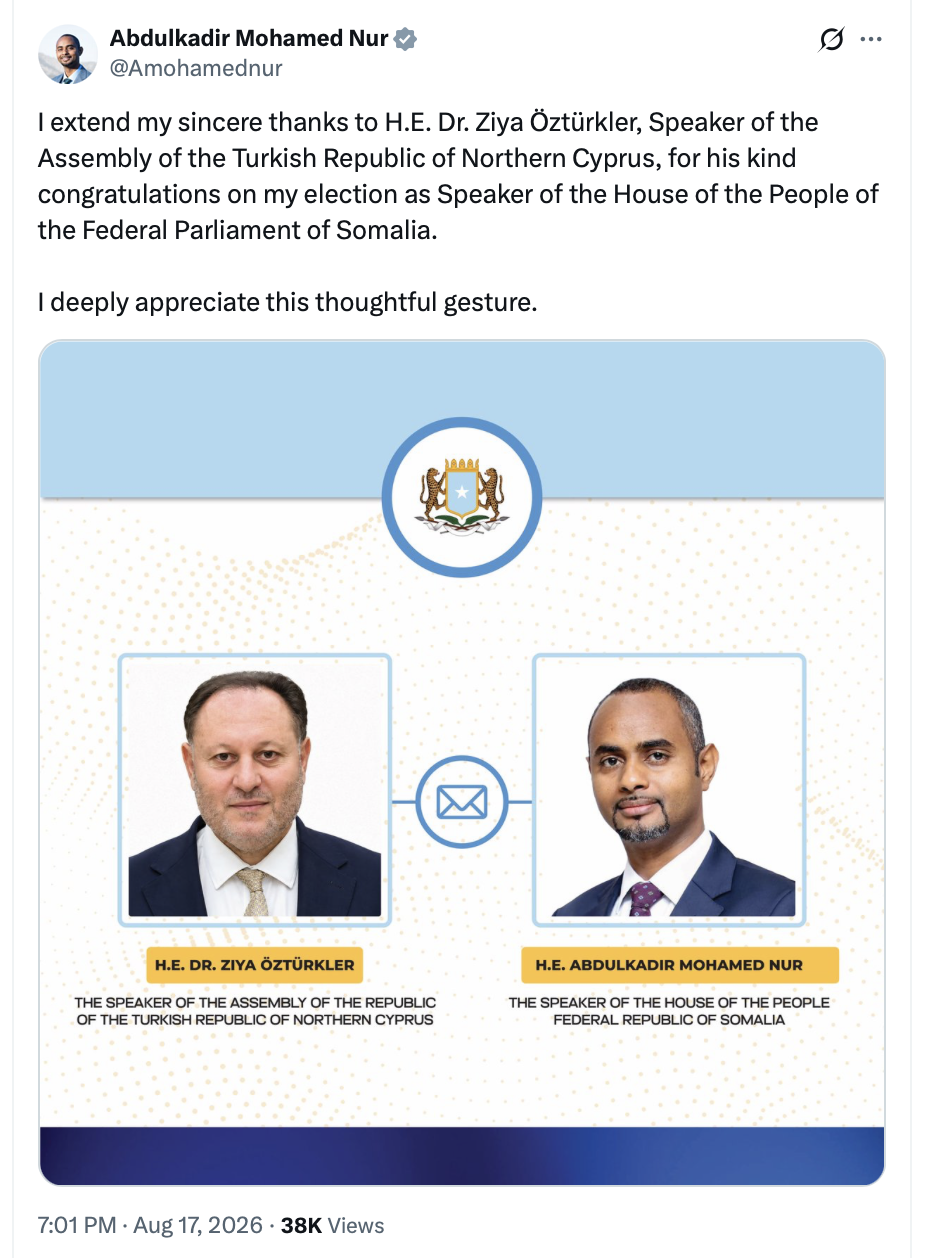
The debate follows a message posted by Somalia’s Speaker of the House of the People, Abdulkadir Mohamed Nur, thanking Dr. Ziya Öztürkler, Speaker of the Assembly of the Turkish Republic of Northern Cyprus (TRNC), for congratulating him on his election.
While the message was framed as a diplomatic courtesy, critics argue it exposes what they describe as a contradiction in Somalia’s foreign policy.
The Turkish Republic of Northern Cyprus is recognized only by Türkiye, while the United Nations and the European Union regard the island’s internationally recognized government as the Republic of Cyprus.
The issue has drawn attention because Cyprus was among the European countries that publicly backed Somalia’s sovereignty and territorial integrity following Israel’s recognition of Somaliland in December 2025. Cyprus also endorsed the European Union’s position that Somalia remains a single sovereign state.
However, analysts argue that Somalia’s willingness to engage publicly with senior officials from Northern Cyprus could be interpreted in Cyprus as a departure from the same principle of territorial integrity that Mogadishu frequently invokes regarding Somaliland.
“States that expect international support for their territorial claims are often expected to apply similar standards elsewhere,” said a Horn of Africa political analyst familiar with regional diplomacy.
The controversy comes at a time when Türkiye’s influence in Somalia continues to expand through security cooperation, military assistance, infrastructure projects and strategic agreements.
Some observers argue that Somalia’s growing dependence on Ankara has increasingly shaped its diplomatic positions, particularly on issues that align closely with Turkish foreign policy interests.
Cyprus and Somaliland
The debate has also revived discussion over whether Cyprus should reconsider its position on Somaliland.
The recognition marked a major diplomatic breakthrough for Somaliland, which restored its sovereignty in 1991 and has since maintained its own government, parliament, security forces, currency and democratic institutions.
Israel and Cyprus have developed close strategic ties in recent years, particularly in the fields of energy, security and Eastern Mediterranean cooperation. Political analysts argue that Israel’s recognition of Somaliland has created a new diplomatic reality that could eventually influence policy debates in other countries with strong relations with Israel.
International supporters of Somaliland contend that Cyprus has little strategic incentive to continue backing Somalia unconditionally if Mogadishu is willing to engage politically with Northern Cyprus while opposing international engagement with Somaliland.
They further argue that Somaliland represents a unique case among disputed territories because it existed as an internationally recognized state in June 1960 before voluntarily entering into union with Somalia. Since reasserting its independence in 1991, Somaliland has operated separately from Mogadishu and has conducted multiple democratic elections and peaceful transfers of power.
Strategic Considerations
Somaliland occupies a strategic position along the Gulf of Aden near the Bab el-Mandeb Strait, one of the world’s busiest maritime corridors linking Europe, the Middle East and Asia.
Advocates of closer Cyprus-Somaliland relations argue that cooperation could serve mutual interests in maritime security, trade and regional stability.
They also note that Israel’s recognition of Somaliland and subsequent diplomatic engagement, including President Abdirahman Mohamed Abdillahi’s official visit to Israel in 2026, have elevated Somaliland’s international profile.
Somalia, meanwhile, continues to reject Somaliland’s independence and has condemned Israel’s recognition as a violation of its sovereignty and territorial integrity.
For Cyprus, the question remains largely hypothetical. Nicosia has not signaled any change in its policy and continues to support Somalia’s territorial integrity.
Yet Somalia’s public engagement with Northern Cyprus has added a new dimension to the debate, prompting some observers to ask whether Cyprus should continue supporting Mogadishu’s position on Somaliland while Somalia maintains contacts with a Turkish-backed administration whose sovereignty Cyprus itself rejects.
As diplomatic competition intensifies across the Horn of Africa and the Eastern Mediterranean, the issue is likely to remain a subject of debate among policymakers in both regions.