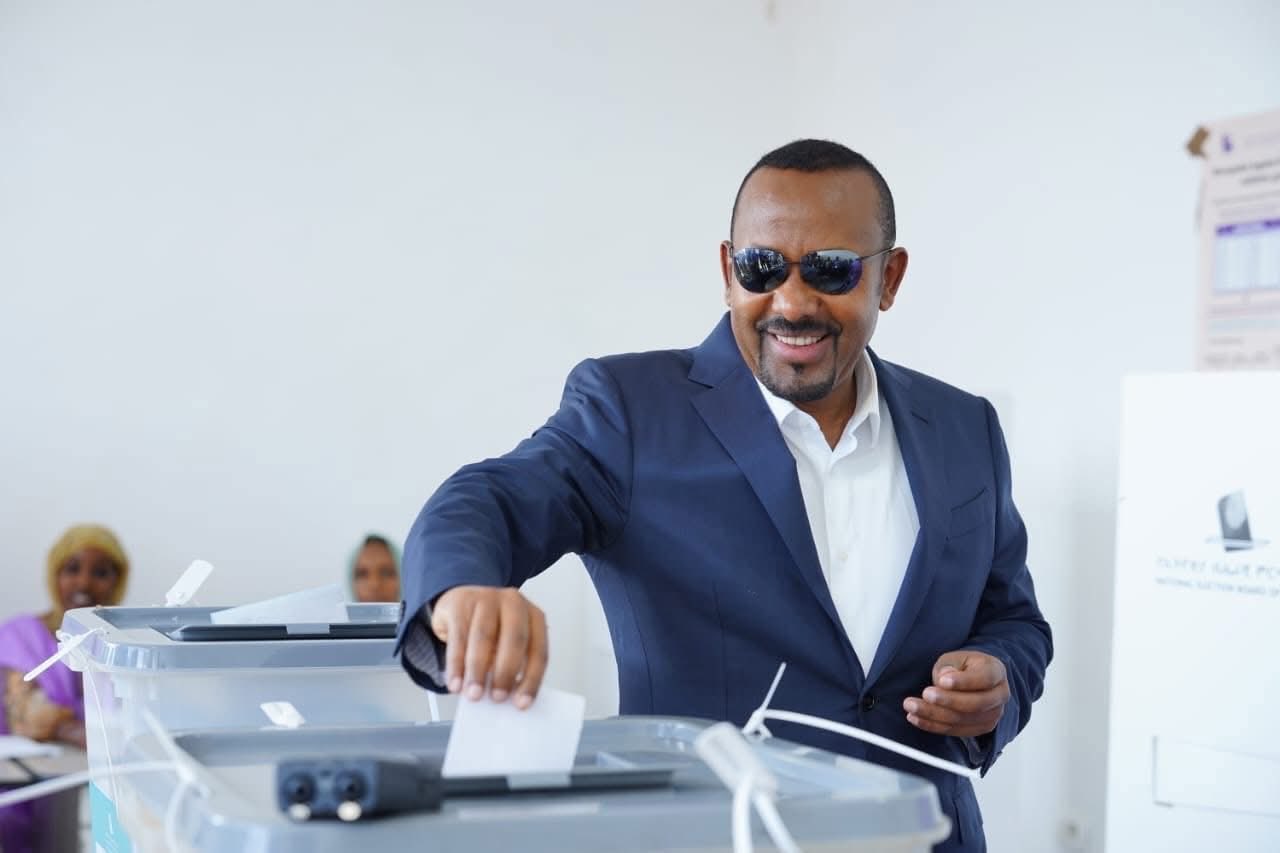
Ethiopian Prime Minister Abiy Ahmed cast his vote on Monday at a polling centre in Jimma, Oromia Region, during the parliamentary and regional elections. More than 50 million people are registered to vote. (📸: Reuters)
By:Ambassador Teshome Shunde Hamito
On the morning of June 1, 2026, Queues have been forming even before voting locations opened at 6:00 a.m. They came from the cities and the rural areas, from the highlands and the lowlands, and they waited patiently, in great numbers, to cast their votes in the country’s 7th General Election.
The Federal Democratic Republic of Ethiopia successfully held its seventh General Election. Managed by the National Election Board of Ethiopia (NEBE), the event was a defining moment in the country’s democratic journey, drawing an impressive 54 million registered voters to 52,000 polling stations. As a crucial pillar for future stability and governance in the Horn of Africa, the peaceful execution of this massive election captured the world’s attention and earned widespread praise for its institutional growth.
One of the most remarkable aspects of the election was the registration of more than 54 million voters, 46 percent of whom were women. This reflects the growing political engagement of Ethiopian citizens. In addition, 42 political parties and more than 10,000 candidates participated freely, giving voters a wide range of choices regarding the country’s future leadership. The public confidence displayed throughout the country reaffirmed Ethiopians’ strong belief in democratic means of determining their future.
This election was more than a political contest or routine event, it became a historic milestone that strengthened Ethiopia’s sovereignty, reinforced democratic institutions, and laid a solid foundation for the country’s future prosperity. Conducted through Ethiopia’s own capabilities despite internal and external challenges, the election showcased institutional strength, homegrown democracy, and national sovereignty. The seventh General Election demonstrated Ethiopia’s ability to overcome challenges, and continue advancing as a significant nation in Africa and on the global stage.
Record-Breaking Participation: The Triumph of Ethiopians
Despite internal and external challenges, the elections saw an astonishing voter turnout of over 54 million registered voters, an extraordinary figure that reflects Ethiopia’s evolving electoral culture and the high stakes citizens associate with their political future. Voters cast their ballots at 52,000 polling stations across the country, with election officials and civil society organizations working tirelessly to ensure a smooth process. Notably, the participation of women, youth, and persons with disabilities was remarkably high, illustrating Ethiopia’s strides towards inclusivity and representative democracy. Many voters endured long queues, adverse weather conditions, and physical hardships to exercise their democratic rights, demonstrating a profound sense of patriotism and collective responsibility.
On the Election Day, President Taye Atske Selassie stated that the seventh general election would write a new chapter in Ethiopia’s democracy. After casting his vote alongside millions of citizens, the president described the moment as part of a collective effort to shape Ethiopia’s democratic path. He noted that while the country’s democracy is still young, the mandate of the people remains firm, saying, our democracy may be young, but the mandate of our people is resolute, irreversible, and entirely our own.
The Prime Minister of Ethiopia, Abiy Ahmed (PhD), praised the resilience and patriotism of the Ethiopian people in his statement, emphasizing that their participation was a testament to their commitment to democracy and national unity. The Prime Minister called on elected representatives to serve with integrity and responsibility, honoring the trust bestowed in them by their constituents. The widespread civic engagement underscores Ethiopia’s cultural values of unity and resilience, even in the face of adversity. All and sundry should heed the call with power comes responsibility.
Institutional Reforms and Innovations
The seventh Ethiopian General Election marked a major reform in electoral administration, introducing several institutional and technological firsts that enhanced efficiency, inclusivity, and integrity. The National Election Board of Ethiopia (NEBE) launched the locally developed “Mirchaye” (My Choice) digital voter registration system, enabling over 5 million citizens to self-register online using their National IDs across multiple platforms. For the first time, candidates and political parties registered digitally, while more than 7,000 polling stations were mapped using GIS technology to improve accessibility and management.
A hybrid registration system combining manual and digital processes broadened participation, and special polling frameworks were established for Internally Displaced Persons (IDPs) and members of the Ethiopian National Defense Forces (ENDF), ensuring greater inclusivity in the electoral process. Meanwhile, the new trend of integration of technology in the electoral process has laid a groundwork for next elections to be more efficient and transparent.
Ethiopian General Election through the Lens of the Regional Press
The June 1st election was closely watched by international and regional media outlets. Notably, prominent outlets from neighboring Somaliland, such as the Horn Diplomat and Saxafi Media, provided extensive coverage.
Elevating Regional Visibility
Somaliland’s media houses offered real-time reporting that framed Ethiopia’s election as more than just a domestic affair. Instead, they highlighted it as a critical anchor for long-term peace across the entire Horn of Africa.
Spotlighting Technological Innovation
Outlets like the Horn Diplomat shed light on Ethiopia’s impressive structural upgrades. They focused heavily on the successful rollout of “Mirchaye” (My Choice), a locally developed digital voter registration system that allowed millions of citizens to self-register online using national IDs. Meanwhile, on-the-ground reporting from Saxafi Media captured the calm, orderly atmosphere at the polling stations. This localized journalism helped foster constructive, transparent regional dialogue, emphasizing a shared interest in stability and democratic progress in the region.
Global and Local Observers Applaud a Peaceful and Inclusive Process
Once the polls closed, the operational efficiency and peaceful nature of the election were highly praised by both international bodies and domestic observation teams.
The African Union (AU): Led by former Kenyan President Uhuru Kenyatta, the 73-member African Union Election Observation Mission (AUEOM) commended Ethiopia’s dedication to building a solid democratic foundation. The AU praised the high voter turnout and credited a collaborative security framework for ensuring citizens could vote safely.
The Intergovernmental Authority on Development (IGAD): Headed by former Ugandan Vice President Dr. Speciosa Wandira Kazibwe, the IGAD mission issued a positive preliminary statement praising NEBE’s administrative strength. Observers noted that polling stations opened on time, well stockedwith materials, and strictly followed legal protocols.
The European Union (EU) and Domestic Observers: Alongside international stakeholders, local civil society groups celebrated the competitive nature of the race, which featured over 42 political parties and more than 10,000 candidates. The overarching consensus among observers was that the 2026 elections set a transparent, collaborative blueprint for peaceful political transitions and institutional resilience.
Looking Forward: A Blueprint for the Horn of Africa
Ultimately, Ethiopia’s June 1, 2026 election stands as a powerful testament to what can be achieved through deliberate institutional reform and regional cooperation. Amplified by the insightful reporting of regional outlets like Somaliland’s press, and validated by the joint praise of the AU, IGAD, and international observers, this election represents a massive leap forward. It has strengthened the building blocks of democracy at home and signaled a brighter, more cooperative future for the entire Horn of Africa.
Honestly, seeing Africa’s second-most populous nation pull this off with pure grit and unity proves they can genuinely lead the continent toward lasting peace and steady growth. It is a massive spark of hope, showing other countries what is possible when you actually build an inclusive system. Because let us be real that kind of energy and unity is exactly what democracy in action looks like!
About the Author
mbassador Teshome Shunde Hamito, is a career Diplomat and currently serving as Head of Ethiopian Consulate in Hargeisa.
Ambassador Teshome Shunde Hamito, is a career Diplomat and currently serving as Head of Ethiopian Consulate in Hargeisa. He previously served at the Ethiopian Embassy in Nairobi as head of the Political Department. He has a Master Degree in Diplomacy and International Relations.