


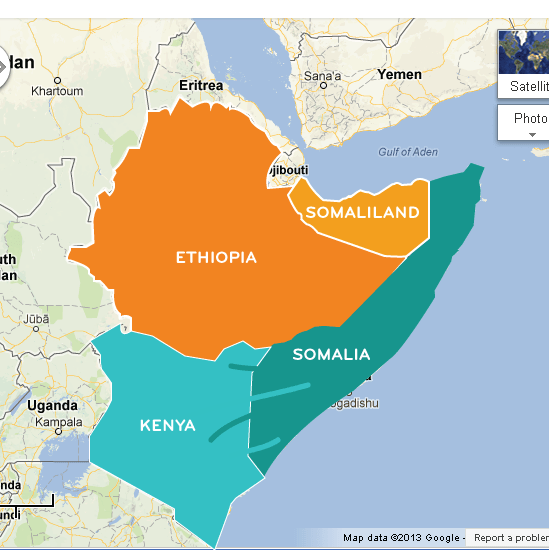
By: Dr. Mohamed Fadal
The Horn of Africa has long been shaped by intersecting conflicts, fragile state structures, and the competing interests of regional and external actors.
Positioned between the Red Sea and the Gulf of Aden, among the world’s most consequential maritime corridors for energy and global trade, the region carries stakes that extend well beyond its own borders.
Today, a familiar set of dynamics is reasserting itself. The Federal Government of Somalia finds itself in a position with clear echoes of the Barre era: this time, seeking to destabilise the Republic of Somaliland.
The 1988 Djibouti Accord and Its Lessons
Few people have reflected on the 1988 Djibouti Accord with more candour than David McDonald, a former Canadian Ambassador who served across the Horn of Africa and later coordinated an all-party Horn of Africa Group in the Canadian Parliament.
Ambassador McDonald played an instrumental role in facilitating the accord between the leaders of Somalia and Ethiopia. Years later, he offered this assessment:
“At the time I believed that we had achieved a historic breakthrough in solving the conflict between the two neighbouring states of Ethiopia and Somalia. However, had I realized the mayhem that Accord unleashed in the Horn, with hundreds of thousands displaced, flooding as refugees across regional borders and into western and Middle Eastern countries, I would not have done it.”— AMBASSADOR DAVID MCDONALD, FORMER CANADIAN AMBASSADOR TO THE HORN OF AFRICA
That candid reflection is not a condemnation of diplomacy. It is a recognition that interventions in complex regional conflicts, however well-intentioned, can produce consequences that no party anticipated or desired.
In April 1988, President Siad Barre of Somalia and President Mengistu Haile Mariam of Ethiopia signed the Accord under considerable internal pressure. Both governments were contending with armed insurgencies: Ethiopia faced the EPLF and the TPLF; Somalia faced the Somali National Movement (SNM), operating from the north.
The Accord’s logic was straightforward: neither country would provide safe haven or material assistance to armed groups operating against the other. Ethiopia would cease supporting the SNM. Somalia would end its backing of anti-Ethiopian forces.
The logic appeared sound. The outcome was not.
With Ethiopian pressure removed, the Somali Government intensified military operations against the SNM and the civilian population of the north. The cities of Hargeisa and Burao suffered severe aerial bombardment in 1988.
Rather than consolidating stability, the campaign deepened the internal fracture of both states. By 1991, both governments had collapsed. The TPLF took over Ethiopia. Eritrea moved toward internationally recognised independence, formalised in 1993. The northern region of Somalia reasserted its separate sovereignty, declaring the Republic of Somaliland on 18 May 1991.
Somalia: Two Trajectories, One Lesson
The dissolution of the Somali Democratic Republic gave rise to multiple political entities whose subsequent paths have been markedly different.
In the south, the collapse of central authority led to prolonged civil conflict, humanitarian crisis, and the eventual emergence of Al-Shabaab as a significant armed presence. The Federal Government of Somalia, formally constituted in 2012 through successive internationally supported processes, still operates in a challenging security environment, without consistent territorial governance, stable public institutions, or freedom from armed insurgency.
Somaliland, by contrast, pursued a path of internal reconciliation and incremental institution-building. Drawing on clan-based consensus mechanisms alongside formal democratic structures, it has conducted multiple rounds of elections and seen executive power transfer peacefully across six consecutive presidencies.
It has maintained a degree of public order and civic life that distinguishes it within the region, achievements built with limited external support and without formal international recognition. That Somaliland has sustained these conditions through more than three decades of isolation is itself a significant political fact.
The two trajectories illustrate a broader point: the conditions for stability are built from within, through negotiated political settlements, inclusive governance, and the careful management of competing interests. External support can assist that process. It cannot substitute for it.