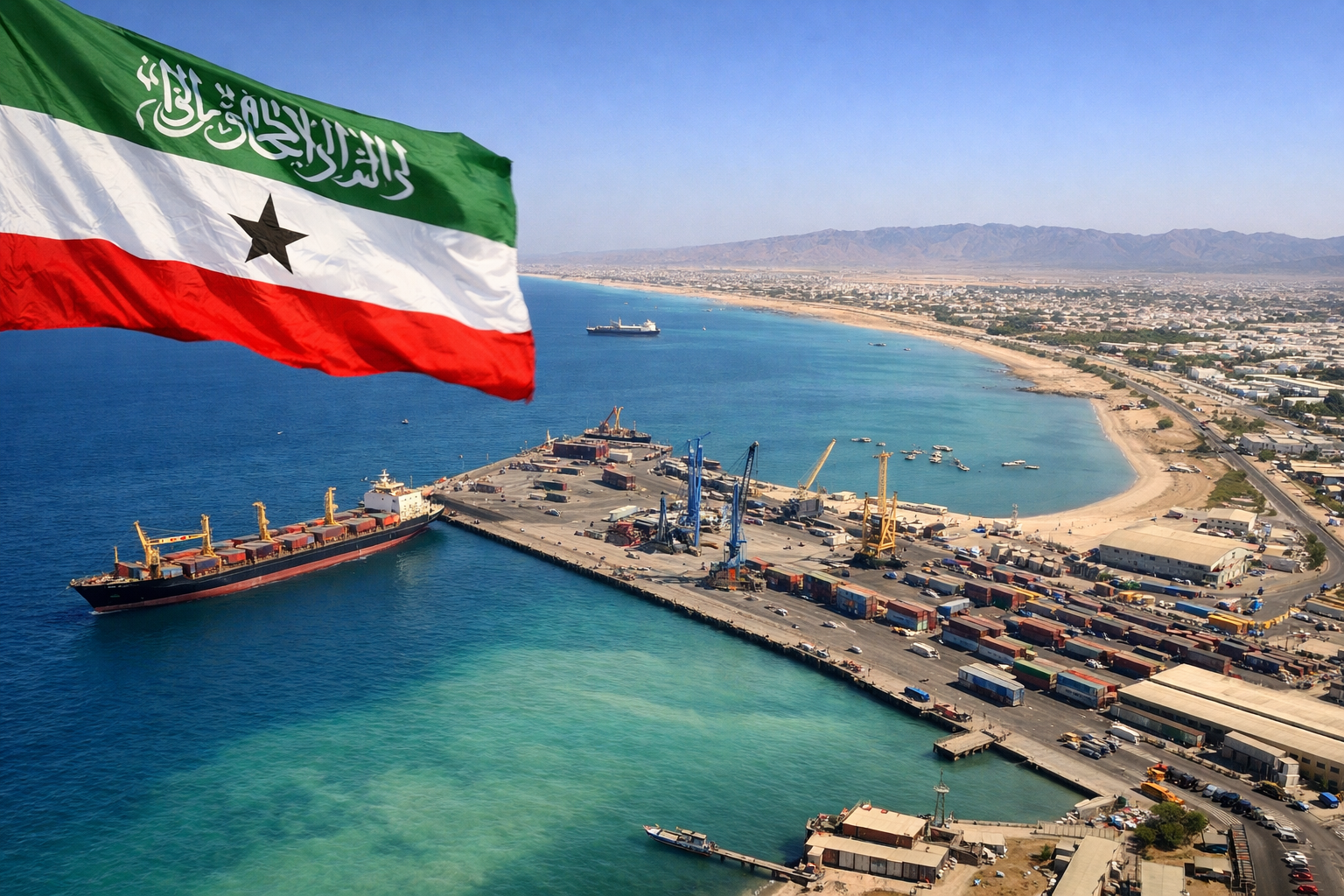
Somaliland is located in the Horn of Africa, occupying a strategically significant position along the coast of the Gulf of Aden. This location places the country near one of the world’s busiest maritime corridors, linking Africa, the Middle East, and Asia. For centuries, this geography made Somaliland an important crossroads for trade, migration, and cultural exchange, a legacy that continues to shape its outlook toward the wider world.
The physical landscape of Somaliland is remarkably diverse. It stretches from long coastal plains and sandy beaches to rugged mountain ranges, high mountains, forests, and fertile valleys. These geographic variations support different livelihoods, cultures, and settlement patterns, giving the country both ecological richness and cultural depth. Historic landscapes and ancient trade routes still mark the land, offering insight into Somaliland’s long interaction with regional and global civilizations.
Hargeisa, the capital city, stands at the center of this geographic and historical narrative. Once severely damaged during the late 1980s, the city has undergone a remarkable transformation. Today, Hargeisa is a bustling urban center with expanding infrastructure, vibrant markets, educational institutions, and cultural spaces that reflect resilience and self-driven reconstruction.
Peace, Security, and Social Stability
Peace and security are among Somaliland’s most defining achievements. In a region often characterized by conflict and instability, Somaliland has maintained internal peace for more than three decades. This stability is visible in everyday life markets function normally, institutions operate without disruption, and communities coexist with a strong sense of order and mutual trust.
Road travel across Somaliland is widely regarded as safe. People regularly travel by car from the Djibouti border to eastern border and coastal towns without fear of armed conflict or insecurity. This freedom of movement is a critical indicator of functional governance and social stability, particularly in a post-conflict context. This stability has created an environment conducive to investment, education, tourism, and civic engagement. For international partners, Somaliland represents a rare example of bottom-up peacebuilding that has translated into long-term security and social cohesion.
A Vibrant Cultural and Intellectual Life
Hargeisa has emerged as one of the leading cultural and intellectual centers in the Horn of Africa. The city is widely known for its strong literary tradition, poetry, debate, and public discourse. These cultural expressions are not confined to academic spaces but are part of everyday social life.
One of the most prominent symbols of this intellectual vitality is the Hargeisa International Book Fair. Held annually, the fair attracts writers, scholars, publishers, and artists from across Africa and the wider world. Each year, a guest country of honor is invited, reinforcing Somaliland’s openness to international dialogue and cultural exchange.
The book fair is more than a literary event. It serves as a platform for discussing politics, history, identity, development, and global affairs. Through panel discussions, book launches, and public debates, Hargeisa becomes a space where ideas move freely and knowledge is celebrated.
Beyond the book fair, cultural forums, poetry nights, and academic discussions take place throughout the year. This vibrant intellectual environment reflects a society that values critical thinking, expression, and learning as foundations for progress.
Artistic expression remains central to Somaliland’s identity. Poetry, music, theater, and storytelling are not merely forms of entertainment but vehicles for social commentary, historical memory, and collective identity.
Hargeisa hosts a vibrant community of artists, musicians, and performers who blend traditional forms with contemporary themes. Music and poetry often address issues such as peace, unity, social justice, and national pride.
Democratic Governance and Political Participation
Somaliland operates under a democratic system grounded in its constitution and shaped by both modern political institutions and traditional governance mechanisms. Citizens participate directly in choosing their leaders through periodic elections, reinforcing the principle that authority derives from public consent.
Presidential, parliamentary, and local council elections have been conducted peacefully over the years, with competitive political parties and active voter participation. These processes have helped entrench a culture of political accountability and non-violent power transition.
Women increasingly participate in political life, civil society, and public administration. While challenges remain in achieving full gender parity, women’s engagement in governance reflects broader social changes and growing recognition of inclusive leadership.
Hargeisa is a growing hub for education and human capital development. The city hosts more than fifteen public and private universities and higher education institutions offering programs in medicine, engineering, education, social sciences, business, and technology.
For international researchers and academic institutions, Somaliland offers a unique environment for studying peacebuilding, post-conflict governance, social resilience, and indigenous conflict-resolution mechanisms. Field research is generally accessible and welcomed.
Religion and Community Life
Religion plays a central role in Somaliland’s social and moral fabric. Mosques serve not only as places of worship but also as centers for education, dialogue, and community organization. Religious lectures, study circles, and public discussions are held regularly, promoting values of ethics, responsibility, and social harmony. These activities contribute to community cohesion and moral guidance.
Somaliland hosts international Qur’an memorization competitions each year, attracting participants from different countries. These events strengthen religious ties and cultural exchange within the Muslim world.
Natural Resources and Economic Opportunity
Somaliland is endowed with diverse natural resources, including gold, gas, and globally renowned frankincense. These resources present long-term opportunities for economic growth if developed responsibly. The country maintains an open and flexible business environment. Individuals can obtain business licenses and engage in import and export activities with relative ease, supporting entrepreneurship and trade.
The private sector, driven largely by local initiative and diaspora investment, forms the backbone of the economy. Small and medium enterprises play a crucial role in employment and service provision.
Tourism potential remains largely untapped, with opportunities in eco-tourism, cultural tourism, and historical exploration. Somaliland’s landscapes and heritage offer unique experiences for adventurous travelers. Somaliland approaches global engagement pragmatically, seeking cooperation based on mutual benefit rather than dependency.
Recognition as a Right, not a Gift
For more than thirty-four years, Somaliland has worked to build peace, institutions, and governance structures without external imposition. Recognition has not been its only goal state readiness has been.
Somaliland meets the practical criteria of statehood, including defined territory, permanent population, functioning government, and capacity to engage internationally.
Its pursuit of recognition is grounded in history, democratic legitimacy, and sustained peace, not charity or political bargaining. Recognition would formalize an existing reality rather than create a new one. Popular cultural expressions in Hargeisa reflect a readiness for partnership and mutual respect with the international community. One widely known song captures this sentiment:
“The countries that acknowledge our sovereignty, That recognize our hard-won independence, Every land that cherishes our success, We reserve for them our deepest gratitude.”
These lyrics symbolize Somaliland’s openness to cooperation grounded in dignity and reciprocity. They reflect a society prepared not only to be recognized, but to contribute meaningfully to regional and global stability.
About the Author
Mahad J. Koronto
Journalism, Communication, and Media Literacy Expert
The views expressed in this article are the author’s own and do not necessarily reflect the Horndiplomat editorial policy.
If you want to submit an opinion piece or an analysis, please email it to Opinion@horndiplomat.com. Horndiplomat reserves the right to edit articles before publication. Please include your full name, relevant personal information, and political affiliations.