
By Abdifatah Ahmed Hurre
Introduction
Somaliland, a partially recognised democratic state in the Horn of Africa, was under British protectorate from 1884 to 1960. During this period, it gained its first independence from Britain on 26 June 1960, before voluntarily uniting with Somalia on 1 July 1960. The union in 1960 between Somaliland and Somalia was not ratified through a proper, legally binding process. However, this union did not succeed, and the people of Somaliland were subjected to brutal genocide perpetrated by the then-ruthless Somali dictator, Mohamed Siad Barre.
Following years of armed struggle—during which hundreds of thousands were killed, millions sought refuge in neighbouring countries, and major cities, including the capital Hargeisa, were reduced to rubble—the people of Somaliland reasserted their lost independence from the failed union with Somalia on 18 May 1991. As a result, Somaliland rebuilt its country from scratch without external assistance. Since then, the Republic of Somaliland has been a beacon of peace, democratic governance, and a shining oasis in a volatile region.
Yet, despite these achievements, Somaliland remains economically constrained due to its unrecognised status. According to the Ministry of Planning and National Development (MOPND, 2025), Somaliland’s Gross Domestic Product (GDP), at constant 2017 prices, stands at USD 2.607 billion, with a per capita income of USD 556. The economy is largely consumptive in nature, making it one of the poorest in the world. This paper argues that international recognition is not merely symbolic; it is essential for Somaliland’s economic survival and growth. Recognition would unlock access to global financial systems, foreign investment, development aid, and formal trade agreements, enabling Somaliland to fully harness its economic potential.
The Economic Cost of Non-Recognition
-
Trade Barriers and Missed Opportunities
Somaliland relies heavily on international trade and operates as a very open economy. However, it lacks formal bilateral or multilateral trade agreements with its trading partners. As a result, Somaliland traders operate largely through informal trade arrangements, which often expose their assets to risk. Somaliland is neither a member of the World Trade Organization (WTO) nor does it have access to regional trade blocs such as the East African Community (EAC), isolating its businesses from regional and international markets.
The absence of trade facilitation instruments, such as Letters of Credit (LCs), further hampers international commerce by delaying transactions and compromising the safety of imported goods. Additionally, Somaliland traders face difficulties exporting goods due to the lack of bilateral trade agreements, while imports are often conducted informally, undermining commodity safety and timely delivery.
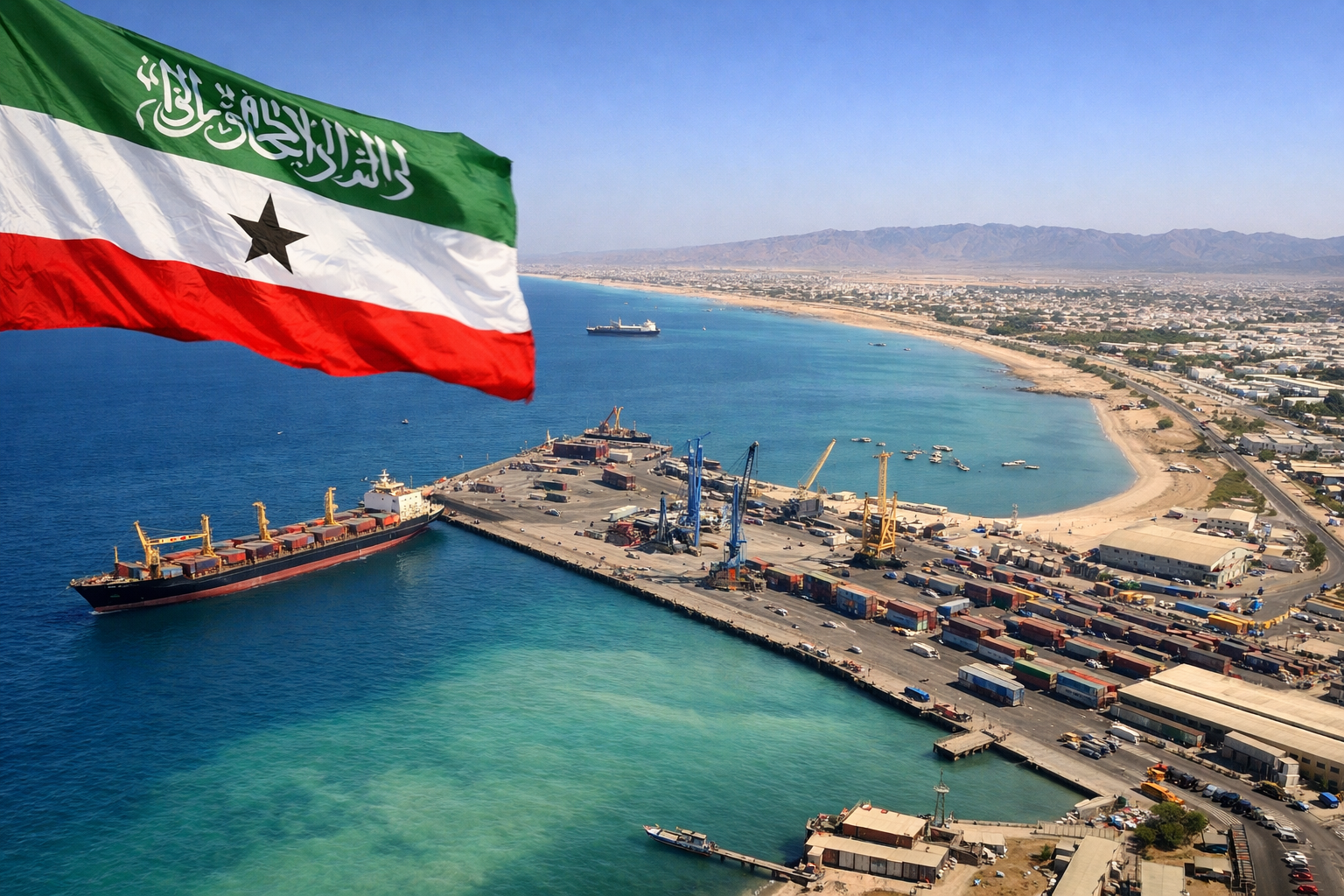
Moreover, the full utilisation of Berbera Port—a key strategic gateway for the region—remains constrained due to Somaliland’s diplomatic isolation.
2.Foreign Direct Investment Constraints
Developing countries often rely on foreign direct investment (FDI) to bridge the gap between domestic savings and capital needs. In 2024, Somaliland’s domestic investment stood at only USD 369 million—approximately 9% of GDP—highlighting a significant capital shortfall (MOPND, 2025).
This limited domestic investment reflects inadequate external financing, as local savings are insufficient to fill the capital gap. In low-income countries like Somaliland, this gap is typically filled through external finance, particularly FDI. Historically, FDI has served as a critical source of funding for developing economies. Many scholars and policymakers regard FDI as a key driver of economic growth due to its positive spillover effects, including increased capital formation, technology transfer, and improved management practices. Empirical studies confirm that FDI plays a significant role in driving economic growth across Sub-Saharan Africa (Ahmed & Rahman, 2020; Joshua et al., 2021; Sukar et al., 2011).
Due to its lack of international recognition, Somaliland has faced substantial challenges in attracting foreign investment. One notable exception is the landmark investment by the UAE government through DP World in Berbera Port and the Berbera–Wajaale Corridor—the largest FDI project in Somaliland’s history. While transformative, this investment represents only a fraction of what could be achieved under full international recognition.
If Somaliland were able to attract dozens of FDI projects similar to DP World’s investment, the economic impact would be profound. With recognition, Somaliland could attract billions of dollars in FDI, boosting infrastructure development, creating employment opportunities, and enhancing technical and institutional capacity.
3:Foreign Aid Diversion
Foreign aid, or Official Development Assistance (ODA), plays a vital role in supporting economic growth in low-income countries such as Somaliland. Existing research shows that ODA finances development projects and economic infrastructure, while also supporting essential social services such as education and healthcare, which are critical for long-term development (Azam & Feng, 2021). Empirical evidence further demonstrates a positive relationship between ODA and per capita GDP growth (Choi & Kim, 2024; Jeong & Yoo, 2008).
Due to the absence of recognition, ODA allocated to Somaliland must pass through Somalia, where it is frequently politicised, weaponised, or diverted to other regions. In response, the Government of Somaliland introduced the Somaliland Special Arrangement (SSA) in 2013, under the New Deal Pact, in cooperation with the international community. The SSA was designed to ensure that aid to Somaliland remained distinct from Somalia’s ODA framework. However, the Farmajo-led government later terminated this arrangement, providing clear evidence of the weaponisation of international aid by Somalia. Consequently, Somaliland continues to face serious challenges in accessing its allocated development funds due to political obstruction from Mogadishu.
Recognition would allow Somaliland to receive development assistance directly, ensuring effective implementation of projects in health, education, infrastructure, and other critical sectors.
4:Banking and Currency Challenges
A sound and functional financial system integrated into the global economy is a cornerstone of national economic development. Somaliland remains excluded from international financial institutions due to prolonged diplomatic isolation. No international banks operate in Somaliland, and the Central Bank of Somaliland is not connected to the global financial system, including the Society for Worldwide Interbank Financial Telecommunication (SWIFT), which facilitates secure and standardised cross-border transactions. Furthermore, Somaliland is not a member of major international or regional financial institutions such as the World Bank, African Development Bank, or the Bank for International Settlements (BIS).
This exclusion from the global financial system severely hampers Somaliland’s import-export activities, foreign investment climate, and cross-border payment mechanisms.
Money functions as a medium of exchange, a store of value, and a unit of account. The Somaliland Shilling (SLSh) does not fully perform these functions. It is not accepted beyond Somaliland’s borders for trade transactions, and many citizens avoid saving in the local currency due to depreciation risks and limited acceptability. Even domestically, most transactions are denominated in US dollars, indicating a lack of trust in the local currency as a unit of account. As a result, Somaliland’s economy is highly dollarised, both domestically and in external trade.
The Economic Promise of Recognition
International recognition would deliver tangible economic benefits, including:
-
Integration into the Global Financial System: Access to institutions such as the World Bank, IMF, BIS, and African Development Bank.
-
Connection to SWIFT: Enabling secure, fast, and standardised international banking transactions.
-
Attraction of Foreign Direct Investment and Aid: Mobilising billions of dollars to finance agriculture, livestock, industry, energy, transport infrastructure, ports, and airports.
-
Formal Trade Agreements: Facilitating exports and imports through official bilateral and multilateral frameworks.
-
Enhanced Port Utilisation: Positioning Berbera Port as a regional hub through transit agreements with Ethiopia and other landlocked East African countries.
-
Tourism Growth: Increased visits to heritage sites such as Laas-Geel, boosting foreign exchange earnings and cultural visibility.
Conclusion
In light of the increasing weaponisation of international aid, airspace, trade, and other essential aspects of daily life, international recognition represents economic survival for the people and government of Somaliland. The lack of recognition has left Somaliland lagging behind its regional counterparts, prevented it from utilising its economic potential, and excluded it from the global financial system. Recognition is therefore not merely symbolic; it is a life-changing necessity for the people of Somaliland.
Through recognition, the Republic of Somaliland would unlock tangible economic benefits, transforming its economy from an informal and disconnected system into a vibrant, globally integrated one equipped with modern trade facilitation tools and financial inclusion. Recognition would enable Somaliland to attract foreign investment and aid, integrate into the global financial system, unlock untapped natural resources, and join regional and international trade organisations. Combined with its democratic governance and strategic location, recognition would position Somaliland as a key economic player in the Horn of Africa.
In short, for Somaliland, recognition is not a diplomatic luxury—it is an economic necessity.
References
-
Ahmed, A. T., & Rahman, I. U. (2020). The Impact of FDI and Foreign Aid on the Economic Growth: Empirical Evidence from Sub-Saharan African Countries. International Journal of Science and Business, 4750, 53–70.https://doi.org/10.5281/ZENODO.3870562
-
Azam, M., & Feng, Y. (2021). Long run effects of foreign aid on economic growth. Journal of Economic Development, 46(2), 1–20. https://doi.org/10.1007/s40847-021-00112-3
-
Choi, J., & Kim, S. (2024). Assessing foreign aid’s long-run contribution to growth in development. Development Policy Review, 42(1), 1–15. https://doi.org/10.1111/dpr.12678
-
Jeong, H., & Yoo, S. (2008). Impact of foreign aid on economic growth in South Asian countries. Asian Economic Policy Review, 3(2), 1–20. https://doi.org/10.1111/j.1748-3131.2008.00063.x
-
Joshua, O., Akinbobola, T. O., & Gibogwe, V. (2021). Globalization, foreign direct investment and economic growth in Sub Saharan Africa. In A. Sukar & K. Kufuor (Eds.), Investment dynamics in Africa (pp. 112–130). Oxford University Press.
-
Ministry of Planning and National Development, Central Statistics Department. (2025). Somaliland gross domestic product report. Hargeisa, Somaliland.
-
Sukar, A., Nigo, A. R. S., & Kufuor, K. (2011). Foreign direct investment and economic growth in the Southern African Development Community. In V. Gibogwe (Ed.), Economic integration in Southern Africa (pp. 88–105). Cambridge Scholars Publishing.