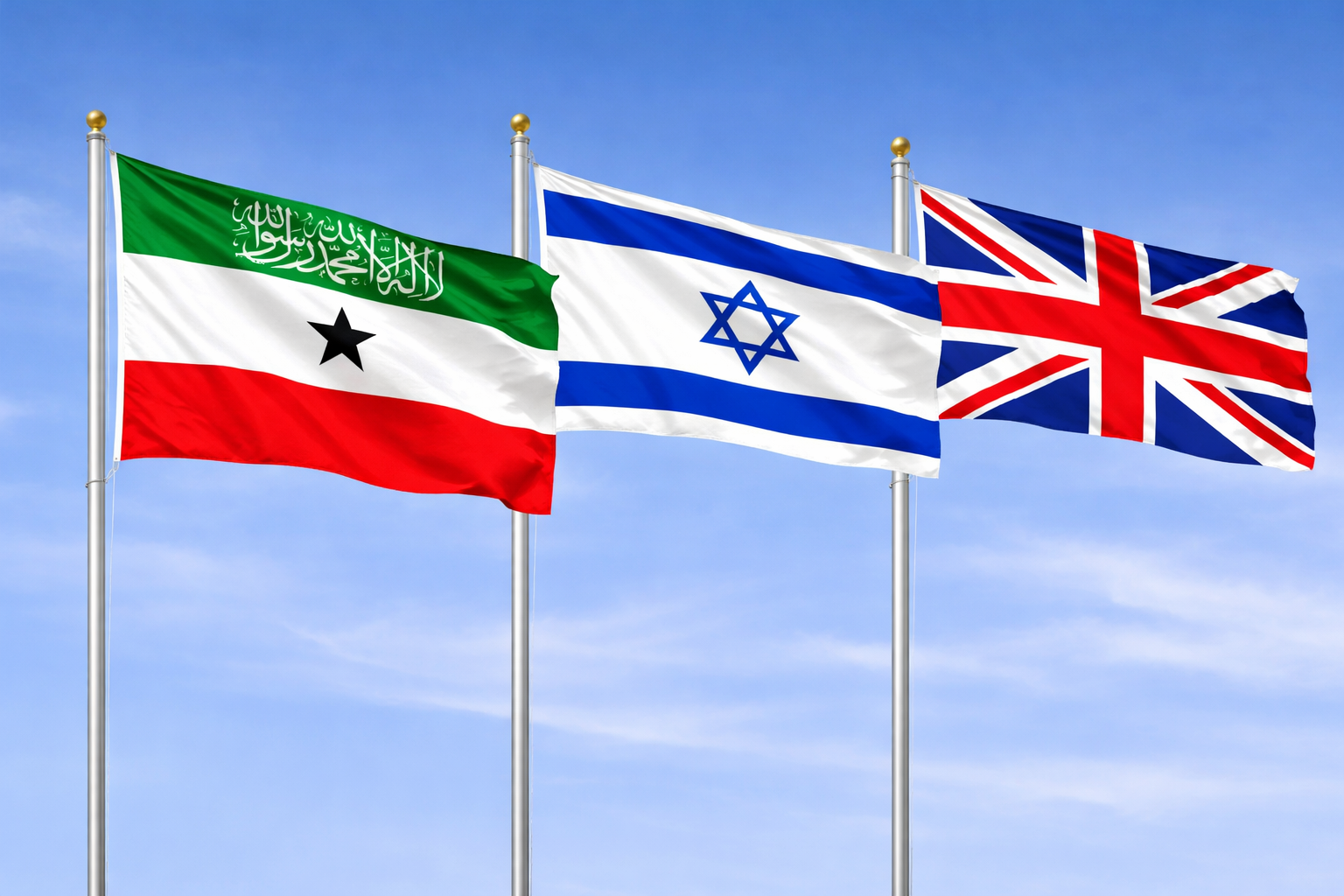
Analysis of Somaliland’s historical military alliance with Britain and its contemporary alignment with Israel.
This report examines the proverbial claim that history is repeating itself with Somaliland, comparing its historical participation alongside British forces a century ago with its current burgeoning relationship with the State of Israel.
The available evidence confirms that the territory of Somaliland was indeed a theatre of conflict during the early 20th century, particularly during the Somaliland Campaign (1900-1920). During the First World War, the British Somaliland protectorate was aligned with the Allied powers, and Somaliland troops, notably the Somaliland Camel Corps, fought alongside British forces .
In a significant contemporary parallel, Israel became the first country to recognise Somaliland as an independent state in December 2025. This has been followed by high-level diplomatic meetings and a visit by Israel’s Foreign Minister to Hargeisa in January 2026 . While Somaliland fought alongside Britain as part of a colonial protectorate, its current alignment with Israel is a diplomatic and strategic partnership between two sovereign entities, driven by shared geopolitical interests in the Red Sea region. The parallel is therefore not an exact military one, but a recurrence of Somaliland forging a critical alliance with a major power to ensure its security and pursue international recognition.
Historical Context: Somaliland and the First World War:
During World War I, the territory that is now Somaliland was a British protectorate. While the global conflict raged in Europe, the region was embroiled in its own prolonged conflict, the Somaliland Campaign (1900-1920)*, also known as the Dervish War . This campaign pitted British forces against the Dervish movement, led by Mohammed Abdullah Hassan.
Although the Dervishes received some support from the Ottoman Empire, which was allied with Germany, the British somaliland protectorate forces remained loyal to the Crown .
Somaliland Participation in the Allied Effort
The local population was not a passive bystander. The British established the Somaliland Camel Corps, a unit that took advantage of local Somaliland skills to fight in the harsh terrain . This corps saw action both in the Horn of Africa and in other theatres like the Far East.
A Proud Heritage: For many in the Somaliland diaspora today, the service of their grandparents in the First and Second World War is a source of pride and a part of British history. An exhibition titled Somaliland People and the First World War” was created to share these memories and highlight the contribution of Somaliland soldiers to the Allied cause .
It is important to note that the conflict was complex. While some Somaliland fought with the British, others joined the Dervish resistance against British, Ethiopian, and Italian colonial rule .
Historical Parallel: The first “repeat” in history is Somaliland’s role as a strategic ally to a global power, contributing to its security framework in exchange for protection and political support.
Contemporary Context: The Alignment with Israel:
A century later, Somaliland has made a significant geopolitical move by forging ties with Israel. In December 2025, Israel became the first nation to formally recognise the Republic of Somaliland, which has been a self-governing but unrecognised state since restoring independence in 1991 .
This recognition has been followed by rapid diplomatic engagement; high-level Meetings; Somaliland’s President, Abdirahman Mohamed Abdullahi (known as Cirro), met with Israeli President Isaac Herzog and Eric Trump at the World Economic Forum in Davos in January 2026 to discuss bilateral relations and investment . It was also a historic visit where Israel’s Foreign Minister, Gideon Saar, visited Hargeisa in January 2026, marking the first official visit since recognition. He met with President Abdullahi to advance political and strategic partnerships .
The alliance is driven by clear strategic interests for both parties; For Somaliland, recognition is the ultimate goal. However, Israel’s move is a major breakthrough in its decades-long quest for sovereignty. President Abdullahi has stated Somaliland would join the Abraham Accords, and the government is pivoting from asking for aid to offering investment opportunities, particularly in the strategic Port of Berbera.
For Israel, the Horn of Africa is a critical strategic theater. Analysts suggest the driving force is the need for allies in the Red Sea region to counter the Iran-backed Houthi rebels in Yemen, who have threatened shipping lanes and fired on Israel. An increased Israeli footprint in Somaliland could help with intelligence and deterring weapons smuggling .
Analysis: History Repeating or a New Paradigm?|
The parallels are striking but not identical. The “repeat” lies in Somaliland’s consistent strategic orientation towards powerful extra-regional actors to secure its interests.
In the first instance, it was as a British protectorate, with its people fighting as loyal subjects within the Empire’s forces.
In the current instance, it is as a self-governing entity seeking the ultimate prize of statehood. The alliance with Israel is a diplomatic and economic partnership, not be considered as a military one commanded by a colonial power but the chances of both forces fighting with terrorists in the sea and the read sea is eminent . While security cooperation is likely a component, Somaliland is also negotiating as an independent actor.
The notion that “history is repeating itself” holds validity when viewed through the lens of Somaliland’s geopolitical strategy. A century ago, the territory aligned with the British Empire, contributing troops to its campaigns. Today, Somaliland has aligned with the State of Israel in a landmark diplomatic and military move.
While the context has shifted from colonial military service to modern sovereign diplomacy, the core theme remains: Somaliland continues to forge critical alliances with global powers to navigate a challenging regional environment and secure its future. The current partnership with Israel, born out of shared interests in Red Sea security and the pursuit of international legitimacy, represents a new chapter in this long-standing historical pattern.
About the Author
Mo Saeed is a senior UK-based professional with over 20 years of experience specialising in healthcare and social policy. He holds academic qualifications in Health and Social Care(BA and DISPWA) and possesses extensive expertise in both practice and policy development within these fields.
Mo Saeed
Somaliland legal research (SLR)
Email: s.mohamed@somalilandlegalresearch.org
The views expressed in this article are the author’s own and do not necessarily reflect the Horndiplomat editorial policy.
If you want to submit an opinion piece or an analysis, please email it to Opinion@horndiplomat.com. Horndiplomat reserves the right to edit articles before publication. Please include your full name, relevant personal information, and political affiliations.