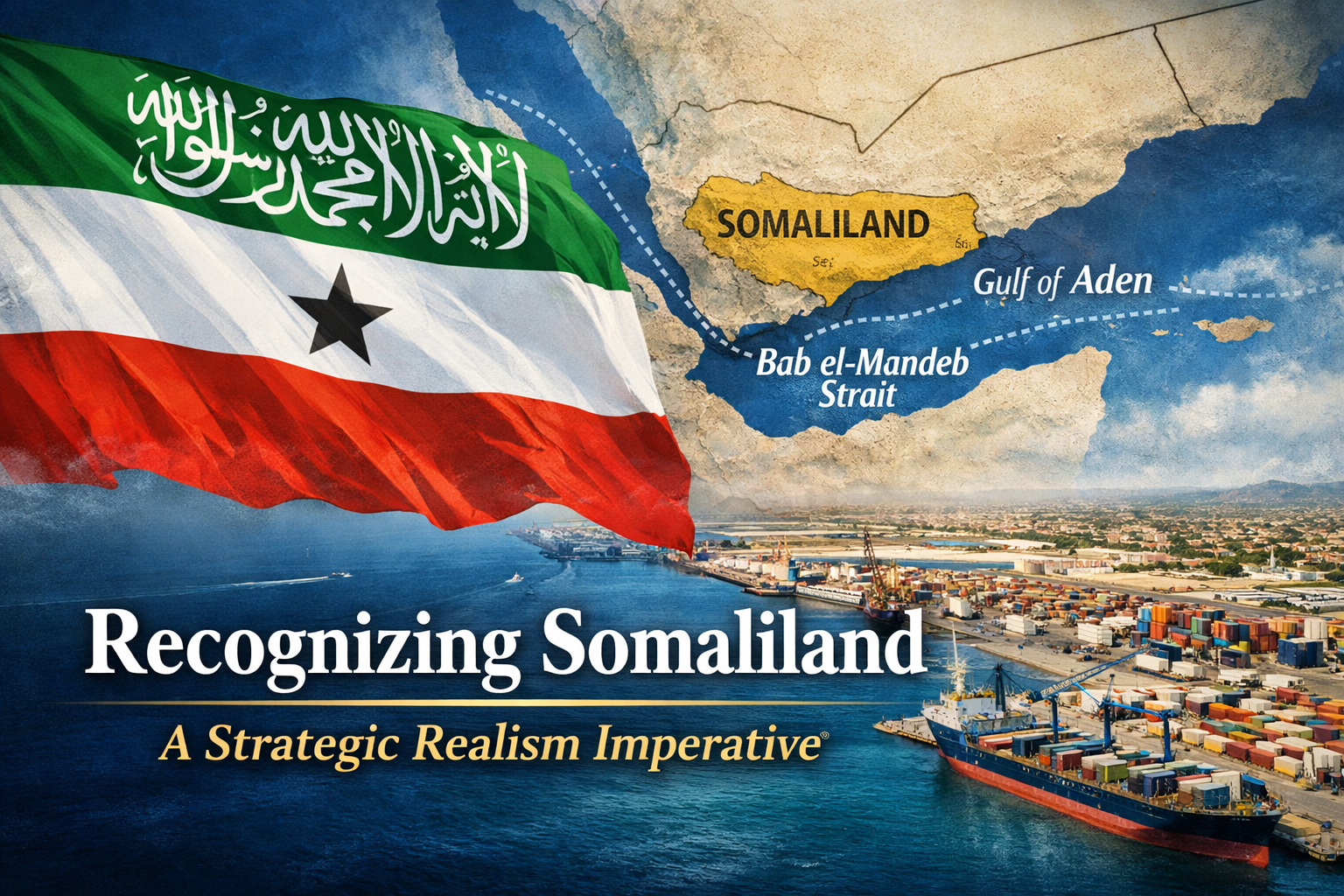
For more than three decades, the Republic of Somaliland has existed as a functioning state without international recognition. It governs its territory, secures its borders, holds competitive elections, and maintains peace in one of the world’s most volatile regions. Its continued exclusion from the international system is not the result of legal deficiency or institutional failure. Instead, it is the product of political inertia and a refusal to confront historical and strategic reality.
A Union That Was Never Legally Ratified
Somaliland gained independence on 26 June 1960 as a sovereign state. It inherited clearly defined colonial borders from British Somaliland and received recognition from more than thirty countries, including the United States, the United Kingdom, and Israel. Days later, it entered into a proposed union with Somalia. However, that union was never legally completed.
No single, jointly ratified Act of Union was ever enacted. The laws passed in Hargeisa and Mogadishu differed in substance and were never harmonized. The legal foundations of the union remained incomplete from the outset. In 1961, the people of Somaliland overwhelmingly rejected the Somali Republic’s constitution in a national referendum, which confirmed the absence of democratic consent. In international law, sovereignty cannot be extinguished without lawful process and popular approval. Therefore, Somaliland’s sovereignty was never legally dissolved.
Colonial Borders and the African Union Principle
Somaliland’s claim also aligns precisely with Africa’s most cited diplomatic principle. The Organization of African Unity committed its members to respecting colonial borders to prevent endless territorial disputes. Somaliland does not challenge that principle. It embodies it.
Somaliland is not seeking to redraw boundaries or create new borders. It seeks recognition within the exact borders it inherited at independence in 1960. Far from undermining African norms, recognition of Somaliland would affirm them by restoring a sovereign state to its original colonial boundaries.
From Political Marginalization to Genocide
The political failure of the unratified union soon became tragic. Somaliland was systematically marginalized as power and resources were centralized in Mogadishu. By the late 1980s, this marginalization escalated into mass violence.
The Somalia military regime launched a campaign of collective punishment against Somaliland’s civilian population. Major cities were bombed by their own air force. Civilians were deliberately targeted and infrastructure was destroyed. Tens of thousands were killed, and hundreds of thousands were displaced. Independent researchers and human rights investigations have documented these crimes as acts of genocide. The union did not merely fail politically. It collapsed morally and violently.
Rebuilding a State Without Recognition
On 18 May 1991, Somaliland restored its sovereignty. What followed defied expectations. Without international recognition or foreign peacekeepers, Somaliland rebuilt itself through locally driven reconciliation. It adopted a constitution, established a bicameral legislature, and achieved multiple peaceful transfers of power.
In a region defined by fragility, Somaliland became an exception. Its stability was not “rented” through foreign aid or external military deployments. It was negotiated, earned, and sustained by its own people.
Why Geography and Infrastructure Make Somaliland Indispensable
Somaliland occupies a pivotal position along the Gulf of Aden. It sits adjacent to the Red Sea corridor linking Europe, the Middle East, and Asia. Today, this corridor faces converging threats from terrorist networks, regional spillover, and maritime instability.
Somaliland has demonstrated that it can provide security in this environment. It has maintained internal stability and denied space to extremist groups. Furthermore, the development of the Berbera Port and its trade corridor has transformed the country into a vital economic gateway. This infrastructure provides a secure alternative for regional trade and serves as a critical link for landlocked neighbors like Ethiopia. Because it remains unrecognized, Somaliland cannot formally participate in international security frameworks or conclude binding defense agreements. This is not a policy of neutrality. It is a strategic blind spot that prevents the international community from fully securing a vital trade artery.
Recognition Is About Strategic Realism, Not Sentiment
In December 2025, Israel became the first UN member state to formally recognize the Republic of Somaliland. While this triggered intense diplomatic discussion, the decision simply acknowledged an existing reality. It proved that the diplomatic taboo regarding Somaliland is finally breaking.
Western governments have long justified non-recognition by invoking territorial integrity. That principle has value, but it was never meant to preserve legal fictions indefinitely or punish societies that govern themselves responsibly. Recognition is a matter of Strategic Realism. It would unlock tangible benefits: enabling formal counter-terrorism cooperation, facilitating maritime domain awareness, and integrating a reliable partner into international institutions.
A Strategic Choice Long Overdue
The cost of continued non-recognition is rising. It deprives the international community of a capable partner while rewarding dysfunction in Somalia. It sends a message that effective governance and responsibility are irrelevant to international legitimacy.
Recognizing Somaliland is not a gesture of goodwill. It is a pragmatic alignment with the reality of regional stability. After more than three decades of peace and governance, the burden of proof no longer rests with Somaliland. It rests with those who continue to deny what is already evident. Recognizing Somaliland is justified by law, validated by history, and demanded by global strategy.
About the Author
Khadar Mariano is a development practitioner whose work and writing explore the intersection of governance, policy, democracy, and community empowerment.
The views expressed in this article are the author’s own and do not necessarily reflect the Horndiplomat editorial policy.
If you want to submit an opinion piece or an analysis, please email it to Opinion@horndiplomat.com. Horndiplomat reserves the right to edit articles before publication. Please include your full name, relevant personal information, and political affiliations.