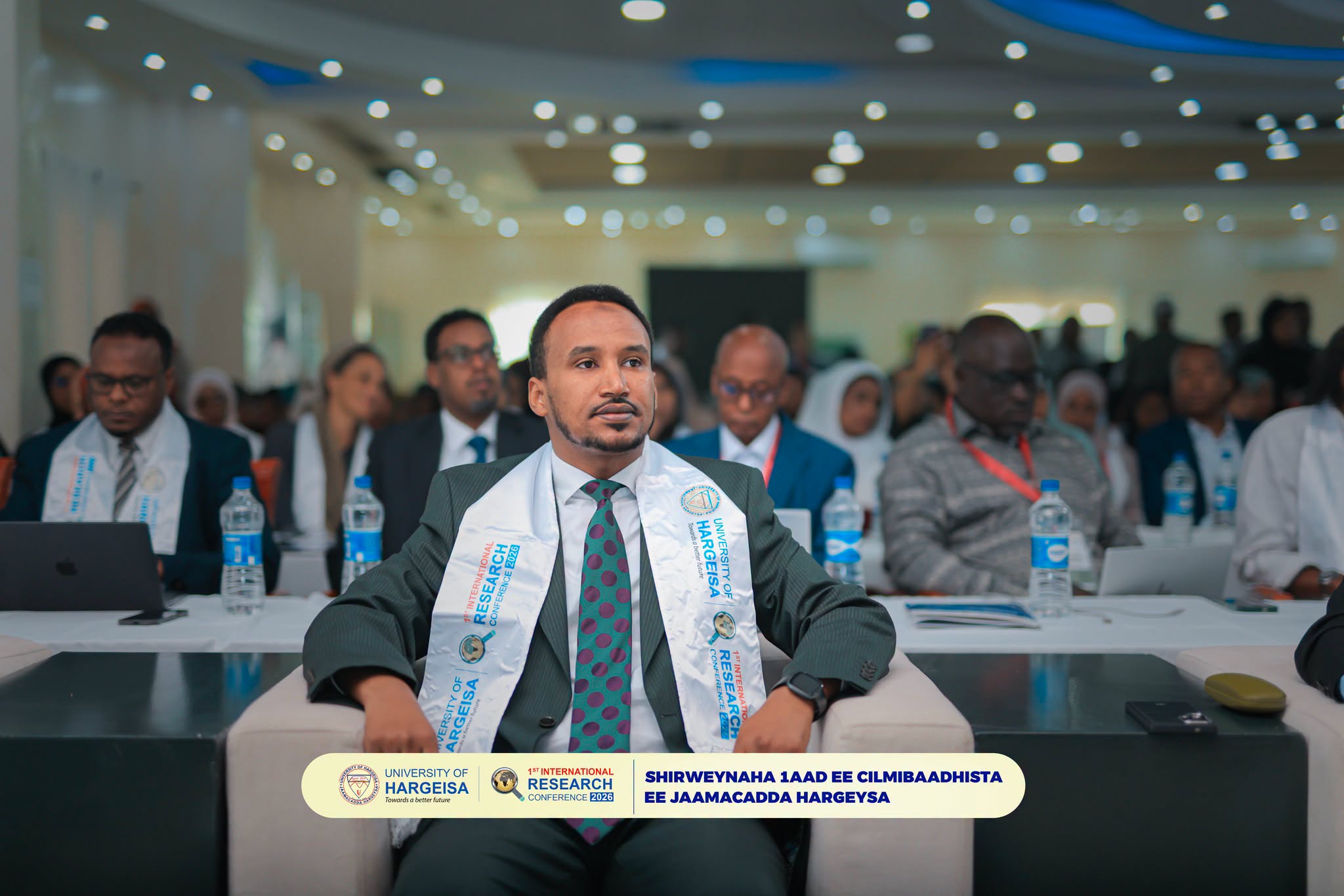
HARGEISA, Aug 18 (Horndiplomat) — The University of Hargeisa has convened its first International Research Conference, bringing together researchers, academics, policymakers and international partners to promote research and innovation aimed at addressing local and regional development challenges.
The conference, held under the theme “Transformative Research for Sustainable Development: Global Innovation, Local Solutions,” brings together participants from Africa, Asia and Europe and features keynote speeches, plenary discussions, thematic panels, technical research sessions, poster presentations and networking opportunities.
University of Hargeisa President Dr. Mohamed Ahmed Sulub said the institution had published more than 121 reviewed research papers over the past year, as the university seeks to strengthen its research output and increase its contribution to policymaking and development.
“We have published over 121 reviewed research papers over the last year,” Sulub said. “We want our research to have an impact and influence policies.”
Sulub also said the university plans in the coming years to revive and promote Somali indigenous knowledge, bringing locally rooted knowledge into its broader research agenda.
Dr. Sacad Ali Shire, Chairman of the University of Hargeisa Board of Trustees, called for greater investment in research, saying spending on research should be viewed as an investment in national development.
“The aim is to reach the 1% of GDP target for research as set by the EU,” Shire said. “Money spent on research is money well spent. It is a great investment.”
Dr. Jona Kirujah, Director of Research, Grants and Community Services, stressed the need for stronger cooperation among universities, researchers and other stakeholders and for research findings to play a greater role in policymaking.
“We need to strengthen collaboration among researchers, universities and stakeholders, and promote the use of research evidence to improve evidence-based policymaking,” Kirujah said.
The conference programme includes senior academics and officials from Somaliland and abroad.
Speakers include Prof. Michael Alfrangis of the University of Copenhagen, who is presenting research on anaemia among school-aged children in Somaliland, including its causes, consequences and opportunities for intervention. Prof. Abdul Hafaz of Universiti Malaysia Terengganu is also participating as a special guest.
Other speakers include Dr. Mohammed Mouse Jibril, President of Amoud University, and Prof. Ayub N. Gitau, Vice Chancellor of the University of Nairobi, alongside representatives of the private sector and the Danish Representation Office in Somaliland.
Somaliland government officials are also participating, with the conference programme including addresses from the Minister of Education and Science and the Minister of the Presidency.
A major panel discussion focuses on the role of higher education institutions in driving national development through research, bringing together senior leaders from the University of Hargeisa, University of Nairobi and Amoud University.
Another plenary examines North-South Research Collaboration: Opportunities, Challenges & Future Partnerships, with representatives from the University of Copenhagen, University of Hargeisa, Somaliland’s Presidential Delivery Unit and the State University of Zanzibar.
Research presented at the conference covers a broad range of areas linked to sustainable development, including maternal and child health, climate change, environmental sustainability, natural resource management, transitional justice, reconciliation, peacebuilding and governance.
Other themes include agriculture and food security, refugee integration and displacement, economic growth, trade and entrepreneurship, digital transformation, higher education, artificial intelligence, digital health, infectious diseases, green innovation, energy and biodiversity.
The conference provides a platform for researchers to share findings, build regional and international partnerships and explore how research and innovation can contribute to sustainable development and respond to challenges facing Somaliland and the wider region.
(Reporting by Mohamed Duale; Editing by Horndiplomat Desk)