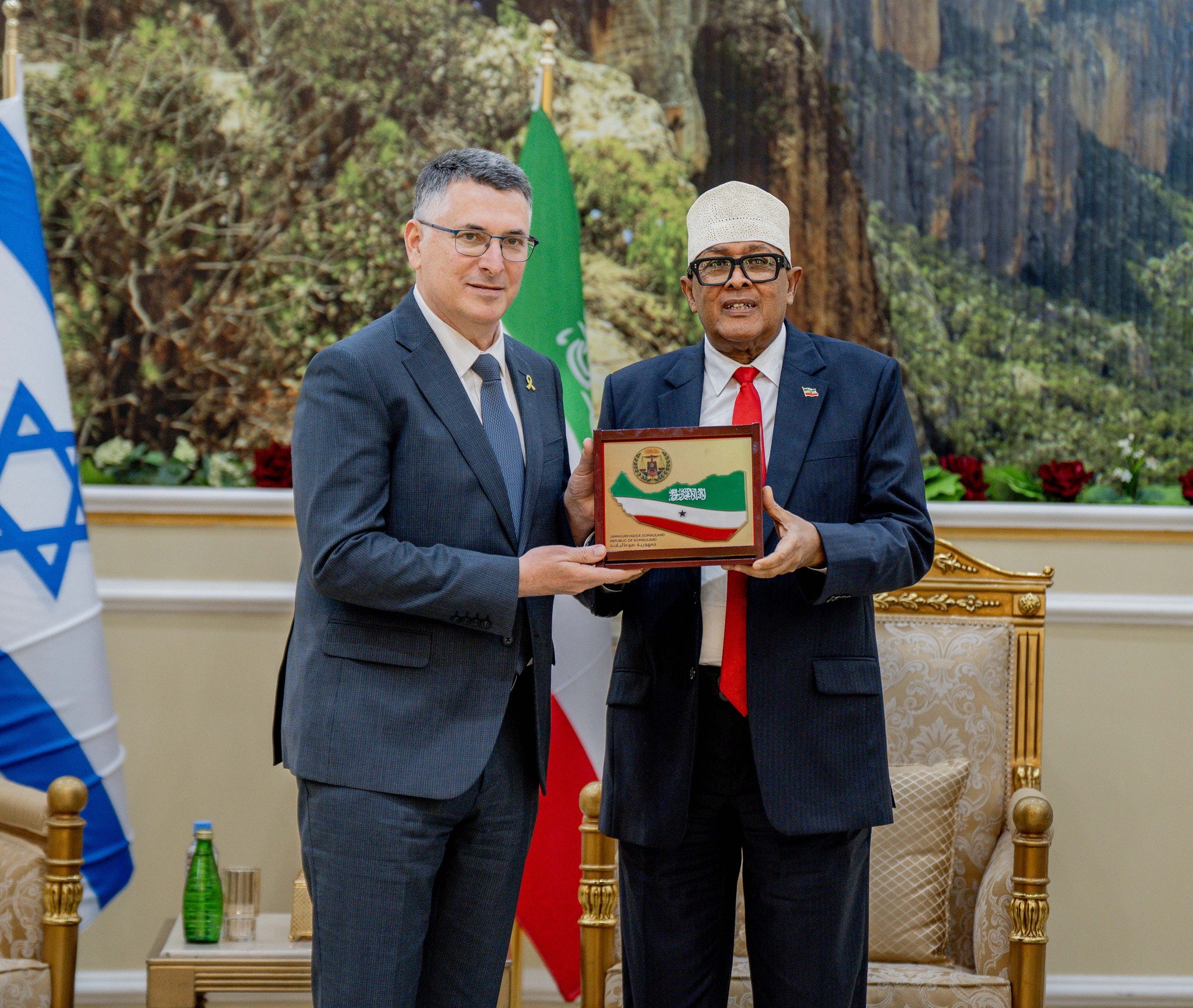
Somaliland President Abdirahman Abdullahi Mohamed (right) posing for a photograph with Foreign Minister Gideon Saar at the Presidential Palace in Hargeisa, Somaliland, January 6, 2026. (Somaliland Presidential Office
By:Abdirahman Jama Ismail (Jamaal)
Introduction
The Horn of Africa is a region of profound historical complexity and geopolitical significance. At its core now lies the contested political relationship between Somaliland and Somalia, two entities whose intertwined histories reflect broader themes of colonial legacy, state formation, governance challenges, and external geopolitical interests. This essay examines the historical underpinnings of two territories unification and forming of Somali statehood, the emergence of Somaliland’s reassertion to independence, the evolution of intra-state and regional dynamics, and the implications of recent international developments, particularly Israel’s recognition of Somaliland in December 2025.
Historical Context: Union, and Early Dissent
The modern political contours of and Somaliland and Somalia are rooted in colonial rule. British Somaliland and Italian Somalia emerged as distinct colonial territories in the 19th and early 20th centuries, with differing administrative structures and legal traditions. British Somaliland achieved independence on 26 June 1960, immediately preceding Italian Somalia’s independence on 1 July 1960, at which point the two territories united to form the Somali Republic. This union was motivated by pan-Somalism (Pan-Somalism, is a nationalist ideology seeking to unite all Somali-inhabited territories in the Horn of Africa into a single country, encompassing areas in Somalia, Ethiopia, Kenya and Djibouti, often symbolized by the five-pointed star on the Somali flag) aspirations but lacked robust legal ratification and popular consent, particularly in the Somaliland
The post-independence period saw significant discontent in the former British Somaliland. In December 1961, a group of junior officers from the Somaliland attempted a military coup aiming to restore Somaliland’s independence, highlighting early resistance to the union and the perception of marginalization within the new Somali state. Although the coup failed, its occurrence underscored persistent regional tensions and unresolved political grievances.
The Barre Regime, Civil War, and Somaliland’s Reassertion of Independence
The Somali Republic’s trajectory was sharply altered in 1969 when Major General Siad Barre seized power, establishing the Somali Democratic Republic and a centralized authoritarian regime. Barre’s rule increasingly alienated Somaliland communities, especially the Isaaq clan, culminating in extensive repression and violence during the 1980s. Armed resistance, organized primarily through the Somali National Movement (SNM), targeted Barre’s government and sought to protect Somaliland communities from state and levelling main city and towns to the ground.
In 1991, following the collapse of Barre’s regime and the onset of widespread civil conflict, Somaliland declared the re-establishment of its independence from Somalia, invoking the borders of the 1960 British Somaliland protectorate. Unlike other Somali regions, Somaliland embarked on a process of reconstruction and institution-building, establishing its own government, constitution, security forces, currency, and electoral systems, achievements that contrast starkly with ongoing instability in Somalia.
Statehood in Practice: Governance and Institutional Development in Somaliland
Since 1991, Somaliland has maintained peace and developed functioning governance structures despite its lack of broad international recognition. The country has held competitive elections, facilitated mechanisms for power transfer, and established bureaucratic institutions without the benefit of sustained external assistance. This relative stability has distinguished Somaliland from the protracted conflict and political fragmentation that have plagued Somalia.
However, challenges persist, where local dynamics have occasionally escalated into armed confrontations. These disputes complicate Somaliland’s territorial claims and underscore ongoing issues in defining political authority and clan-based allegiances.
International Law and the Recognition Dilemma
Critics argue that recognizing Somaliland could set a precedent for secessionist movements across Africa, potentially undermining the stability of existing states. Conversely, supporters of Somaliland’s recognition emphasize unique legal and historical factors, including the unratified nature of the 1960 Act of Union and the distinctive colonial origin of Somaliland as a separate entity, which is not against the African unions charter. This argument draws on the African Union’s 2005 fact-finding mission, which reaffirmed the principle of respecting inherited colonial borders. Somaliland’s claim to statehood is therefore consistent with, rather than in violation of, this principle.The controversy surrounding recognition, however, cannot be understood solely as a legal or regional matter. Rather, it reflects a broader geopolitical strategy in which legal arguments are selectively invoked, and religious solidarity is often employed as a discursive cover for strategic interests.
Israel’s Recognition of Somaliland (December 2025): Geopolitical Implications
A pivotal development occurred on 26 December 2025, when Israel became the first United Nations member state to formally recognize Somaliland as an independent sovereign state. This milestone marked the first official diplomatic recognition of Somaliland as a separate entity since its 1991 Somaliland reclaimed its sovereignty .
Somaliland welcomed the decision, viewing it as a breakthrough in its long-standing pursuit of international legitimacy. Israeli officials have underscored shared strategic interests, particularly Somaliland’s geopolitical position near the Bab al-Mandeb Strait, a vital global maritime chokepoint—and potential cooperation on security and trade.
However, the recognition has generated significant international controversy. Somalia’s weak but internationally recognised federal government condemned Israel’s move as a violation of its sovereignty and territorial integrity, calling for diplomatic support to reverse the decision. Major regional and international bodies, including the African Union and Arab League, have criticized the recognition as destabilizing.
Strategic Silence and Alignments
The diplomatic reactions to Israel’s recognition of Somaliland reveals complex regional calculations. Some countries, such as Turkey, Egypt, and Saudi Arabia, have expressed strong support for Somalia’s claim for territorial integrity and condemned the recognition, aligning with broader political and religious solidarities. The diplomatic reactions to Israel’s recognition of Somaliland reveal complex regional calculations. While these positions are frequently framed in terms of political unity and religious solidarity, they are more plausibly explained by strategic concerns, including competition over influence in the Horn of Africa, Nile Basin politics, Red Sea security, and Turkey’s expanding regional foreign policy footprint. Notably, some of these same states maintain diplomatic and economic relations with Israel, underscoring that opposition to Somaliland’s recognition
Other states, notably Ethiopia, Kenya, and the United Arab Emirates, have remained comparatively neutral or cautious in their responses. Ethiopia’s silence likely reflects a delicate balancing of interests: while it benefits strategically from access to port infrastructure like Berbera. Similarly, Kenya and the UAE may prioritize economic and security interests over taking explicit stances on sovereignty disputes, signalling a diplomatic preference for stability and pragmatism.
Regarding Somaliland’s recognition, the United Kingdom and the United States continue to state officially that the issue should be resolved through dialogue among Somalis themselves. In practice, this position has become increasingly detached from realities on the ground, as sustained and meaningful intra-Somali negotiations remain unlikely.
The critical issue, therefore, is not stated policy but future strategic behaviour. As regional geopolitics in the Horn of Africa evolve, it remains uncertain whether the UK and the US will maintain their current stance or eventually recalibrate, potentially aligning with early recognizers such as Israel once political conditions shift.
Geopolitical Risks and Prospects
The potential for conflict between Somaliland and Somalia remains a concern, though full-scale war is unlikely given the risks of broader regional destabilization and international condemnation. Instead, tensions may be channelled through diplomatic, economic, and proxy arenas, with external powers leveraging their influence to shape outcomes.
Somalia’s central government, weakened by internal fragmentation and security challenges—including persistent threats from extremist groups such as al-Shabaab—may seek to bolster alliances with sympathetic states like Turkey and members of the Arab League, countering the diplomatic isolation it faces due to Israel’s actions.
Conclusion: Reassessing Somaliland’s Recognition: Stability, Statehood, and Regional Order in the Horn of Africa
The debate surrounding the potential international recognition of Somaliland has largely been framed through the lenses of sovereignty, territorial integrity, and the preservation of the existing international order. While these concerns are central to international law and diplomatic practice, the dominant discourse has tended to underemphasize the existence of internationally recognised colonial borders and the empirical governance record of Somaliland and the potential stabilizing effects that recognition could produce for Somalia and the wider Horn of Africa. A more balanced and analytically rigorous assessment is therefore required, one that evaluates recognition not only as a legal or symbolic act, but also as a possible instrument of regional stabilization.
Since reclaimed its sovereignty in 1991 , Somaliland has developed relatively effective state institutions, maintained a high degree of internal security, and conducted multiple competitive elections. In contrast to southern and central Somalia, where state authority has remained fragmented and contested, Somaliland has demonstrated a sustained capacity for local conflict resolution, civilian governance, and political continuity. From a state-building perspective, these characteristics align with functionalist criteria of statehood, raising questions about the extent to which prolonged non-recognition contributes to, rather than mitigates, regional instability.
Recognition could potentially enhance Somalia’s stabilization rather than undermine it. Formal recognition would clarify political realities that have persisted for more than three decades, allowing Somalia and Somaliland to engage through structured, internationally mediated frameworks. Such clarity could reduce recurring tensions arising from ambiguous authority claims and enable pragmatic cooperation in areas such as border management, trade, counterterrorism, and migration governance. Moreover, recognizing Somaliland may encourage a more realistic approach to Somalia’s federal project, one grounded in negotiated coexistence rather than juridical insistence on territorial unity that lacks legal and effective enforcement.
Economically, recognition could unlock trade and investment opportunities with regional and global implications. Somaliland’s strategic position along the Gulf of Aden, coupled with its functioning port infrastructure and relative security, positions it as a potential logistics and commercial hub in the Horn of Africa and middle east. Legal recognition would permit formal engagement with international financial institutions, development banks, and foreign investors, reducing risk premiums and improving regulatory transparency. These developments could generate positive spillover effects for Somalia through increased regional trade, employment, and infrastructure connectivity, contributing indirectly to economic stabilization across borders.
At the regional level, recognition could strengthen political stability in the Horn of Africa by integrating Somaliland into formal multilateral and security frameworks. The current diplomatic limbo (except Israeli and Taiwanese recognition) restricts Somaliland’s participation in regional mechanisms addressing shared challenges such as maritime security, violent extremism, climate shocks, and forced displacement. Recognition would enhance accountability and coordination, allowing Somaliland to act as a predictable and legally bound partner within regional governance architectures.
Nevertheless, recognition has generated significant international controversy. Somalia’s internationally recognized federal government has condemned such moves as violations of its sovereignty and territorial integrity, framing recognition as a destabilizing precedent. And international bodies—including the African Union and the Arab League—reflect concerns that recognition could encourage secessionist claims elsewhere on the continent. However, these assessments have predominantly relied on normative geopolitics, with limited engagement with Somaliland’s empirical political trajectory and the potential costs of continued non-recognition.
The assumption that recognition would necessarily produce destabilization warrants closer scrutiny. Prolonged ambiguity may itself function as a source of instability by limiting diplomatic engagement, obstructing development cooperation, and sustaining unresolved political disputes. A failure to consider recognition as a possible stabilizing mechanism risk perpetuating a status quo that has yielded limited progress toward durable peace and effective governance in Somalia.
In conclusion, the recognition of Somaliland should not be evaluated solely as a challenge to established principles of sovereignty, but also as a policy option with potential implications for peacebuilding, economic development, and regional order. A more nuanced, evidence-based debate—one that weighs both risks and opportunities—is essential for understanding how recognition might contribute to long-term stability in Somalia itself and the wider Horn of Africa.
For Somaliland’s leaders, the path forward should emphasize inclusive dialogue with Somalia, adherence to international legal norms, and strategic engagement with a diversified set of partners to reduce dependency on any single external power. Efforts to resolve internal disputes and strengthen democratic institutions will be critical in legitimizing claims to statehood and ensuring long-term stability.
Ultimately, the Horn of Africa’s political future hinges on reconciling historical grievances with contemporary geopolitical realities, balancing aspirations for self-determination with the imperatives of regional peace and cooperation.
Abdirahman Jama Ismail (Jamaal) is an academic and former university lecturer, with research and analytical interests in Middle Eastern and Horn of Africa politics. The views expressed in this article are solely those of the author and do not necessarily reflect the positions of any institution.
E-post: abdiraxmaani@hotmail.com
The views expressed in this article are the author’s own and do not necessarily reflect the Horndiplomat editorial policy.
If you want to submit an opinion piece or an analysis, please email it to Opinion@horndiplomat.com
Horndiplomat reserves the right to edit articles before publication. Please include your full name, relevant personal information and political affiliations