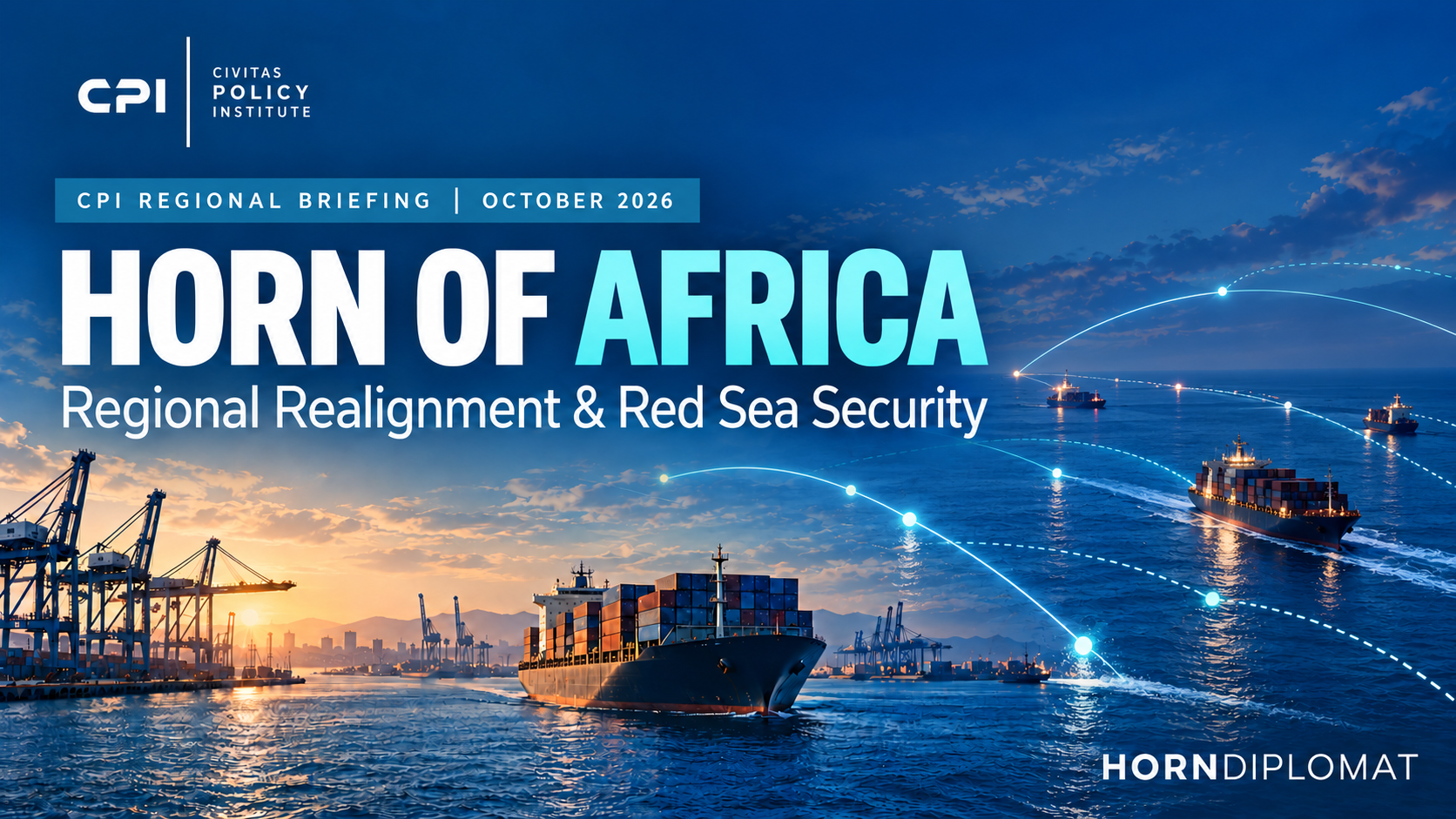
Nairobi — Somaliland’s growing diplomatic significance is becoming a central feature of a wider regional realignment, as competition over recognition, maritime security and trade corridors intersects with conflicts across the Horn of Africa, according to an October report by the Civitas Policy Institute.
The report, Regional Conflict Analysis and Geopolitical Dynamics: Red Sea and Middle East Conflict Spillover, identifies Israel’s recognition of Somaliland as a catalyst for shifting alliances. It places that development within a broader landscape shaped by Ethiopia–Eritrea tensions, Sudan’s war, Somalia’s political disputes and expanding foreign military involvement.
For Somaliland, the institute’s assessment highlights both an opportunity to strengthen international engagement and the challenge of navigating rivalries involving neighbouring governments and external powers.
CPI argues that Somaliland’s political resilience, democratic experience and strategic location have strengthened its regional importance. Berbera’s port infrastructure and access to the Gulf of Aden give Somaliland a commercial and security role extending beyond its diplomatic recognition campaign.
The report presents Israel’s recognition of Somaliland as a counterbalance within the region’s shifting power dynamics, strengthening Somaliland’s diplomatic position amid competing alliances involving Somalia, Türkiye and other external actors.
Its analysis suggests that Somaliland’s international engagement is increasingly being considered alongside questions of shipping security, economic connectivity and regional stability.
However, greater attention does not automatically produce lasting gains. The practical test for Somaliland is whether diplomatic advances translate into investment, expanded trade and stronger institutions while preserving its ability to make independent decisions.
Berbera illustrates that relationship between economic opportunity and geopolitical exposure. Its development can strengthen regional connectivity, particularly through trade with Ethiopia, but its commercial potential also depends on predictable agreements and stable relations.
The report argues that competition between transport corridors can undermine regional integration when governments regard neighbouring infrastructure primarily as a strategic threat.
For Somaliland, that suggests a need to connect its growing diplomatic profile with a clear economic proposition: reliable access, competitive services and partnerships that deliver benefits to businesses and communities.
CPI also supports inclusive maritime governance, arguing that arrangements excluding important regional stakeholders are unlikely to provide a durable foundation for security. That assessment is relevant to Somaliland’s demand for participation in discussions affecting its coastline and commercial interests.
Ethiopia occupies another central position in the report. Its pursuit of sea access intersects with deteriorating relations with Eritrea and broader competition involving Egypt and other regional actors.
CPI warns that escalating rhetoric between Ethiopia and Eritrea could develop into direct confrontation, while tensions surrounding Tigray further complicate the security environment.
The implications would extend beyond the two countries. Renewed conflict could disrupt trade, deepen humanitarian needs and draw neighbouring governments into competing alignments.
The institute advocates negotiated sea-access arrangements that support economic integration. Its assessment suggests that treating connectivity principally as a military contest would narrow the space for agreements capable of benefiting both coastal and landlocked economies.
Egypt’s dispute with Ethiopia over the Grand Ethiopian Renaissance Dam adds another dimension. CPI places disagreements over Nile water use alongside competition over Red Sea security, showing how separate disputes can influence the same diplomatic relationships.
The resulting risk is that partnerships formed around one issue become instruments of pressure over another. Maritime cooperation, water diplomacy and regional security then become harder to address on their individual merits.
Sudan’s war presents a more immediate humanitarian and institutional crisis. The report identifies the conflict as a major source of regional instability and an arena in which external competition complicates efforts to end the fighting.
Prolonged conflict weakens the country’s institutions while increasing displacement and pressure on neighbouring states. CPI calls for coordinated diplomacy to secure a ceasefire and protect humanitarian access.
Its broader assessment indicates that regional governments cannot insulate themselves from Sudan’s collapse simply by avoiding direct involvement. The humanitarian and economic consequences extend across borders.
In South Sudan, the institute highlights political fragility and risks surrounding planned elections. An electoral process without sufficient political agreement or credible safeguards could deepen existing divisions, according to its assessment.
Taken together, the crises in Sudan and South Sudan illustrate the limits of a regional system in which several countries face serious internal pressures simultaneously. Governments already managing domestic instability have less capacity to absorb shocks originating next door.
Somalia’s challenges combine militant violence with political disagreement. CPI argues that disputes involving federal leaders, opposition figures and federal member states risk weakening the cooperation required to confront Al-Shabaab and Islamic State militants.
The report also highlights funding and logistical pressures affecting the African Union mission.
Its analysis points to a persistent problem: security assistance depends on a functioning political framework to produce sustainable results. Disagreement over elections and constitutional arrangements can undermine the coordination on which military gains rely.
Somalia’s opposition to Somaliland’s recognition adds a regional diplomatic dimension to these domestic difficulties. CPI presents the dispute as increasingly connected to external partnerships and competition over influence around the Red Sea.
Djibouti’s position reflects a different combination of opportunity and exposure. Its ports and proximity to the Bab el-Mandeb corridor give it commercial importance, while instability in Yemen threatens shipping and can increase humanitarian pressures.
The report also identifies strained relations involving Djibouti, Eritrea and Somaliland as obstacles to cooperation.
For regional trade, the implication is that infrastructure investment alone cannot overcome political fragmentation. Ports and corridors require dependable cross-border relationships to realise their economic potential.
Across the region, CPI questions the growing reliance on competing bilateral defence arrangements.
“Each new bilateral defence pact tends to invite a countervailing arrangement from a rival external patron,” the report says.
That dynamic can leave governments more heavily armed without making the region collectively more secure. Partnerships intended to deter threats may encourage rival governments to seek additional military backing, reinforcing a cycle of suspicion.
Yemen and the wider Middle East connect these national challenges to international shipping and energy markets.
CPI describes maritime disruption as a channel through which distant fighting affects the Horn and East Africa. Higher freight costs, insurance premiums and delivery delays can place pressure on fuel supplies, food prices and household budgets.
The report also examines governance concerns beyond the Horn, including electoral credibility and civic freedoms in Uganda and Tanzania, political risks surrounding Kenya’s 2027 elections, and conflict in the Democratic Republic of Congo.
These findings reinforce its argument that external rivalry is only part of the problem. Weak institutions, political exclusion and unresolved domestic conflicts create vulnerabilities that foreign actors can exploit.
CPI recommends stronger regional coordination, inclusive maritime security arrangements, credible elections and sustained support for independent media and civil society.
For Somaliland, the challenge is to turn growing strategic relevance into durable diplomatic and economic gains. For the wider region, it is to prevent overlapping disputes from becoming a single, increasingly militarised contest in which commercial opportunity is repeatedly undermined by political insecurity.
This analysis is based on CPI’s October 2026 regional briefing. Events and assessments attributed to the report have not all been independently verified.