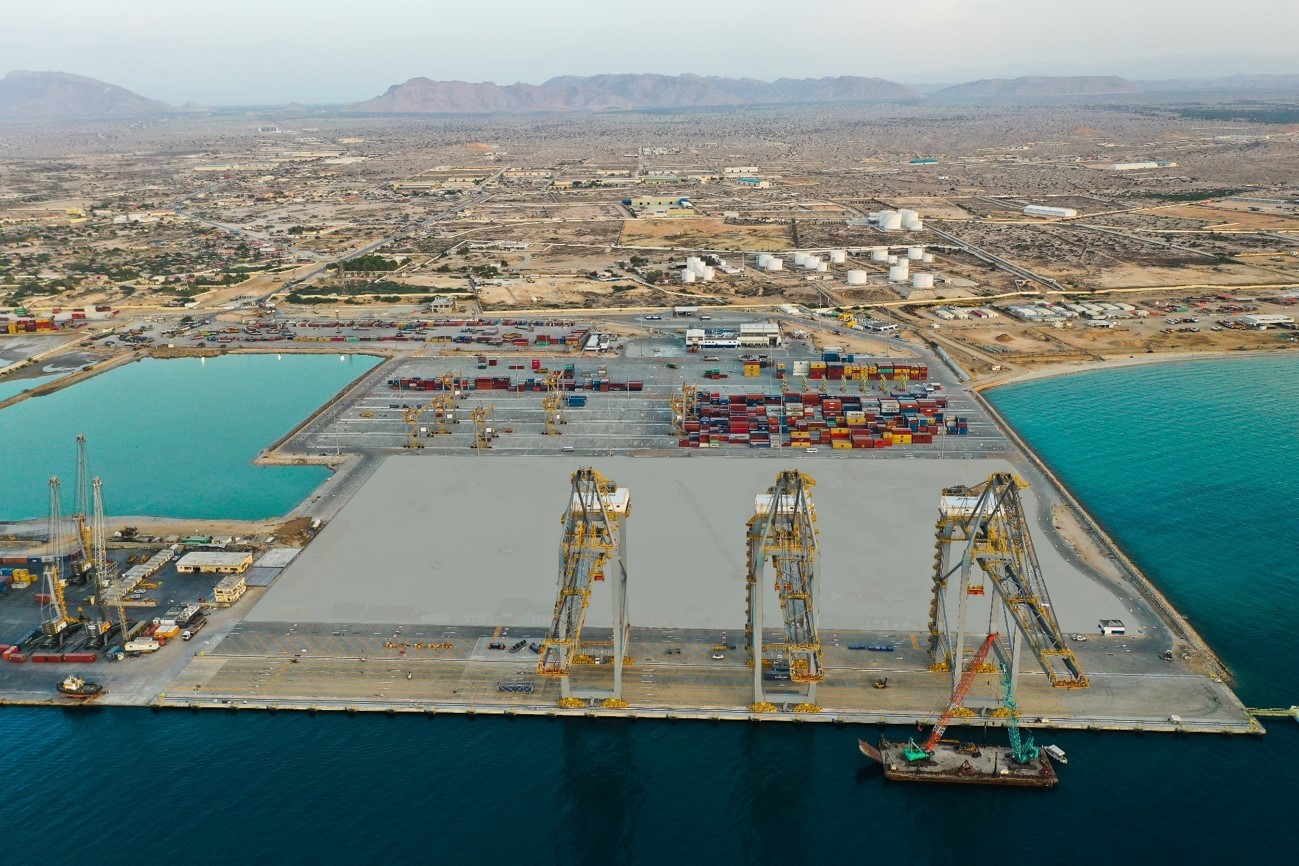
HARGEISA -Dec 20 (Horndiplomat) — Investment in the expansion of Berbera Port has reduced transport costs for businesses, strengthened regional trade resilience and delivered measurable economic and environmental benefits for Somaliland, according to an evaluation published on Thursday byBritish International Investment (BII).
The port, a strategic gateway on the Gulf of Aden and an alternative trade corridor for Ethiopia, has undergone a major modernisation led by DP World in partnership with the Government of Somaliland. BII joined the project as a minority investor in early 2022 under the BII–DP World Africa Gateway partnership.
The independent study, conducted by Itad and Steward Redqueen using trade data and stakeholder interviews, found that container handling capacity at Berbera more than tripled to 500,000 twenty-foot equivalent units (TEU) from 150,000, while operational efficiency improved sharply.
Vessel turnaround times fell to about 25 hours in 2024 from 64 hours in 2018, the report said, following the addition of new quay length, deeper draught and modern cargo-handling equipment that allow the port to accommodate larger vessels.
“These upgrades have positioned Berbera as a viable regional competitor,” the study said.
Container traffic has risen steadily since the expansion, with Berbera’s share of regional trade increasing to 14% in 2024 from 9% in 2017. Modelling suggests the port now offers cost-competitive access to parts of eastern Ethiopia and Somaliland that were previously underserved, particularly beyond the Addis Ababa–Djibouti railway corridor.
Transport cost savings for importers and exporters were estimated at $8.4 million in 2024, or $6.9 million after adjusting for new users, the report said. Efficiency gains also delivered environmental benefits, cutting carbon emissions by an estimated 7,651 tonnes a year.
The economic impact was significant, according to the evaluation. The upgraded port and the adjacent Berbera Economic Zone supported around 2,490 jobs and added $45.1 million to Somaliland’s economy in 2024. Of that, 921 jobs and $16.7 million in value added were directly linked to the expansion, equivalent to about 0.4% of gross domestic product.
The study cautioned that the full impact of the expansion has yet to be realised, noting that current trade volumes do not yet require the port’s full capacity, partly due to disruptions linked to the Red Sea crisis.
It also said some benefits may not be fully captured, including the effect of cheaper imports on living standards, broader macroeconomic spillovers into neighbouring Ethiopia, and the impact of non-containerised cargo.
Still, the evaluation concluded that investment in port infrastructure in underserved frontier markets combined with experienced global operators and complementary logistics ecosystems can unlock substantial trade and economic gains.