
By Eng. Ahmed Ali Warsame (Ubaxle), Coordinator, Energy Sector Working Group (ESWG) Republic of Somaliland
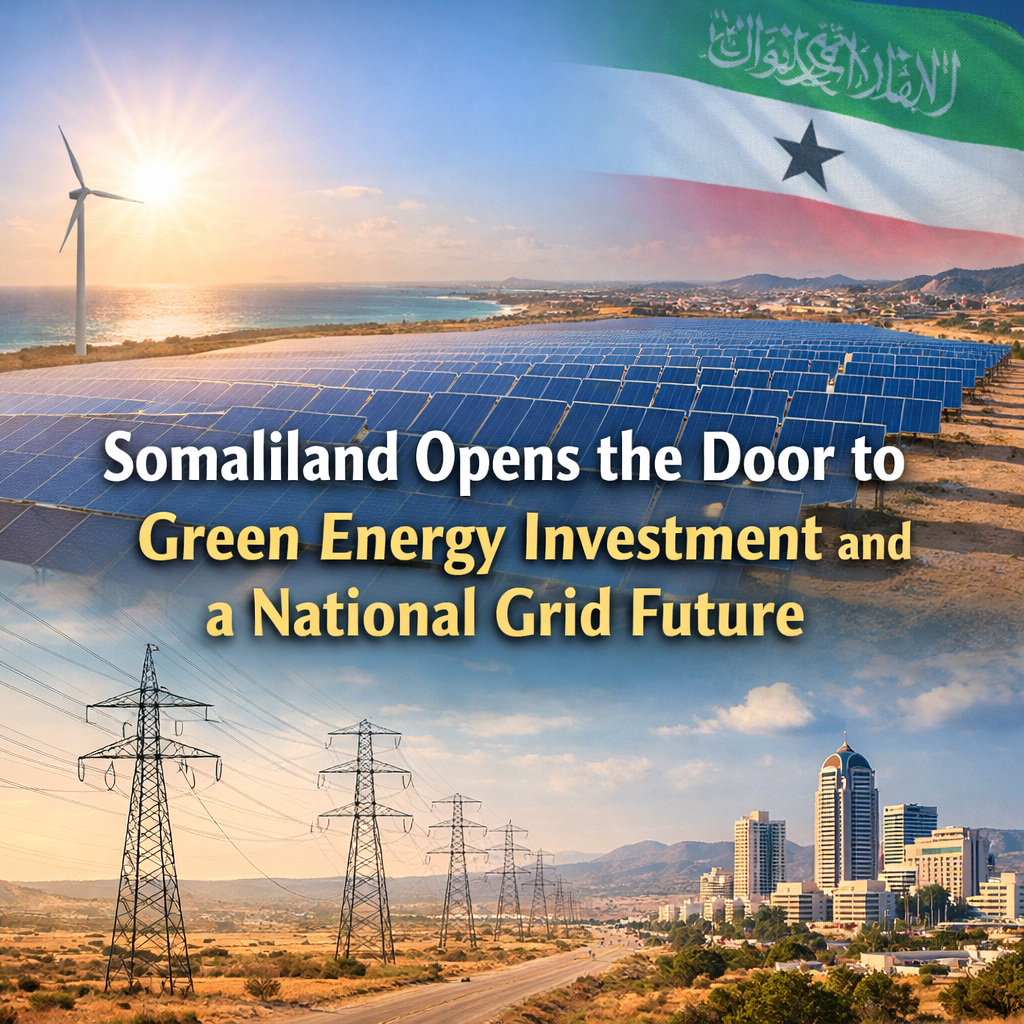
Somaliland has entered a decisive phase in the transformation of its electricity sector.
For over three decades, electricity supply evolved through privately operated urban Mini-Grids. In the absence of a national utility, private initiative sustained service continuity under extremely constrained conditions. Diesel generation ensured survival and stability.
But survival is not development.
The diesel-based model exposed the economy to fuel volatility, constrained industrial growth, and maintained high consumer tariffs. It preserved continuity, but it limited scalability.
Today, Somaliland is shifting from survival electrification to structured renewable modernization.
This transition is active, not theoretical.
Renewable Energy as a Strategic Economic Decision
Reducing diesel dependence is not simply technical reform. It is macroeconomic stabilization.
Heavy diesel reliance increases tariff volatility and exposes systems to global fuel price shocks. Renewable integration improves affordability, strengthens resilience, and enhances long-term energy security.
Among all available resources, solar energy presents Somaliland’s most mature and immediately deployable solution through 2030.
The country benefits from:
· High solar irradiation levels
· Abundant land availability
· Expanding urban demand centers
· Increasing battery storage affordability
Solar-plus-storage hybrid systems reduce fuel consumption, stabilize frequency, and improve reliability without dismantling existing distribution infrastructure.
Wind corridors along the coast and elevated regions present long-term diversification potential.
The guiding principle is clear:
All renewable investments must be Grid-Ready.
Even before a fully integrated national transmission backbone exists, technical standards adopted today determine tomorrow’s integration cost and feasibility.
Somaliland is not improvising short-term projects. It is laying foundations for a future national grid.
Berbera: A Renewable Investment Signal
DP World demonstrated international confidence in Somaliland when it invested heavily in the Port of Berbera, transforming maritime infrastructure through long-term capital commitment.
Now, the electricity sector is witnessing a similar signal.
Global South Utilities (GSU) has entered the renewable electricity space with significant private capital commitment, marking the first large-scale structured foreign participation in regulated renewable generation.
Berbera has transitioned from diesel dependency toward becoming Somaliland’s first renewable urban corridor.
This is not symbolic.
It represents:
· Structured foreign direct investment in renewable generation
· Integration under regulatory oversight
· A proof-of-concept for scalable green infrastructure
International markets understand this language:
Governance clarity + political commitment = investable frontier.
A Unique Advantage: USD-Denominated Electricity Market
One of Somaliland’s most powerful investor protections is often overlooked. Electricity tariffs in Somaliland are denominated and charged in United States Dollars (USD).
For investors, this eliminates one of the largest infrastructure risks in emerging markets:
foreign exchange volatility.
There is:
· No local currency depreciation exposure
· No forced conversion losses
· No exchange-rate instability risk on revenue streams
Revenue predictability strengthens bankability.
In many frontier markets, currency fluctuation undermines long-term project viability.
Somaliland’s electricity sector avoids this structural vulnerability.
For renewable investors seeking stable cash-flow structures, this is a decisive advantage.
The “Virgin Sector” Advantage: Building with Modern Systems
Unlike countries burdened by aging centralized grids and obsolete dispatch systems,
Somaliland’s electricity sector offers a rare structural opportunity:
It is not constrained by legacy infrastructure.
There is no outdated national grid to retrofit.
No entrenched centralized inefficiencies to dismantle.
Instead, Somaliland can design:
· Smart-grid-compatible distribution systems
· Digital metering from the outset
· Hybrid renewable dispatch architecture
· Modular, scalable transmission corridors
· PPP-integrated grid backbone design
This is not grid rehabilitation. It is grid construction from first principles.
In infrastructure economics, leapfrogging often produces superior outcomes compared to incremental reform of outdated systems.
Somaliland has the opportunity to integrate renewable energy, storage, and digital systems simultaneously — rather than sequentially.
For technology-oriented investors, this represents a clean design platform.
Executive-Level Guarantees
Infrastructure capital requires executive certainty.
The President of the Republic of Somaliland Honorable Dr. Abdirahman Mohamed Abdillahi Irro, has publicly guaranteed:
· Tax exemptions for qualifying renewable investments
· Facilitated access to strategic land for energy projects
· Partnership opportunities in a future National Electricity Grid
These commitments reduce entry friction and signal top-level state backing. Energy reform is not confined to policy discussion. It is supported at the highest executive level.
The absence of a national grid is no longer viewed as weakness.
It is a strategic opportunity to design a modern PPP-driven national electricity architecture without legacy burden.
Regulatory Clarity and Institutional Structure
Investor confidence depends on enforceable rules.
Somaliland has enacted a functioning electricity regulatory framework covering:
· Licensing
· Tariff methodology
· Safety standards
· Compliance reporting
The Foreign Investment Law provides additional legal protection for international capital.
Institutional responsibilities are clearly delineated:
· Ministry of Energy and Minerals — policy leadership
· Somaliland Electricity Regulatory Commission — regulatory enforcement
· Electricity Service Providers — operational management
· Energy Sector Working Group — sector coordination platform and formal convener of Joint Sector Reviews
Progress has occurred because institutional boundaries are respected.
Predictability lowers risk premiums.
Clarity attracts capital.
Distribution Reform and Tariff Discipline
Generation reform alone cannot guarantee affordability.
Distribution modernization reduces technical losses and improves operational efficiency. Digital metering, network rationalization, and standardization lower generation requirements and improve cost recovery.
Tariff harmonization does not mean uniform pricing nationwide.
It means regulator-verified cost transparency and predictable methodology.
Affordability must result from efficiency, not unsustainable subsidy.
A National Grid Through Public-Private Partnership
Somaliland does not intend to nationalize private mini-grids that sustained the country during difficult decades.
The future is integration, not displacement.
The National Electricity Grid will emerge through:
· Regulated private participation
· Transparent PPP frameworks
· Executive-backed guarantees
· Renewable corridor anchoring
· Technical standardization from generation to dispatch
Urban renewable corridors beginning in Berbera will form integration anchors.
Distribution modernization in Hargeisa and other demand centers will follow.
The same structural confidence that attracted DP World to Berbera’s port is now extending to the renewable electricity sector.
A Regional Positioning
The Horn of Africa is entering a period of infrastructure recalibration and renewable expansion.
Somaliland is positioning itself as:
· A renewable resource hub
· A politically committed reform environment
· A USD-stable electricity market
· A regulatory-defined frontier
· A smart-grid-ready emerging system
This is no longer a post-conflict recovery narrative.
It is an investment narrative.
The door is open.
The first renewable corridor is operational.
Foreign capital has entered.
Regulatory structures are functioning.
Executive guarantees are explicit.
The National Electricity Grid is not yet physically present.
But its architecture is already being constructed through renewable integration, smart design, and structured public-private partnership.
Somaliland is ready to power its future.
And it is inviting disciplined, long-term green energy investors to build that future alongside it.
About the Author
By Eng. Ahmed Ali Warsame (Ubaxle) Coordinator, Energy Sector Working
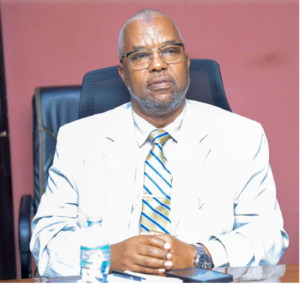
Group (ESWG) Republic of Somaliland
Ubaxle@gmail.com
Twitter : Ahmad A. W. (Ubaxle)
@ubaxle