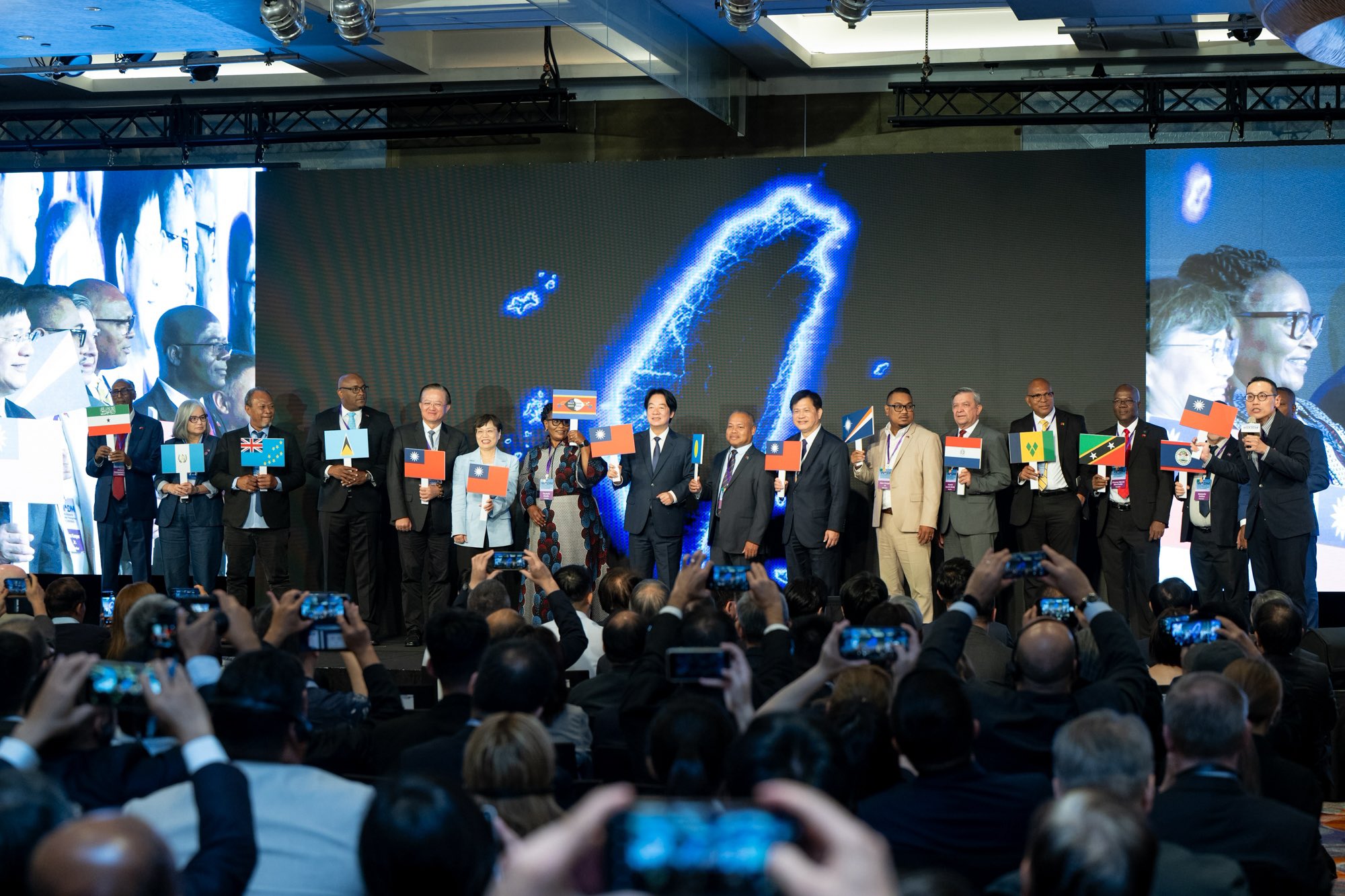
Representatives of the alliance’s founding members, including Somaliland, hold their flags alongside Taiwan President Lai Ching-te at the launch ceremony in Taipei on September 19, 2026.
By: Sakariye Khayre
Introduction:
On September 19, 2026, the opening of the “2026 Resilient Taiwan for Sustainable Democracy International Forum” Was held in Taipei. More than 500 experts and distinguished guests from Taiwan and other countries attended the forum. The Forum focused on the resilience of societies, the management of emerging risks, civil military cooperation, climate change and geopolitical risks.
During the forum, Taiwan’s President Lai Ching-te announced the establishment of the World Alliance for Disaster Management (WADM), an international organization led by Taiwan. The alliance is designed to bring together governments, disaster managements agencies, and relevant organizations to work together through joint trainings and exercises, mutual assistance, and information sharing, with the aim of strengthening their capacity to prevent and respond to disasters.
What makes this development particularly important from an international relations perspective is that WADM represent a step for Taiwan in expanding its participation in the development of international institutions.
President Lai described the establishment of WADM as a “Major breakthrough” in Taiwan’s efforts, over more than half a century, to participate in the development of international organizations. He also clearly mentioned Somaliland, stating that Taiwan’s 11 Diplomatic allice and the Republic of Somaliland are the founding members of WADM. Meanwhile, governments and organizations from21 countries, including the United States, Japan, the United Kingdom, Germany, the Netherlands, Poland, Turkey, and Philippines, have joined the alliance in different forms, including as observers and or partners.
Therefore, Somaliland was not simply a participant in an international forum held in Taipei; it was officially included among the countries and members that founded this international organization initiated by Taiwan.
President Lai summarized Taiwan’s vision for the initiative by saying, “Taiwan is Taiwan of the World”. He added that Taiwan wants to expand its international participation by making meaningful contribution, building trust through experience and expertise, and engaging with the world through partnerships of this kind.
For Somaliland’s perspective, therefore, the question is not only what WADM can do in the field of disaster management, but also what it means for Somaliland to be included among the founding members of an international organization led by Taiwan, at a time when Somaliland continues to seek opportunities to expand its voice, experience, and international relations beyond bilateral relationships.
At the same time, if we understand Somaliland’s membership in WADM in proper context, it is an international partnership focused on disaster management and community resilience. It will bring together the experience, solidarity, and cooperation of countries from around the world, with Somaliland as one of the participating members and Taiwan taking the lead in organizing and managing the initiative. This article will therefore examine several important points, or questions; What happened during the forum? What opportunities could Taiwan’s WADM initiative create? What does it mean for Somaliland to be among the founding members of this international organization? What opportunities could emerge from participating in a new international network? And what can Somaliland learn from such forums and initiatives, to develop stronger international relations, including by organizing and initiating similar forums and organizations to strengthen its relationships with its international partners?
What Happened During the Forum, and What Opportunities Could It Create!
The Forum and the meeting held in Taipei from September 19 – 21 were not simply events or gatherings held to announce the creation of a new organization. They were designed as a platform that brought together government leaders and officials, disaster management experts, rescue agencies, international representatives, security experts, and professionals working in the fields of security, safety, and community resilience. Taiwan’s Ministry of Foreign Affairs stated that 91 foreign guests from 21 countries took part in the activities marking the establishment and first forum of WADM. Among the high-level participants were Palau’s Vice President Raynold Oilouch and Eswatini’s Deputy Prime Minister Thulisile Dladla, both of whom led high-level delegations.
At the same time, the forum brought together more than 500 experts, and distinguished guests who took part of discussions on community resilience, maritime resilience, cybersecurity, so-called gray-zone activities, the protection of critical infrastructure, and how governments can prepare for complex crises situations. According to the official program, the discussions were divided into five main seasons, covering the training and use of civilian capabilities, strategic stockpiling, energy and critical infrastructure, healthcare and evacuation facilities, and the protection of information networks, transportation, and financial systems.
The quality and the diversity of the participants was one of the important features of the forum. President Lai Ching-te specifically highlighted Palmer Luckey, founder of Anduril Industries; Hirofumi Takinami, a member of Japan’s House of Councilors; Hermogenes Esperon, Former National Security Adviser of the Philippines; and Matt Pottinger and Anne Neuberger, both of whom previously held senior positions in the United Stated national security establishment.
The participation of Raymond Greene, Director of American Institute in Taiwan; Ruth Bradley-Jones, Britain’s representative in Taipei; and Lutz Gullner, Head of the European Economic and Trade Office in Taiwan, was also significant. Other international participants included Somaliland’s Ministry of Interior and National Security, Abdallah Mohamed Arab; Mark Montgomery, a senior fellow at the Foundation for Defense of Democracies; Tomas Godliauskas, former Deputy Minister of Defence of Lithuania; and Janis Karlsbergs, a former member of Latvia’s defence institutions.
Part of the discussions at the forum focused specifically on lessons from the war in Ukraine. Mark Montgomery said that in the three years following Russia’s invasion of Ukraine, warfare technologies and tactics have changed significantly, describing the current situations as a form of adaptive warfare from which governments need to continuously learn. Clara Kaluderovic, from Mental Health Global, who has worked in Ukraine, also emphasized the important of civilian training and the ability of the communities to respond systematically to fear and crises.
Palmer Luckey, who also delivered a keynote address, connected his argument to the idea that freedom and society’s capacity for innovation are themselves part of national defence capabilities. He argued that Taiwan has a system that encourages innovation and technology, and that this capacity should become part of its resilience for the future.
Meanwhile, the Somaliland delegation presents its experience in disaster response through its firefighting services. The minister of Interior of the Republic of Somaliland also expressed his appreciation to the government of Taiwan for hosting the forum, and for Somaliland’s participation in WADM. The alliance, he noted, could become a channel for cooperation that creates many opportunities for Somalilanders, while serving as one of the diplomatic and practical bridges through which Somaliland can develop cooperation with international partners. Somaliland has been given the opportunity not only participate in the alliance, but also to be part of its establishment and its development.
The WADM initiative was the most widely discussed outcome of the meetings. The new organization has been designed to connect governments, disaster prevention agencies, and rescue organizations, with its work based on joint trainings, collective assignments and exercises, mutual assistance, coordinated operations and information sharing.
President Lai said that the system would connect early warning, emergence response and post-disaster recovery. Taiwan’s goal is for the training centre in Zhushan to become an important hub for international cooperation and disaster prevention across the Indo-Pacific.
One of the most important institutional outcomes was the election of Hsiao Huan-chang, Director General of Taiwan’s National Fire Agency, as the first Secretary-General of WADM.
President Lai noted that his experience in disaster prevention and international cooperation would help the organization develop a strong operational direction.
Statements from the founding members also demonstrated the direction in which the organization is expected to move. Palau’s Vice President Raynold Oilouch said that member countries face different types of disaster – including earthquakes, floods, volcanic eruptions, tsunamis and droughts – but share the same need to improve preparedness. He said Palau could particularly benefit from shared knowledge and experience as the country prepares for risks associated with severe droughts.
Eswatini’s Deputy Prime Minister, Thulisile Dladla proposed three principles to guide WADM’s future work: inclusive disaster preparedness, the development of the technology with people at the centre, and demonstrating unity through concrete action. She also argued that no single country can face disaster risk alone, and that every country can contribute to international cooperation.
When President Lai met with leaders of the WADM delegations, on September 21, he recalled an important lesson from Taiwan’s 1999 earthquake. The 7.3 magnitude earthquake caused more than2,400 deaths and destroyed more than 100,000 buildings. At that time 38 rescue teams from 21 countries came to Taiwan to provide assistance, bringing more than 700 rescuers and 103 search and rescue dogs.As Lai explained, 27 years later, Taiwan wants to return to the world the support that the international community once provided to Taiwan, this time through WADM.
Somaliland and WADM: An Opportunity to Build International Partnership and Relationships
From Somaliland’s perspective, being a founding member of the World Alliance for Disaster Management (WADM) could be particularly important for a country that regularly faces natural hazards and disasters made more difficult by limited capacity to prevent and manage emergencies. Somaliland has already experienced major disasters that have demonstrated the need to strengthen emergence response institutions, preparedness, early warning systems, and international cooperation.
The Waaheen fire in Hargeisa on April 1, 2022 is clear example of the scale of such risks. The fire destroyed one of the Somaliland’s largest markets, affecting thousands of businesses. Preliminary estimates by Somaliland’s response committee placed the total losses from the fire at between $1.5 – 2 billion, while thousands of workers also lost their livelihoods.
Waaheen is not only example of a major fire disaster in Somaliland. Fires have become a recurring risk, particularly affecting markets and commercial centres. Similar incidents have occurred in the cities and commercial areas across Somaliland, demonstrating the need to move beyond responding after disaster happen and towards a permanent system of prevention, preparedness and cooperation.
At the same time, Somaliland regularly faced droughts, floods and risks associated with heavy rainfall and climate change. Somaliland’s disaster-planning document identify floods and droughts among the country’s most significant recurring hazards.
For this reason, Somaliland can use WADM for purposes that go beyond simply attending conferences and occasional meetings. The organization could become a channel through which Somaliland builds international partnerships focused on disaster management. Countries or institutions with greater technical expertise and capacity could share training, technical knowledge, planning experience, equipment, early warning systems and emergency response methods with Somaliland. Somaliland, in turn, can bring its own experience and the particular circumstances in which it operates to the table.
The most important lesson can Somaliland learn from Taiwan’s initiative is how to use an issue of shared international interest to built a network of relationships. Taiwan build WADM around an area in which it has particular experience – disaster management and prevention – and invited governments and institutions from different parts of the world to take part.
Somaliland can apply this lesson by also hosting and organizing international forums, around issues that matter the wider world. If Somaliland wants to increase the number governments and institutions that engage with it on a regular basis, it is important that it does not limit itself to attending conferences organized by other countries. It should also create it own forums, invite governments, experts, and international institutions, and provide meaningful reasons for them to come to Somaliland.
For example, Somaliland’s membership in WADM could give it an opportunity to invite the WADM Secretary-General, founding members, and key experts who participates int Taipei forum to visit Hargeisa. Somaliland could host a meeting or training program focused on disaster management, community resilience, and emergency response. If such a meeting were held in Somaliland, it would allow officials and experts from different countries to see Somaliland for themselves – its institutions, its society, the challenges it faces, and the capacity it has developed.
This could create an event greater opportunity: people who visit to Somaliland could become sources of knowledge about the country, taking what they have seen and learned back to their governments and institutions. This could create what my be understood as a form of People-to-People and administration-to-administration diplomacy.
In this way, Somaliland can make WADM a two-way bridge. On one side, it can learn from countries with greater experience and capacity in disaster management; on the other, it can give those countries an opportunity to learn about Somaliland. This is a relationship built not only around what Somaliland wants to receive, but also around what Somaliland can bring to the table.
Beyond this, Somaliland can turn the lessons gained through WADM into domestic policies. The Waaheen fire demonstrated the need for markets with modern safety and emergency plans, while droughts and floods highlight the importance of early warning, data and planning. Therefore, participation in WADM should be about more than conferences and photographs. It should lead to training, planning, stronger institutions, and new system designed to reduce the impact of the disasters.
Ultimately, WADM and Taiwan’s partnership-based support can offer Somaliland a lesson in how disaster management can also become a tool of building international relationships. Taiwan is using its initiative to bring together governments and institutions from different parts of the world, and Somaliland can learn from this approach.
If Somaliland uses its WADM membership strategically, invites members and experts of the organization, hosts conferences and training programs, and develops long-term cooperation with these countries, the outcome could go beyond shared knowledge and disaster response. It could help Somaliland build a wider network of international relationships, opining new doors for cooperation, engagement and diplomacy.
Sakariye Khayre: a Somaliland writer and researcher focused on political and cultural affairs in the Horn of Africa, with particular interests in Somaliland, governance, diplomacy and regional affairs.
Email: yarekhayre@gmail.com
The views expressed in this article are the author’s own and do not necessarily reflect the Horndiplomat editorial policy.
If you want to submit an opinion piece or an analysis, please email it to Opinion@horndiplomat.com
Horndiplomat reserves the right to edit articles before publication. Please include your full name, relevant personal information and political affiliations