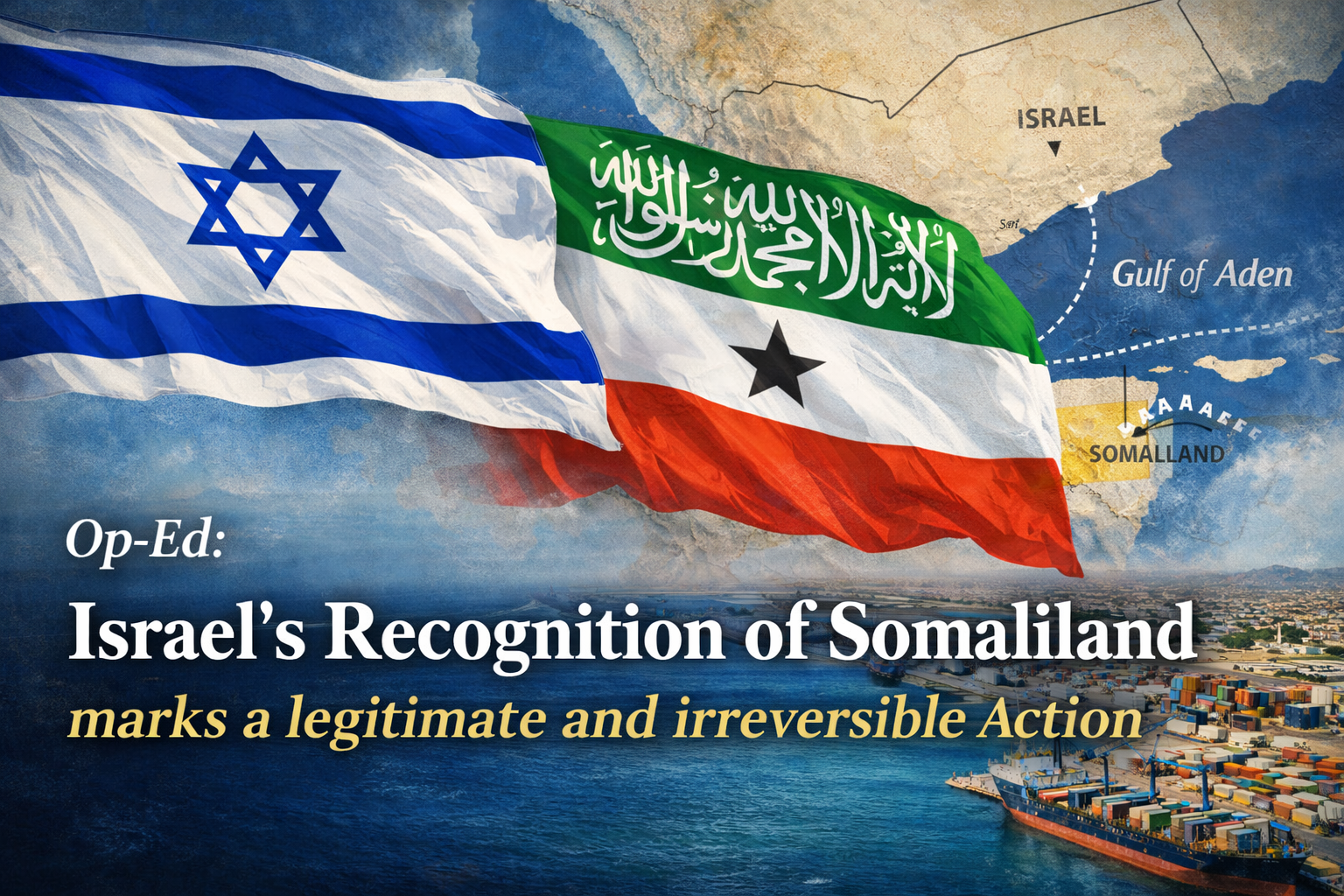
The Israeli Prime Minister’s formal recognition of the statehood of Somaliland has sparked widespread public celebrations, renewed national pride, and a deep sense of historical vindication among Somalilanders. For many, this moment represents the fulfilment of a long-held aspiration that dates back to the immediate collapse of the failed union with Somalia after 1960.
Historic Overview
Somaliland has a distinct and credible history of statehood that is rarely presented accurately in international media and is often obscured by Somalia’s political narrative. Between 1884 and 1960, Somaliland existed as a British Protectorate, while Somalia was colonised by Italy. These differing colonial experiences shaped separate institutional systems, administrative traditions, legal frameworks, and political cultures.
During the height of Pan-Somalism, Somalilanders were among the strongest advocates for uniting all Somali-inhabited territories in the Horn of Africa, including Somalia, Somaliland, Djibouti, the Somali Region of Ethiopia, and North Eastern Kenya, under a single flag. However, this aspiration proved impossible. The union between Somaliland and Somalia, formed hastily in 1960, lacked a ratified legal framework to regulate power-sharing, governance, or dispute resolution. What followed was political marginalisation, systemic exclusion, and violent repression.
Under the military regime, Somaliland experienced widespread human rights violations, collective punishment, and mass atrocities. Resistance culminated in 1991 with the collapse of the Somali Republic. Somaliland subsequently reclaimed its sovereignty, restored its pre-1960 borders, and embarked on an internally driven state-building process. Over the past three decades, Somaliland has established peace, stability, and a functioning multiparty democratic system, an achievement unmatched in much of the region.
The Case for Recognition
Somaliland presents a strong and credible legal case for international recognition. It possesses a defined territory based on its former British Protectorate borders, a permanent population of approximately six million people, and an effective government exercising authority over its territory. Somaliland operates its own currency, constitution, judiciary, security institutions, and public administration.
Crucially, Somaliland has demonstrated a clear capacity to enter into and implement international agreements. The 2016 Berbera Port development agreement with DP World, valued at over USD 442 million, is a concrete example of this capacity. Under the criteria set out in the Montevideo Convention on the Rights and Duties of States (1933), Somaliland meets all four requirements for statehood under international law.
In 2005, the African Union (AU) itself acknowledged this reality through a fact-finding mission that concluded Somaliland’s case was unique and historically distinct, and not comparable to conventional secessionist movements. The report recognised that Somaliland’s sovereignty claim predates the failed union and cannot be understood within a simple breakaway framework.
Despite this, the AU’s response following Israel’s recognition has been contradictory and politically driven. The current AU leadership, influenced by regional geopolitical rivalries, particularly involving Djibouti, has departedfrom its own established findings. Fears of a so-called “Pandora’s box” of African fragmentation are misplaced and inconsistent with precedent. The AU has already recognised Eritrea and South Sudan, both of which emergedthrough separation from existing states. Somaliland’s case is legally and historically even stronger.
Geopolitics in the Horn of Africa
Somaliland is not a newly emerging entity. Its statehood claim has evolved over more than three decades and has been a central, unresolved issue in Somali politics. Numerous internationally mediated talks, led by the United Kingdom, the European Union, Turkey, Djibouti, and others, have failed to produce agreement on either reunification or separation.
The strategic location of Somaliland in the heart of the Bab-el-mendab straight along the Gulf of Aden at the front of the Red Sea and its untapped resources are strong leverage. It has over nine consulates and missions present inside its capital, closely working in various economic, security and diplomatic relationships, including Taiwan, Ethiopia, Kenya, Djibouti, the UAE, the British office, and Turkey, among others.
Israel’s recognition comes at a moment of geopolitical deadlock. Somalia and its regional allies, including Turkey, Djibouti, Qatar, and Saudi Arabia, have strongly opposed any steps toward Somaliland’s recognition, particularly following Ethiopia’s engagement with Somaliland through a memorandum of understanding related to Port liaison. While Ethiopia promised formal recognition upon the MoU. This opposition is deeply inconsistent, given that Somalia has allowed extensive foreign access to its maritime resources, energy exploration, and minerals over the past decade to Turkey with no viable benefits.
Somalia’s political leadership has consistently failed to engage meaningfully with Somaliland’s aspirations for statehood or to address its own broader national challenges, including dysfunctional federalism, insecurity, corruption, aid diversion, terrorism, and elite capture of state institutions. The fundamental question remains: how long should Somaliland wait for Somalia to resolve these deeply entrenched failures?
The answer is clear. Somaliland will not wait. It will continue to pursue its statehood through diplomacy, lawful engagement, and strategic partnerships. Recognition by Israel marks not an endpoint, but a significant step in a long, legitimate, and irreversible process.
About the Author
Yahye Xanas, Deputy Director, Somaliland Maritime Security Coordination Office at the Ministry of Foreign Affairs. A recent graduate of MA Governance, Development & Public Policy at the Institute of Development Studies, University of Sussex. Yahye is also a former Executive Director for the Somaliland Journalists Association.
The views expressed in this article are the author’s own and do not necessarily reflect the Horndiplomat editorial policy.
If you want to submit an opinion piece or an analysis, please email it to Opinion@horndiplomat.com. Horndiplomat reserves the right to edit articles before publication. Please include your full name, relevant personal information, and political affiliations.