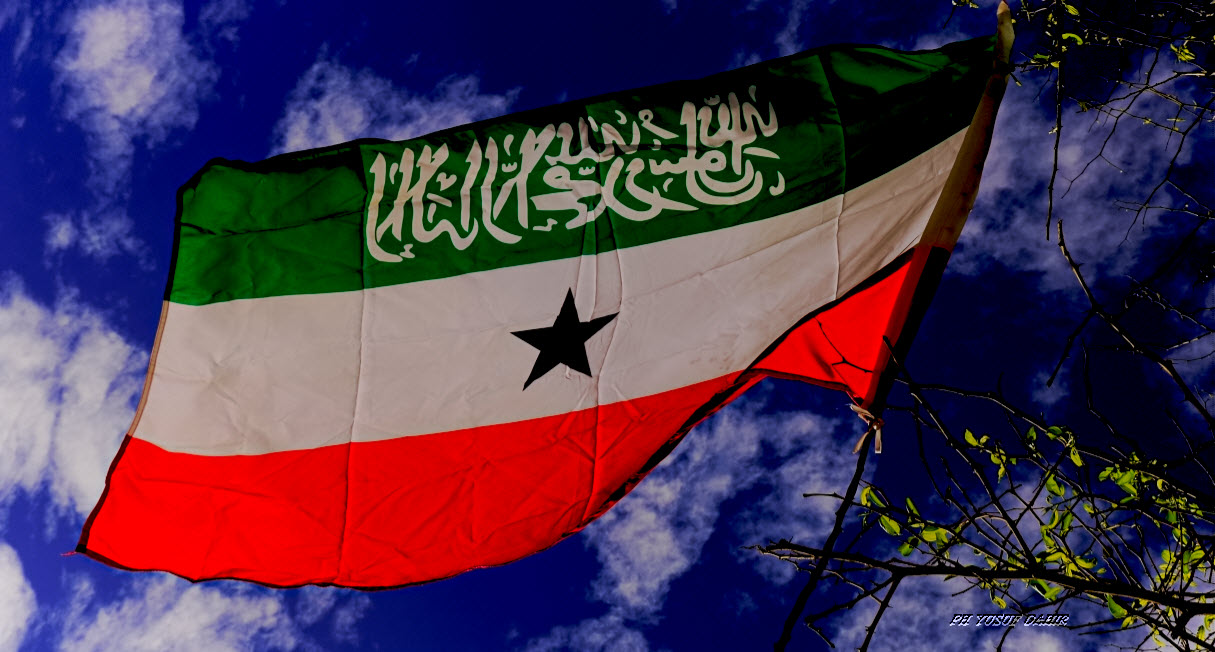
Somaliland flag photo credit Photographer Yusuf Dahir
By: Abdirashid Ibrahim Abdirahman
In recent weeks, the Partially recognized Somaliland has increasingly featured in international conversations about stability, security, and development in the Horn of Africa and the wider Red Sea region following the historic re-recognition by Israel. These discussions have often been accompanied by misinformation and speculative claims that obscure the reality on the ground. It is therefore important to begin with clarity. There are no Israeli military bases in Somaliland, and there is no relocation or resettlement of Palestinian refugees to Somaliland that is in discussion. These assertions are false and distract from a far more substantive and constructive discussion: what Somaliland already contributes to regional and global security, and what it could offer the international community if formally recognized as a sovereign state.
Somaliland’s experience over the past three decades stands out in a region frequently associated with conflict and fragility. Since restoring its sovereignty in 1991, Somaliland has built a peaceful and functioning political order through locally driven reconciliation, traditional conflict-resolution mechanisms, and gradual institutional development. Unlike externally imposed state-building experiments, Somaliland’s governance emerged from broad-based consensus among clans and communities, creating a durable foundation for stability. This internal legitimacy has allowed Somaliland to avoid large-scale conflict, maintain public order, and foster a strong sense of national ownership over peace and security.
Democratic governance has been central to this achievement. Somaliland has held multiple competitive elections, including presidential, parliamentary, and local council polls, with peaceful transfers of power. The commitment to constitutionalism, multiparty politics, and civilian oversight of security institutions has distinguished Somaliland within the Horn of Africa. This political stability has delivered concrete security dividends, enabling sustained counter-terrorism efforts, effective policing, and community-based intelligence that have significantly limited the spread of violent extremism within its borders.
Somaliland’s role in regional security extends well beyond its territory. Situated along the Gulf of Aden and adjacent to the Red Sea, Somaliland occupies a strategic position along one of the world’s most vital maritime corridors. A significant share of global trade, including energy supplies and essential commodities, passes through these waters each year. Instability along this route has global consequences, as demonstrated during periods of heightened piracy and maritime insecurity. Somaliland has contributed quietly but consistently to maritime safety by maintaining secure coastlines, cooperating informally with international anti-piracy efforts, and ensuring that its ports and territorial waters do not become safe havens for criminal or extremist networks.
These efforts have also supported regional trade security and humanitarian access. Somaliland’s ports and transport corridors serve as critical gateways for goods entering the Horn of Africa, including landlocked neighboring states. By providing a stable and predictable transit environment, Somaliland has reduced risks to supply chains, facilitated commerce, and supported humanitarian operations during times of drought and crisis. In a region where conflict often disrupts logistics and access, Somaliland’s reliability has been an unrecognized but essential asset.
Geography amplifies this contribution. Somaliland’s coastline lies along a maritime chokepoint that connects the Indian Ocean to the Red Sea and onward to the Suez Canal and global markets. The security of this corridor affects shipping costs, food security, energy markets, and economic stability far beyond the region. Somaliland’s ability to secure its territory and waters therefore contributes directly to the resilience of the international trading system. Its ports, particularly Berbera, have grown in importance as part of emerging regional trade corridors linking Africa, the Middle East, and Asia.
Despite these contributions, Somaliland operates under significant constraints due to the absence of international recognition (Now a Partially recognized Somaliland). Its security institutions – while professional, disciplined, and effective relative to many regional counterparts – lack access to formal multilateral training programs, advanced technology, structured intelligence-sharing mechanisms, and recognized security cooperation frameworks. Recognition would not create Somaliland’s security capacity; it would legitimize, strengthen, and scale it through lawful and transparent partnerships grounded in international norms.
A nation as strategically positioned as Somaliland carries importance that extends far beyond its borders. Somaliland is not an untested or hypothetical partner; it is a proven and reliable security actor. Even without recognition, it has demonstrated commitment to counter-terrorism cooperation, maritime security, and internal stability. Its maritime security capacity has been showcased under the most constrained conditions, operating responsibly in a diplomatic and legal vacuum where no formal recognition exists. This reality raises a fundamental question for the international community: if Somaliland can contribute this much while excluded from global security frameworks, how much more could it offer as a recognized state fully integrated into the shared responsibility of global peace and security?
Recognition would transform Somaliland’s role from an informal security contributor into a fully accountable international partner. As a recognized state, Somaliland would be able to enter binding security agreements, participate in intelligence-sharing and maritime enforcement regimes, contribute to regional and international peacekeeping missions, and help shape the rules and norms governing security, trade, and stability in the Red Sea and Gulf of Aden. In doing so, Somaliland would move from operating at the margins of the international system to sharing directly in the collective responsibility for global security.
Somaliland’s security institutions have consistently emphasized professionalism, restraint, and civilian protection. Its armed forces, police, and coast guard focus on internal stability and territorial defense rather than regional projection. With recognition, these institutions could be further modernized through standardized training, technology transfer, intelligence cooperation, and adherence to international best practices. This would allow Somaliland to play a more coordinated and effective role in securing the Red Sea and Gulf of Aden, strengthening counter-terrorism efforts, and supporting collective maritime security initiatives.
In the global fight against terrorism and violent extremism, Somaliland’s value lies as much in prevention as in enforcement. Its social cohesion, functioning local governance, and trusted community structures have limited the space in which extremist ideologies can flourish. Recognition would reinforce these strengths by enabling investment in education, economic opportunity, and institutional resilience—addressing the root causes of insecurity rather than merely its symptoms.
International recognition would also have broader systemic benefits. Formal access to global forums and multilateral institutions would enable Somaliland to engage transparently on security, development, trade, climate resilience, and humanitarian coordination. Participation would strengthen accountability, improve data sharing, and align Somaliland’s policies more closely with international law. Rather than operating in legal ambiguity, Somaliland could contribute further openly and responsibly to regional and global initiatives, including peacekeeping, maritime coordination, and disaster response.
From a development perspective, recognition would unlock opportunities for sustainable growth that reinforce security outcomes. Investment in infrastructure, ports, logistics, and trade corridors would expand economic opportunity, create employment, and reduce incentives for illicit activity. Somaliland has already demonstrated how stability attracts private investment despite political constraints. Formal recognition would amplify this effect by lowering risk, enabling development finance, and integrating Somaliland into global economic systems.
Equally important is Somaliland’s diplomatic posture. Its external engagement has been pragmatic, non-confrontational, and oriented toward mutual benefit. Somaliland has consistently emphasized peaceful coexistence, respect for international norms, and constructive regional cooperation. Recognition would not alter this approach; it would allow Somaliland to pursue it more effectively and transparently, contributing to confidence-building in a strategically sensitive region.
Ultimately, the question of Somaliland is not about speculation or external agendas. It is about recognizing an existing reality and assessing its implications for global security and development. Somaliland already provides stability along a critical maritime corridor, supports regional trade and humanitarian access, and demonstrates that locally driven governance can succeed where externally imposed models often fail. With recognition, these contributions could be expanded, formalized, and aligned more closely with international efforts to promote peace, security, and sustainable development.
For policymakers, security practitioners, and development partners, Somaliland represents not a risk to be managed but a strategic opportunity to be embraced. Engaging Somaliland on the basis of facts rather than myths would strengthen collective security in the Red Sea and Gulf of Aden, support long-term stability in the Horn of Africa, and affirm a principle increasingly voiced in global forums: that where a people have demonstrated capacity, responsibility, and commitment to peace, statehood is not a favor, but a right—and a necessity for lasting global security and development.
It is now time for the international community to follow Israel’s re-recognition and formally recognize the Republic of Somaliland as a responsible, reliable, and indispensable partner in global security and development.
About the Author
Mr. Abdirashid Ibrahim Abdirahman, Former Director-General of the Ministries of Planning & National Development, Social Affairs & Labour, and Trade & Tourism of the Republic of Somaliland.
The views expressed in this article are the author’s own and do not necessarily reflect the Horndiplomat editorial policy.
If you want to submit an opinion piece or an analysis, please email it to Opinion@horndiplomat.com. Horndiplomat reserves the right to edit articles before publication. Please include your full name, relevant personal information, and political affiliations.