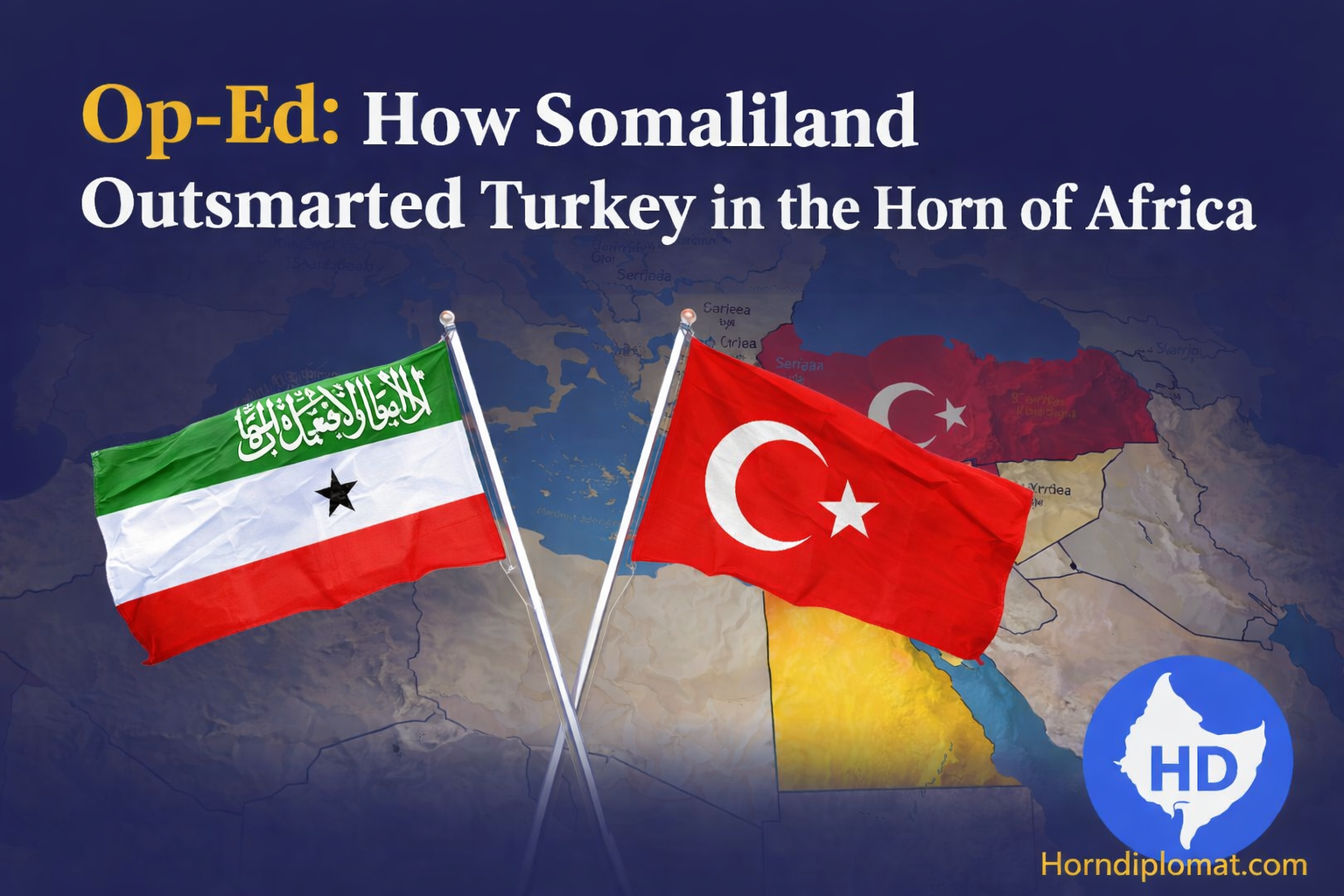
For more than a decade, Turkey has presented itself as a benevolent actor in the Horn of Africa—first as a humanitarian responder, then as a security partner, and eventually as a strategic investor. Nowhere has this presence been more visible than in Somalia, where Ankara’s footprint stretches across ports, airports, military bases, and energy agreements.
Yet Turkey’s expanding influence has met an unexpected limit. Somaliland, long dismissed as diplomatically marginal, has become the first political entity in the Horn of Africa to effectively counter Ankara’s regional ambitions—culminating in its recognition by Israel.
This did not happen by chance. It was the result of deliberate choices rooted in calculated foreign policy, sovereignty, institutional control, and a firm refusal to outsource the core functions of the state.
From humanitarian entry to strategic control
Turkey entered Somalia in 2011 during a devastating famine. Its intervention—food aid, hospital construction, and high-level diplomatic engagement—was widely praised. Somalia was and remains collapsed state, and Turkey stepped in when others hesitated.
But humanitarian access soon turned into long-term leverage. Turkish companies assumed management of Mogadishu’s port and airport. Turkey established its largest overseas military base. Over time, security training, infrastructure management, and economic agreements placed critical state functions under Ankara’s influence.
The model delivered visibility and short-term capacity. It also created dependency.
Key revenue-generating assets moved under long-term external management. Oversight remained opaque. Strategic decisions increasingly reflected external priorities rather than domestic accountability. Somalia became less a partner and more a platform.
Why Turkey opposed Somaliland’s trajectory
As Turkey’s foreign minister acknowledged in a recent interview, Ankara’s resistance to Somaliland’s recognition reflects strategic anxiety over how Somaliland’s strategic location could reshape influence in the Horn of Africa.
A recognized Somaliland—stable, self-governing, and in control of its coastline—directly undermines Ankara’s preferred model in Somalia: centralized influence exercised through a weak government.
Somaliland represents the opposite approach: territorial control without foreign military bases, governance without externally managed strategic assets, and diplomacy conducted on its own terms.
This is why Turkey pushed for Somalia–Somaliland talks in 2012. Officially, these talks were framed as reconciliation. In practice, they functioned to freeze Somaliland’s recognition momentum while preserving Mogadishu’s claim of sovereignty.
When neutrality collapsed and agreed commitments were politicized, Somaliland withdrew. It refused to legitimize a process designed to delay its status rather than resolve it.
That decision marked a turning point.
Somaliland’s counter-strategy: sovereignty before partnerships
Unlike Mogadishu, Hargeisa declined externally managed ports, airports, and security arrangements. It did not outsource core state functions. It made one position clear: engagement would follow recognition—not substitute for it.
That choice limited short-term inflows. It also preserved leverage.
Somaliland reassessed its foreign policy and chose partners it considered reliable, including the United Arab Emirates. The DP World–Berbera agreement transformed Berbera Port into one of the most efficient ports in Sub-Saharan Africa, according to World Bank efficiency rankings, outperforming Djibouti and Mogadishu.
Rather than loud diplomacy, Somaliland pursued strategic restraint—protecting its territory and coastline while remaining disciplined and unpredictable. As global competition intensified around the Red Sea and Bab el-Mandeb, Somaliland positioned itself not as a client, but as a gatekeeper.
That distinction proved decisive.
Recognition changed the rules
Israel’s recognition of Somaliland was not symbolic. It reflected a strategic reality: Somaliland – is stable, democratic, and a reliable partner in a volatile corridor.
Turkey moved quickly to oppose the recognition, invoking Somalia’s territorial integrity. But the reaction itself revealed Ankara’s vulnerability and exposed limits in its foreign policy approach.
Somalia may issue condemnations. Turkey may mobilize diplomatic allies. Neither can erase a simple fact: for more than three decades, Somaliland has governed its territory, secured its borders, and conducted foreign relations independently.
Recognition now places Somaliland firmly on the Red Sea chessboard. It elevates Hargeisa from a regional actor to a maritime stakeholder with leverage over trade routes, security cooperation, and regional stability.
The Somaliland–Israel relationship is grounded in mutual interest. It opens space for cooperation in trade, port logistics, mining, agriculture, technology, and maritime security—areas with long-term economic and strategic returns for both sides.
The Horn of Africa is shifting
Turkey now faces a strategic dilemma. Its model—centralized influence built on dependency, works where institutions are weak and sovereignty is negotiable. Somaliland is neither.
Recognition does not end the contest. It confirms a truth Ankara resisted for years: Somaliland is an independent nation, built and defended by its own people, standing tall despite pressure and decades of non-recognition.
The Horn of Africa is entering a new phase. Influence will be determined by control and realities on the ground, not recognition on paper.
Somaliland understood this early and waited its time. Turkey did not.
About the author Mohamed Guleid is a former Chairman of the Somaliland National Tender Board and an independent political analyst based in Hargeisa.
The views expressed in this article are the author’s own and do not necessarily reflect the Horndiplomat editorial policy.
If you want to submit an opinion piece or an analysis, please email it to Opinion@horndiplomat.com. Horndiplomat reserves the right to edit articles before publication. Please include your full name, relevant personal information, and political affiliations.