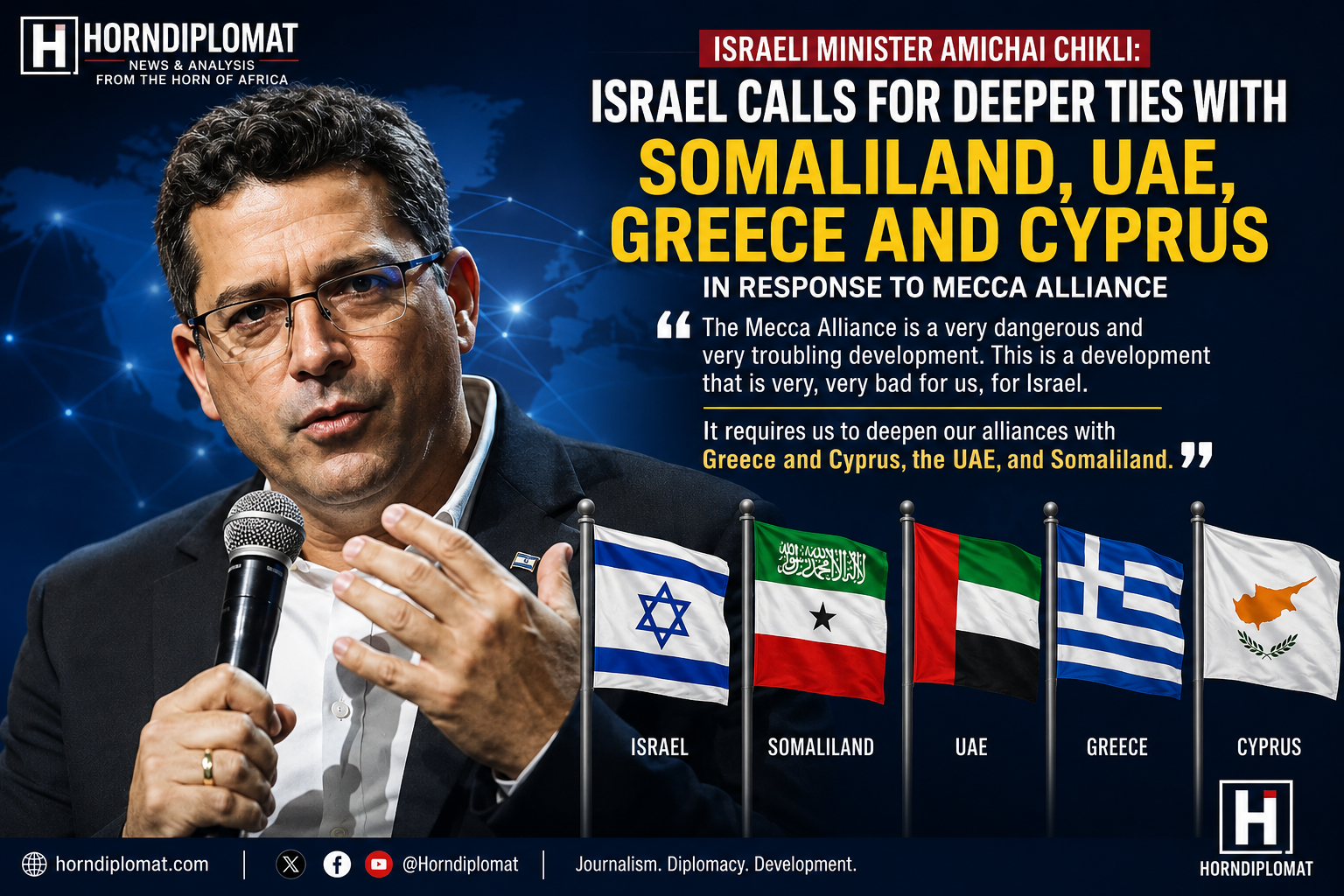
Israeli Diaspora Affairs Minister Amichai Chikli has called for Israel to deepen its ties with Somaliland, the United Arab Emirates, Greece and Cyprus in response to the newly formed Mecca Alliance,
JERUSALEM, Aug 10 (Horndiplomat) — Israeli Diaspora Affairs Minister Amichai Chikli has called for Israel to deepen its ties with Somaliland, the United Arab Emirates, Greece and Cyprus in response to the newly formed Saudi-Turkish-Pakistani alliance, known as the “Mecca Alliance,” which he described as a “very dangerous and very troubling development” for Israel.
Speaking to i24NEWS, Chikli said the emergence of the alliance represented a significant change in the regional strategic landscape and raised particular concerns for Israel.
“The Mecca Alliance is a very dangerous and very troubling development,” Chikli said. “This is a development that is very, very bad for us, for Israel.”
“It requires us to deepen our alliances with Greece and Cyprus, the UAE, and Somaliland,” he added.
The Mecca Alliance was established under the Mecca Joint Defence Agreement signed on Aug. 7, creating a collective defence framework under which an armed attack against one member would be considered an attack against all. Turkish Foreign Minister Hakan Fidan has compared the principle to NATO’s Article 5 collective-defence clause.
Officials involved in the pact have said it is defensive and is not directed against a particular country. Fidan said the agreement, negotiated over nearly three years, was intended to strengthen regional deterrence and could eventually be expanded to include other states.
Chikli, however, said the development should be viewed seriously from Israel, particularly because of the changing regional alignments and tensions between Israel and Turkey.
He said Saudi Arabia had previously remained largely on the sidelines of Israel’s confrontation with Turkey, while maintaining an existing defence relationship with Pakistan. The emergence of the broader Mecca Alliance, he argued, represented a more consequential shift.
Chikli pointed in particular to tensions between Israel and Turkey, warning that further deterioration could have implications for the eastern Mediterranean and Syria.
His remarks also placed Somaliland alongside the UAE, Greece and Cyprus in his proposed framework for strengthening Israel’s regional partnerships.
Somaliland occupies a strategically important position on the Gulf of Aden, close to the Bab el-Mandeb maritime passage connecting the Indian Ocean and Red Sea. Its location has increasingly drawn attention amid wider international concerns over maritime security and trade routes through the Red Sea.
Israel already has longstanding strategic cooperation with Greece and Cyprus in the eastern Mediterranean, while its relationship with the UAE expanded significantly following the establishment of diplomatic relations under the Abraham Accords.
Chikli’s inclusion of Somaliland signals the importance he attaches to partnerships extending beyond the Mediterranean and Gulf into the Horn of Africa and the approaches to the Red Sea.
The Mecca Alliance comes amid a broader reshaping of security relationships across the Middle East. Its members have said the agreement is designed to enhance collective deterrence rather than target a specific state, while Turkey has indicated that the framework could ultimately be widened.
Chikli’s comments highlight a contrasting Israeli strategic vision focused on strengthening cooperation with Somaliland, the United Arab Emirates, Greece and Cyprus as Israel assesses the implications of the emerging Mecca Alliance.
(Reporting by Horn Diplomat Desk; Editing by Desk)