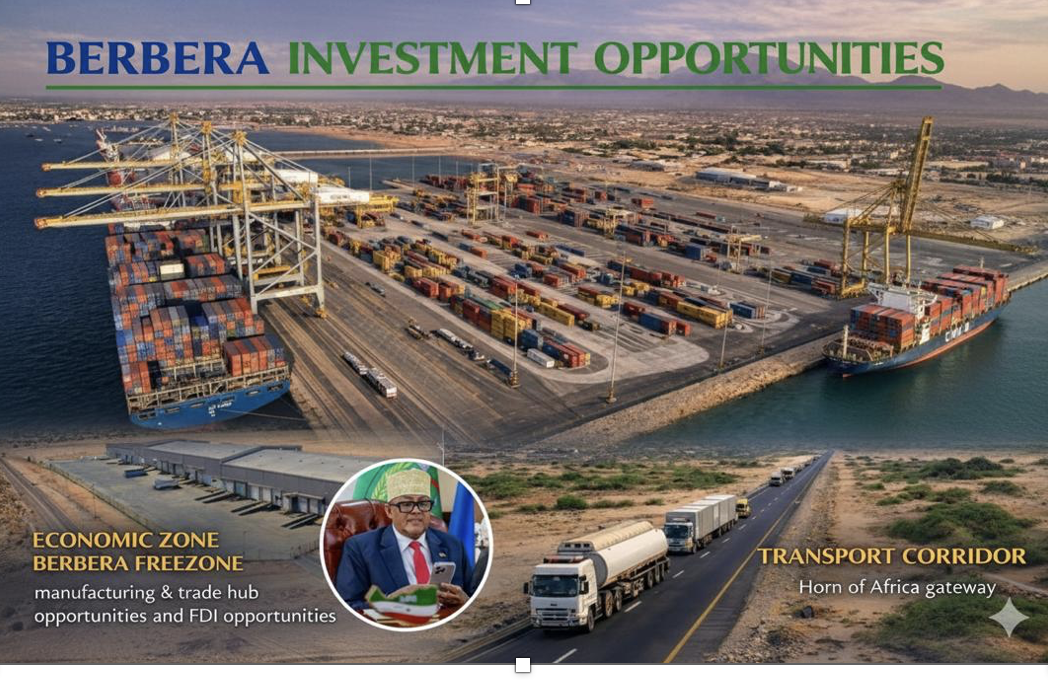
Berbera, a historic coastal city on the Gulf of Aden, is entering a pivotal phase marked by growing international attention and recent recognition by Israel. Strategically positioned along key global trade, energy, and security routes, Berbera places Somaliland at the center of regional and global geopolitical interest. Its port and long airstrip give it growing importance for logistics, maritime security, surveillance, and counter-terrorism, particularly as congestion and competition intensify in Djibouti. Amid instability in the Red Sea and Horn of Africa, Berbera is increasingly seen as a stable alternative base. Berbera Port is Somaliland’s economic backbone and an emerging regional trade hub. Its expansion has improved cargo capacity and efficiency, offering landlocked Ethiopia a vital alternative to Djibouti and strengthening regional trade integration. For Somaliland, the port generates jobs, revenue, foreign investment, and infrastructure development, reinforcing economic resilience despite the absence of international recognition.
Somaliland’s relative political stability, democratic institutions, and internal security distinguish it from failed Somalia, making Berbera its most valuable strategic asset and a key argument for international engagement. Historically, it has served as a major trade center linking Africa, the Middle East, and Asia. Beyond geopolitics, it remains a vibrant city reflecting Somaliland’s cultural identity.
Berbera: A Strategic Location with Global Potential
Berbera’s greatest strength is its strategic location at the intersection of major maritime routes connecting Africa, the Middle East, and Asia. This position makes it well-suited to become a logistics and services hub. The deep-water port, managed by DP World, has been modernized and expanded, enabling it to handle larger cargo volumes and compete directly with regional ports. Israel’s recognition of Somaliland has elevated Berbera’s global profile, adding legitimacy and opening doors to diplomatic ties, partnerships, and foreign direct investment. This development could encourage further recognition and boost investor confidence, accelerating economic activity and international engagement. For centuries, Berbera functioned as a major trading hub, facilitating commerce in goods such as frankincense, myrrh, and livestock between Africa and the Arabian Peninsula.
Challenges on the Ground (Skilled Labor, Poor Energy, Infrastructure, Local Investments & Globalization)
Rapid investment has increased demand for skilled workers, but Berbera faces shortages in technical expertise, particularly in manufacturing, logistics, and services. Addressing this gap requires investment in education, vocational training, and foreign-language proficiency to support international engagement. Unreliable and underdeveloped electricity infrastructure limits industrial growth and raises business costs. Investment in renewable energy, especially solar and wind, along with grid modernization is essential. Major investments signal growing confidence in Berbera’s potential. DP World’s port expansion has transformed regional trade and supported the Berbera Corridor linking Ethiopia to the port. UAE-based IFFCO has established a manufacturing plant, while local companies such as Horn Cement, Omar Edible Oil, and Som Tuna are driving job creation, value addition, and export growth. Infrastructure development is central to Berbera’s transformation.
The Berbera Corridor enhances trade efficiency with Ethiopia and Somaliland western regions, while urban investments in roads, housing, and utilities support population growth and industrial expansion. As Berbera integrates into the global economy, English and Arabic languages proficiency is increasingly vital. Strengthening foreign languages education enables the workforce to engage effectively with international investors, partners, and markets. Somaliland’s relative peace and security provide Berbera with a strong competitive advantage in an unstable region. Maintaining law enforcement capacity and regional cooperation is essential to preserve investor confidence.
Conclusion: A City on the Rise
Berbera’s trajectory mirrors global success stories. Dubai leveraged infrastructure and location to become a global hub; Singapore focused on education, stability, and English proficiency; Djibouti capitalized on its strategic Red Sea position; Mauritius diversified its economy through stability and services; and Rwanda invested in governance, infrastructure, and human capital to attract investment. These cases demonstrate how strategic planning can transform regions. With the support of local authorities and other stakeholders, the Somaliland central government can jointly develop a strategic plan to guide Berbera’s transformation and address current challenges.
Berbera stands on the threshold of major transformation. Its strategic location, historical role, and rising international recognition position as a potential global logistics and investment hub. However, success depends on addressing skilled labor shortages, energy constraints, and infrastructure gaps while maintaining security and stability. By learning from global examples and building on current investments, Berbera can unlock its full potential and emerge as a beacon of opportunity in the Horn of Africa.
About the author:
Mukhtar Mahdi is a dedicated humanitarian worker with extensive experience in education and community development. He has committed his career to empowering communities through innovative educational programs and sustainable development initiatives with successful implementation of numerous educational and community projects aimed at providing access to quality learning and community resilience for underserved populations
Mukhtar holds a master’s degree in International Humanitarian Aid and a master’s degree in Internation Relations. Mukhtar is also certified project planning and management. Mukhtar is actively involved in community development projects that foster collaboration and resilience among Somali communities which leads to sustainable improvements in living conditions and economic opportunities.
The views expressed in this article are the author’s own and do not necessarily reflect the Horndiplomat editorial policy.
If you want to submit an opinion piece or an analysis, please email it to Opinion@horndiplomat.com
Horndiplomat reserves the right to edit articles before publication. Please include your full name, relevant personal information and political affiliations