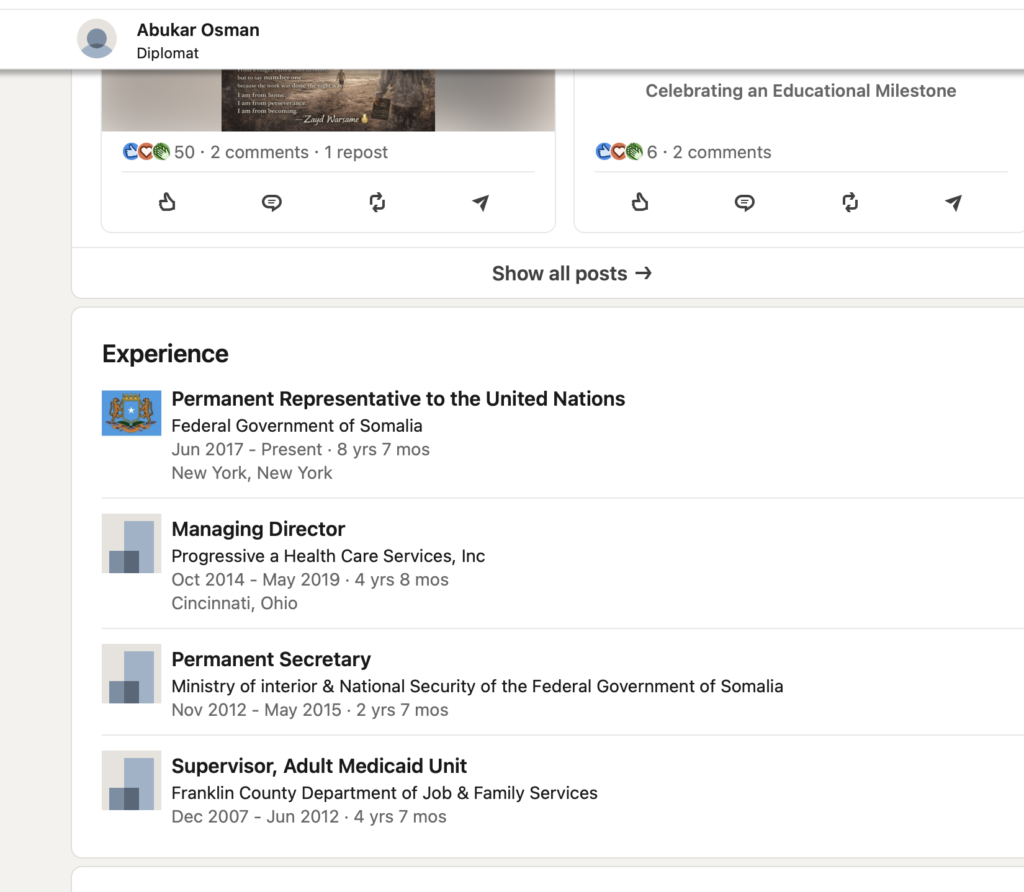
NEW YORK / CINCINNATI — Public corporate filings and professional records have raised questions about transparency and potential conflicts of interest involving Abukar Dahir Osman, Somalia’s Permanent Representative to the United Nations.
The scrutiny comes as Somalia prepares to assume the rotating presidency of the United Nations Security Council on January 1, 2026, a role that places the country at the center of global diplomatic decision-making on peace, security and sanctions.
Ohio state corporate records show that Osman was listed as the statutory agent for Progressive Health Care Services Inc, a Cincinnati-based home healthcare company, while simultaneously serving as Somalia’s top diplomat at the United Nations.
Filings with the Ohio Secretary of State, electronically submitted on October 22, 2018, identify Osman as the company’s agent. He had been appointed Somalia’s UN ambassador in June 2017, creating an overlap of nearly two years between his diplomatic role and his involvement with a U.S. healthcare provider operating within Medicaid-funded systems supported by U.S. taxpayers.
Professional records, including publicly available LinkedIn information, indicate Osman served as Managing Director of Progressive Health Care Services Inc. from 2014 until May 2019, alongside his UN posting in New York.
The overlap has drawn attention because the U.S. home healthcare sector has repeatedly been identified by federal authorities as one of the areas most vulnerable to fraud, abuse and improper billing.
That vulnerability was highlighted by a sweeping fraud scandal in Minnesota, one of the largest public-assistance fraud cases in U.S. history. In an investigation reported by The New York Times, federal prosecutors charged dozens of people with felonies, accusing them of stealing hundreds of millions of dollars from a government program designed to keep children fed during the COVID-19 pandemic.
According to that reporting, law-enforcement officials said fraud took root in pockets of Minnesota’s Somali diaspora, where individuals established companies that billed state agencies for millions of dollars in social services that were never provided. Federal prosecutors have said 59 people have been convicted so far, and that more than $1 billion in taxpayer funds was stolen across three major investigations—an amount exceeding Minnesota’s annual corrections budget.
Prosecutors and state officials have emphasized that such crimes reflect the actions of specific individuals and organizations, not communities as a whole.
Against that broader backdrop, regulatory and compliance records show that Progressive Health Care Services Inc.was subject to billing and compliance scrutiny in 2019. No publicly available court records show that Osman has been charged or convicted of any crime, and no judgment has established criminal liability against him.
Transparency advocates say the timing of the revelations has intensified attention.
“When a country is about to assume the presidency of the Security Council, unresolved questions about financial disclosures and overlapping roles inevitably draw closer scrutiny,” said a governance expert familiar with UN ethics standards.
Somalia’s assumption of the council presidency will place its UN mission in charge of setting agendas, chairing meetings and representing the Security Council before the wider UN membership.
There was no immediate response from Osman or Somalia’s UN mission to requests for comment.
The United Nations maintains an internal ethics framework governing conflicts of interest among senior officials, though oversight of permanent representatives largely depends on disclosures made by member states themselves.
Observers say the case underscores a broader debate over whether diplomatic status should shield officials from scrutiny when regulated industries and taxpayer-funded programs are involved.