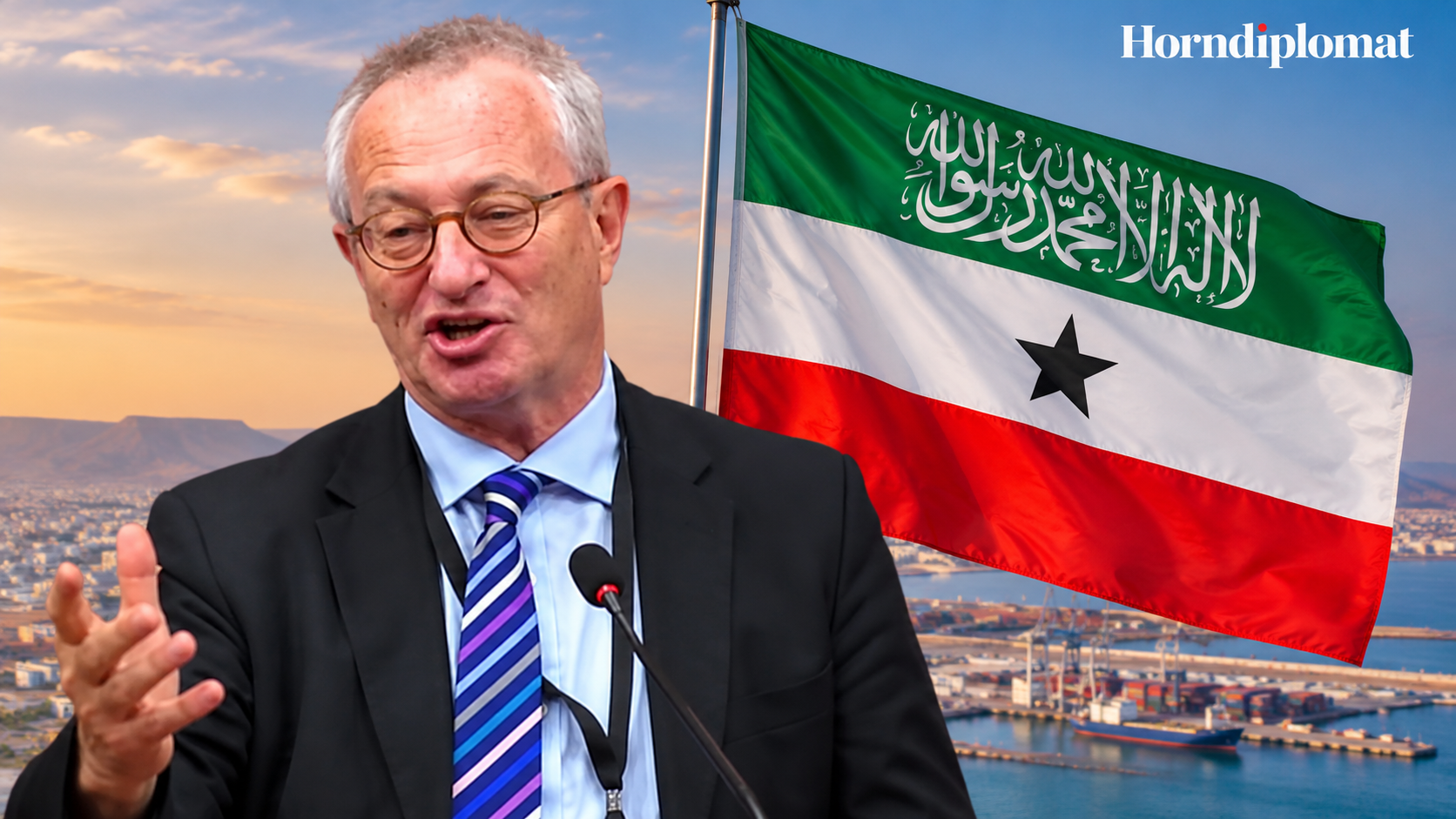
LONDON, Oct. 20, 2026 — British House of Lords member Lord Stuart Polak has urged international investors to look more closely at Somaliland, citing its political stability, expanding infrastructure and growing economic opportunities during an address at the Somaliland Investment Summit in London.
Polak, who has visited Somaliland several times over the past five years, said the country had made considerable progress in building political and economic institutions, while international perceptions were beginning to change.
“The story of Somaliland is no longer a dream. It’s a dream about potential. It’s actually real. It’s about now what we can do and what happens next,” he told the summit.
“For years the question was whether Somaliland could build a stable political economic foundation in one of the world’s most difficult regions. But it did. And the question is now what that foundation can support.”
Polak said Somaliland had reached a stage where attention should shift from its political and economic potential to the opportunities already available to international businesses.
“Investors do not invest in maps. They invest in people, infrastructure, institutions and markets,” he said.
He identified Somaliland’s young population as a major economic asset, describing its people as ambitious, entrepreneurial and increasingly connected to international markets.
“Its young people in my view are ambitious, entrepreneurial and hungry for opportunity,” Polak said.
He said the widespread use of English in business and education offered international companies access to a workforce capable of operating in global markets.
“When you invest in a country, you’re not only investing in roads and ports and natural resources. You’re investing in the people and the people who will operate them,” he said.
Polak said young Somalilanders were seeking opportunities to establish businesses, expand trade and attract foreign investment rather than simply secure employment.
“There’s a generation here that doesn’t only want jobs. It wants to build companies. It wants to trade. It wants to connect Somaliland to the world and it wants international capital to be part of that story,” he said.
The British lawmaker also pointed to Somaliland’s democratic institutions and peaceful political transitions as important factors in building investor confidence.
He cited the November 2024 presidential election, in which the incumbent accepted defeat and opposition candidate Abdirahman Mohamed Abdillahi assumed office following a peaceful transfer of power.
Polak said the election demonstrated the strength of Somaliland’s institutions and their importance to long-term economic development.
“Continuity matters. The ability to resolve disputes matters,” he said.
Turning to regional trade, Polak highlighted Berbera Port’s strategic position on the Gulf of Aden and its growing importance as a commercial gateway to Ethiopia and other markets in the Horn of Africa.
“Somaliland sits in a place where the global economy really now cannot ignore,” he said.
He pointed to the expansion of Berbera Port, the development of the Berbera Economic Zone and the transport corridor connecting the port to Ethiopia.
“The port has expanded. The economic zone is operational. The corridor connects the port towards Ethiopia and the wider region,” Polak said.
The British peer, who has personally visited Berbera, said infrastructure improvements were creating opportunities for trade, logistics and international investment.
Polak also urged Somaliland’s Ministry of Finance to allocate funding for visits by foreign politicians and international delegations, arguing that firsthand experience was essential to understanding the country’s development.
“You need to make a budget to bring politicians from around the world to visit because at the moment people just heard of it but they’re not visiting,” he said.
Polak, who has repeatedly raised Somaliland’s case in the British House of Lords, also recalled attending events surrounding the opening of Somaliland’s embassy in Israel.
He said he had accompanied Somaliland’s president and members of his cabinet during the visit to Jerusalem and described the reception at the Israeli parliament as a significant diplomatic moment.
“What was really special was I was standing in the Israeli parliament and we were as the guests and I watched the president come through with the military bands and the speaker of the Israeli parliament,” he said.
“What was happening was Somaliland was being treated as a country as part of the world,” he added.
Polak expressed hope that the occasion would mark the beginning of further diplomatic engagement with other countries.
“My hope and prayer is that that’s just the beginning,” he said.
Somaliland restored its sovereignty in 1991 and has since established its own government, security institutions and electoral system. Its authorities have sought to attract foreign investment by promoting political stability, infrastructure development and access to regional markets through the strategically located Berbera Port on the Gulf of Aden.
(Reporting by Mohamed Duale; HornDiplomat News Desk)