

Somaliland President Offers U.S. Strategic Partnership in Hudson Institute Address

0
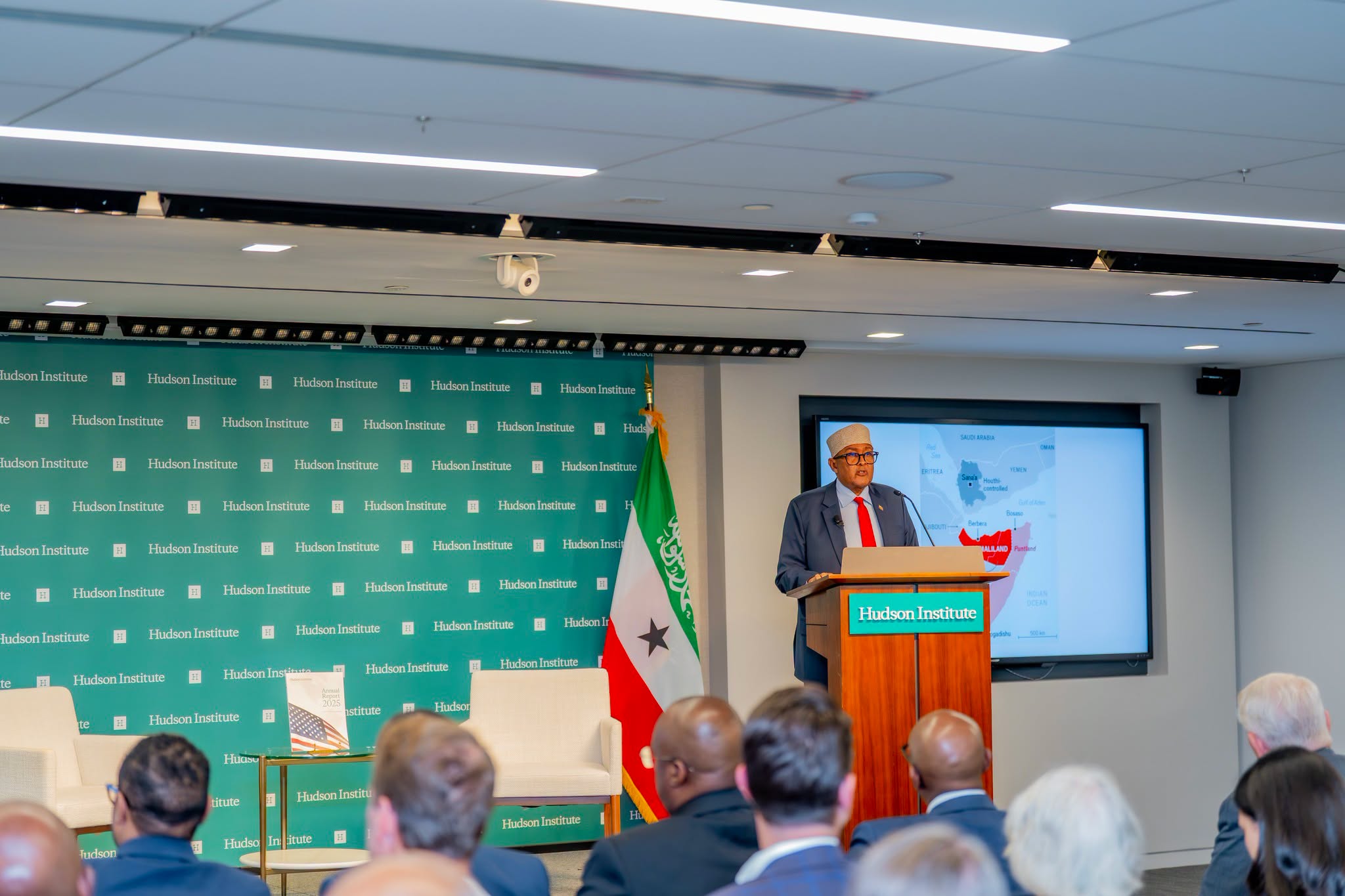
Somaliland President Abdirahman Mohamed Abdullahi addresses an audience at the Hudson Institute in Washington, outlining Somaliland’s strategic importance to the United States and the security of the Red Sea corridor.

By: Mohamed Duale

WASHINGTON, Sept. 15 (Horndiplomat) — Somaliland President Abdirahman Mohamed Abdullahi, known as Irro, presented his country as a stable and democratic strategic partner for the United States, citing its position near vital Red Sea shipping routes, security record and the modernised Port of Berbera.

In an address at the Hudson Institute in Washington, Abdullahi said closer cooperation would advance Somaliland’s development while giving Washington a dependable partner along the Gulf of Aden.

“Long-term cooperation between the two sides will bring development and regional stability to Somaliland, while providing the United States with a strategic advantage,” he said.

The speech, titled Somaliland as a Strategic Partner in the Horn of Africa, focused on regional security, trade, investment and Somaliland’s potential contribution to U.S. and allied interests in the Red Sea and Gulf of Aden.

Abdullahi said Somaliland had spent more than three decades building a functioning government, strong national institutions, a growing economy and a free-market system.

He pointed to a series of competitive elections and peaceful transfers of power as evidence of Somaliland’s democratic record.

Somaliland declared the restoration of its sovereignty in 1991 and secured a major diplomatic breakthrough when Israel formally recognised it as an independent and sovereign state on December 25, 2025.

“Somaliland is not seeking to redraw the borders left by colonialism; it is seeking to return to the borders it previously had,” Abdullahi said.

“Our case is not one of secession. It is based on the dissolution of a failed union and the restoration of our statehood within the internationally recognised colonial borders that existed before the 1960 union.”

Security, Berbera and the Red Sea Corridor

Abdullahi said Somaliland had protected its territory and coastline from militant groups and piracy despite operating for decades without international recognition.

“For 35 years, no American soldier has been harmed or attacked in Somaliland, and no American ship or aircraft has been threatened from our land or waters,” he said. “Somaliland will never become a sanctuary for groups hostile to the United States.”

The president said Somaliland could provide Washington with a stable and democratic partner in an area where foreign powers are competing for military, political and commercial influence.
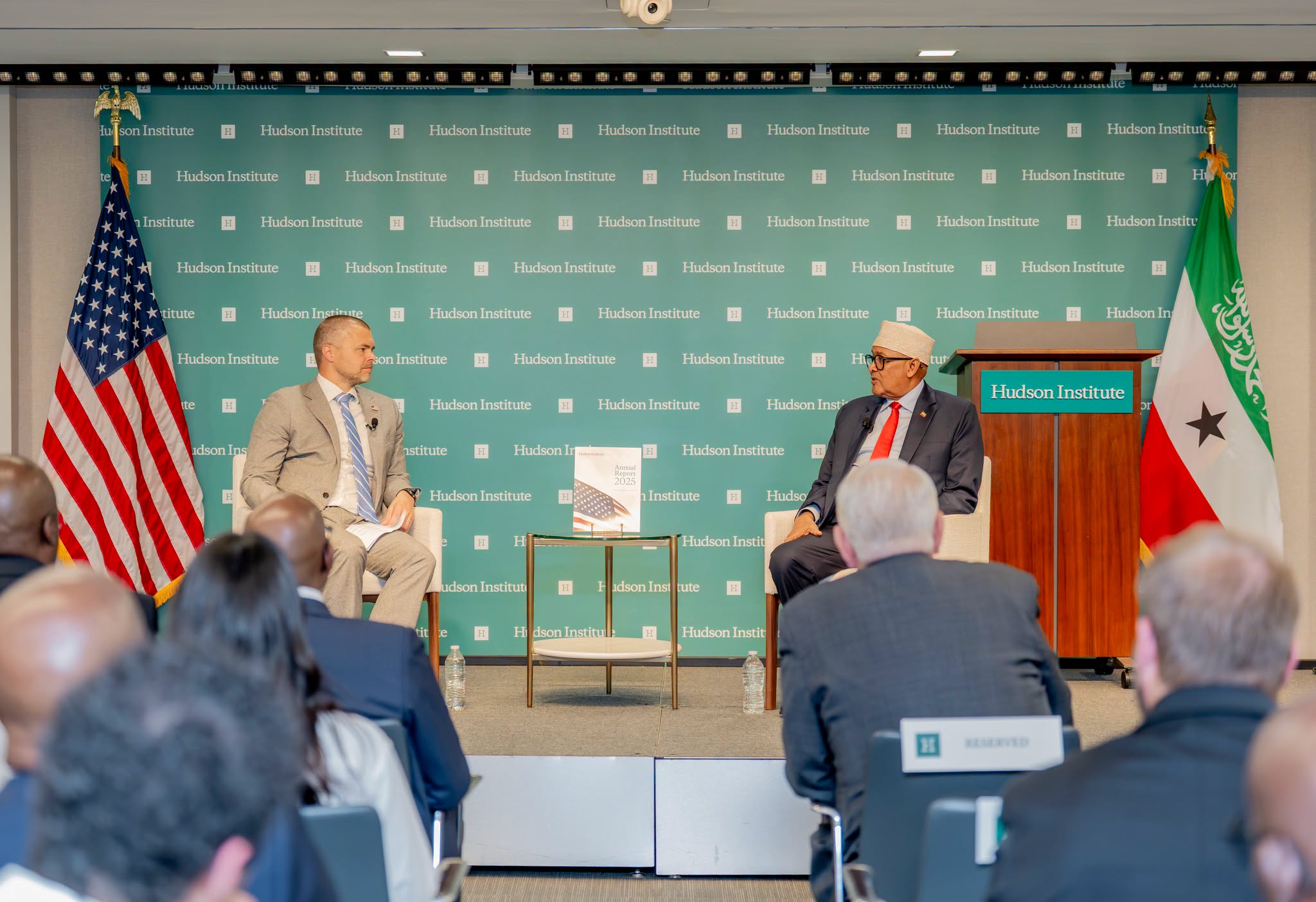
Somaliland President Abdirahman Mohamed Abdullahi participates in a discussion with Hudson Institute Senior Fellow Joshua Meservey following his keynote address in Washington. The U.S. and Somaliland flags are displayed on either side of the stage.

“Somaliland offers Washington a stable strategic base, a democratic partner committed to cooperation and close friendship with the West, while foreign forces compete around us and it remains unclear whose side Somalia is on,” he said.

He said geopolitical changes in the Horn of Africa and elsewhere had increased the alignment between Somaliland’s interests and those of the United States.

“Somaliland offers the United States an option and a dependable partner that it does not currently have on this coast,” Abdullahi said.

The president also criticised Somalia’s federal government, accusing it of lacking the legitimacy and capacity to exercise authority beyond Mogadishu and of using its internationally recognised sovereignty to obstruct Somaliland.

“The government of Somalia lacks the legitimacy and capacity to govern beyond Mogadishu and has become an epicentre of instability in the Horn of Africa,” he said.

“Somalia has not only failed to govern its people and territory; it has also used the sovereignty it possesses as a political weapon to isolate Somaliland.”

Abdullahi said Somaliland’s position on the Gulf of Aden gave it growing strategic importance for the security and stability of the Red Sea corridor.

“The strategic location of Somaliland on the Gulf of Aden is becoming increasingly important to the security, stability and movement of the Red Sea corridor,” he said.

He highlighted the country’s proximity to the Bab al-Mandab Strait, the narrow passage connecting the Red Sea with the Gulf of Aden and the wider Indian Ocean.

“Bab al-Mandab is one of the world’s most important commercial waterways. More than 12% of global maritime trade passes through it every day,” Abdullahi said.

Attacks on commercial vessels and wider regional tensions have disrupted shipping through the Red Sea, forcing some operators to divert vessels around southern Africa and increasing transport times and costs.

The president also promoted Berbera as a potential logistical and security partner for Washington.

“The Port of Berbera is a modern deep-water port that AFRICOM has assessed, and DP World has invested $442 million in it,” he said. “Berbera is a port ready for cooperation with and use by the United States government.”

Somaliland sits across the Gulf of Aden from Yemen, giving its coastline and port infrastructure potential importance for monitoring one of the world’s most contested maritime corridors.

Israel Recognition Signals Diplomatic Shift

Abdullahi cited Israel’s recognition of Somaliland as evidence that governments were beginning to reassess longstanding diplomatic positions in the Horn of Africa through the lens of shared security interests.

“Israel did not recognise Somaliland by accident. It recognised it as a political decision based on strategic interests, and it was the right decision,” he said.

“Israel’s recognition reflects a new shift towards the Horn of Africa, as governments move beyond outdated diplomatic practices and base their assessments on shared security interests.”

He described Somaliland and Israel as democratic countries situated at opposite ends of the Red Sea, with common interests in regional stability, prosperity and security.

“Somaliland and Israel are two democratic countries located at opposite ends of the Red Sea, working together for the stability, prosperity and security of the region,” Abdullahi said.

The president said pragmatic cooperation could benefit both Somaliland and the United States as competition intensifies over ports, trade routes and military influence around the Red Sea.

His address formed part of Somaliland’s broader diplomatic campaign in Washington, where his administration is seeking stronger political, economic and security relations with the United States.

“Long-term cooperation between the two sides will bring development and regional stability to Somaliland, while providing the United States with a strategic advantage,” Abdullahi said.

(Reporting by Mohamed Duale; Editing by Horn Diplomat Desk)

Leave a Reply