

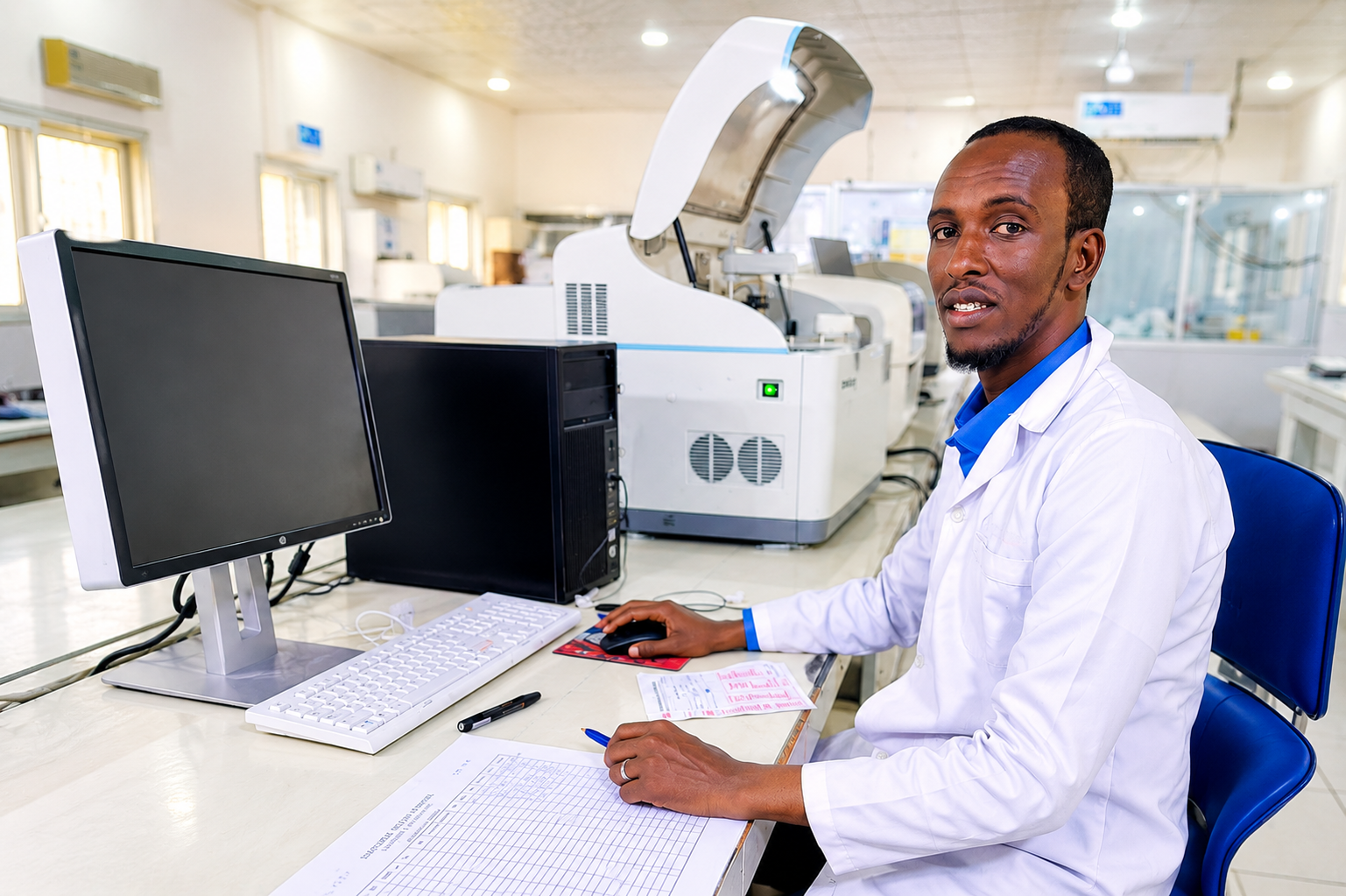
For twelve years, medical laboratory professional Abdilaahi Abdi Muse has helped connect patients with blood donors through volunteer networks. Today, his grassroots humanitarian effort has evolved into Badbaado Blood, a digital platform designed to speed up life-saving blood donations across Somaliland
By: Mohamed Duale
HARGEISA, Somaliland — When hospitals urgently need blood, every minute can mean the difference between life and death.
Across Somaliland, families confronted with medical emergencies often begin a frantic search for compatible blood donors, relying on relatives, friends and social media appeals while racing against time. In those moments, one name has quietly become familiar to doctors, hospitals and patients alike: Abdilaahi Abdi Muse, widely known as “Shicib.”
For more than a decade, Shicib has volunteered his time to connect patients with blood donors, building an informal network that has helped hundreds of people access life-saving transfusions. What began with Facebook posts and late-night phone calls has since evolved into Badbaado Blood, a mobile platform designed to connect patients, hospitals and volunteer blood donors in real time.
Unlike many digital health initiatives, the project was not launched through a government programme, international health organization or donor-funded initiative. Instead, it grew from years of volunteer work after Shicib repeatedly witnessed patients struggling to find compatible blood during medical emergencies.

Speaking to Horn Diplomat, Shicib said his journey began long before the application was developed. A medical laboratory professional with nine years of clinical experience, he has spent the last twelve years helping patients locate blood donors while promoting voluntary blood donation across Somaliland and beyond.
“For many years I have worked to ensure patients receive blood whenever they need it, using social media—especially Facebook—to search for volunteer blood donors.”
His work started in 2014, during his final year of secondary school, when he began responding to emergency requests from families unable to find compatible donors.
“I began this work during my final year of secondary school in 2014, and today I have continued it for twelve years.”
Over the years, what began as a personal initiative evolved into an extensive volunteer network connecting patients, hospitals and blood donors. Healthcare workers increasingly contacted him whenever blood supplies became scarce or patients required rare blood types.
“I have maintained strong relationships with doctors and hospitals across Somaliland, who contact me whenever they need blood for patients.”
His work became especially critical during periods of armed conflict and major emergencies, when hospitals suddenly required large quantities of blood.
“Whenever conflicts or violence occurred, there was an urgent need for large quantities of blood covering every blood type.”
Health workers regularly reached out to him for help locating compatible donors.
“Healthcare workers contacted me whenever they needed help finding different blood types for their patients.”
According to Shicib, he helped coordinate blood donations for 405 patients during 2024 alone, covering every major blood group, including A, B, AB and O, both positive and negative. Those requests came not only from Somaliland but also from Somalia, Ethiopia and Bangladesh, illustrating how volunteer networks can extend beyond national borders during medical emergencies.
Speaking to Horn Diplomat, Shicib said years of responding to emergency blood requests exposed a deeper structural challenge. Families often depended on personal contacts or public appeals because there was no centralized digital system capable of rapidly connecting patients with compatible volunteer donors.
That experience eventually inspired him to transform twelve years of practical experience into a technological solution.
“When I saw the enormous need for blood and realized Somaliland did not have a national blood bank, I decided to take on the responsibility of filling that gap.”
Drawing on the experience gained from thousands of interactions with patients, doctors and volunteers, Shicib developed Badbaado Blood, a mobile application designed to reduce the time required to locate compatible blood donors.
“After twelve years of experience, I created an application that connects patients who need blood with volunteer blood donors.”
The application allows hospitals and patients to submit emergency blood requests through the platform. Once verified, compatible donors receive notifications based on their blood type and location, enabling them to respond quickly during emergencies. Administrators monitor every request until the patient receives the required blood.
“Badbaado Blood is a digital platform that directly connects patients who need blood with volunteer blood donors.”
The platform also includes hospitals with blood banks across Somaliland and aims to expand its database to additional healthcare facilities throughout the country and neighboring states.
