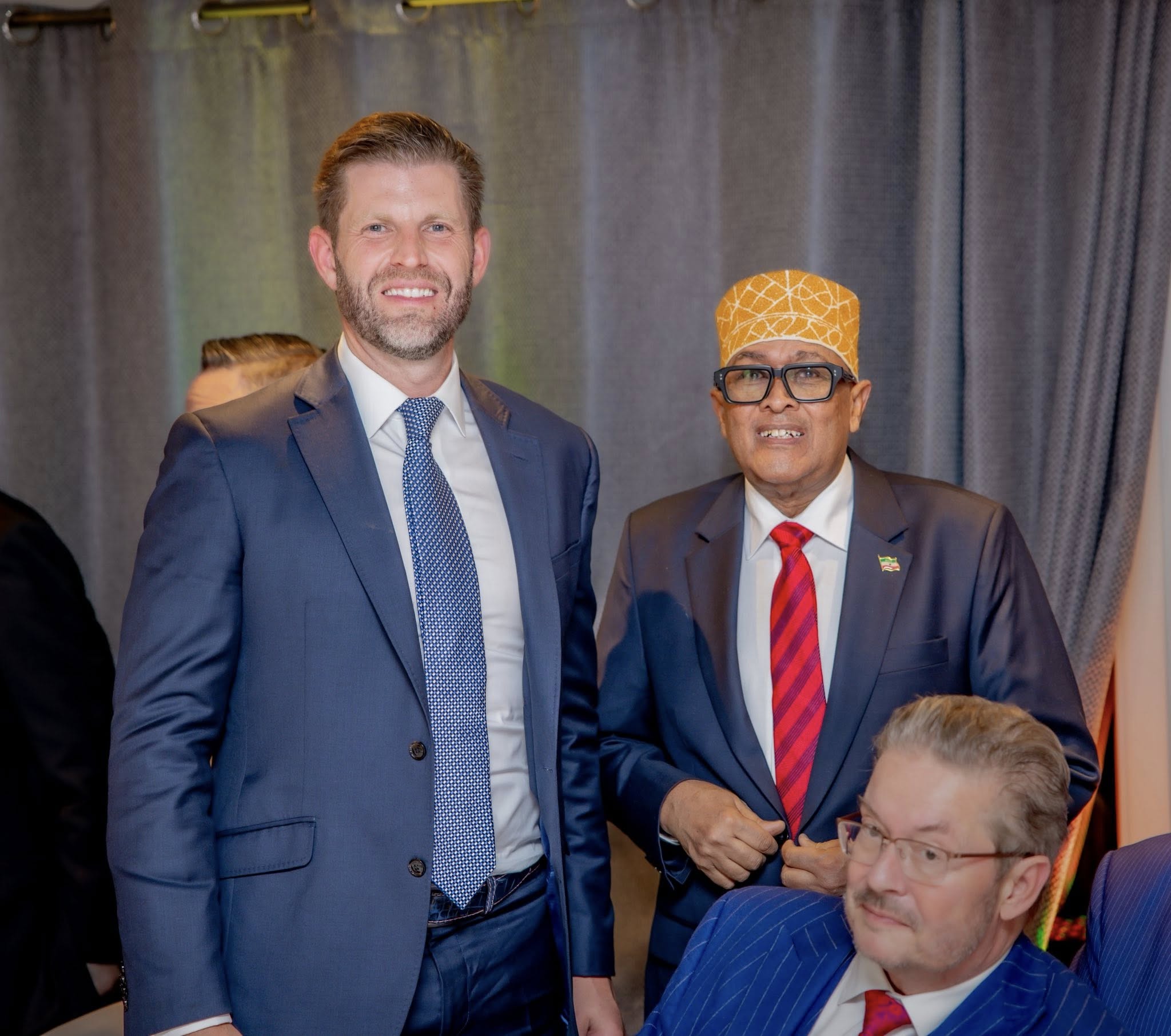
Somaliland President Abdirahman Mohamed Abdullahi, right, poses for a photo with Eric Trump, son of US President Donald Trump and a lead executive of the family’s cryptocurrency enterprise, on the sidelines of the World Economic Forum in Davos, Switzerland, January 21, 2026. (Abdirahman Mohamed Abdullahi via X)
By:Rooble Mohamed
A meeting between the President of republic of Somaliland Dr Abdirahman Mohamed Abdilahi and Eric Trump on the sidelines of the World Economic Forum in Davos should be understood neither as a ceremonial encounter nor as an immediate diplomatic breakthrough. Rather, it represents a calculated move within Somaliland’s evolving recognition strategy—one that prioritizes access, narrative positioning, and long-term influence over short-term announcements. In contemporary geopolitics, especially in recognition politics, outcomes are rarely produced by single events; they are the result of sustained exposure to power networks long before formal decisions are made.
Eric Trump does not hold public office and has no formal authority over U.S. foreign policy. However, his relevance lies in his proximity to power rather than in constitutional mandate. As the son of Donald Trump and a senior figure within the Trump family’s political and business ecosystem, he operates at the intersection of politics, capital, and influence. He has direct access to individuals who shape agendas, frame priorities, and influence presidential thinking—particularly within conservative and Republican-aligned circles. In recognition diplomacy, such informal influence often precedes official consideration, especially during periods of political transition.
Beyond politics, Eric Trump’s role within the Trump Organization connects him to global investors and business actors accustomed to operating in complex and frontier markets. For Somaliland, this dimension is critical. Recognition today is increasingly tied to economic relevance and strategic utility rather than legal arguments alone. Engagements that introduce Somaliland as a viable destination for infrastructure development, logistics, ports, hospitality, and branding help shift international perceptions from a “disputed territory” narrative toward that of a functioning, opportunity-bearing state. Davos, as a platform where political legitimacy and economic viability intersect, amplifies this effect.
Politically, the meeting advances Somaliland’s long-term objective of inserting itself into U.S. conservative policy and donor ecosystems that have historically been underutilized in Somaliland’s diplomacy. Washington is not a single actor; it is a contested arena where bureaucratic inertia often coexists with sudden political shifts. While traditional engagement with the State Department and multilateral institutions remains important, recognition decisions tend to crystallize when political leadership is receptive. In establishing familiarity within Trump-aligned networks now, Somaliland reduces the distance between itself and future decision-makers should political circumstances change.
At the level of the White House, the implications are necessarily indirect. Eric Trump cannot deliver recognition, policy change, or formal engagement. What he can do is normalize Somaliland’s case within the inner political discourse of a potential future administration. Recognition processes often begin not with policy memos, but with repeated informal exposure: a leader becomes known, a narrative is understood, and a strategic logic is internalized. When that moment arrives, Somaliland’s name is no longer unfamiliar, nor its claims abstract.
Strategically, this meeting fits into a broader recognition funnel that moves from awareness to familiarity, from familiarity to acceptance, and eventually—if conditions allow—to advocacy and decision. Somaliland has long cleared the awareness threshold; the challenge has been converting visibility into elite acceptance within decisive power circles. Elite-network diplomacy, of which this meeting is a clear example, is designed precisely to address that gap. It complements formal diplomacy rather than replacing it, offering an alternative pathway where bureaucratic channels have proven slow or resistant.
In sum, the significance of the Somaliland President’s meeting with Eric Trump lies in timing, access, and intent. It reflects a shift from reactive appeals for recognition toward proactive insertion into global power networks. In recognition politics, presence precedes influence, and influence precedes decision. This engagement does not deliver recognition—but it ensures that when political windows open, Somaliland is already in the room, already understood, and already part of the conversation.
About the Author
Rooble Mohamed
Hargeisa, Somaliland
Maritime Security Expert and Political Analyst
The views expressed in this article are the author’s own and do not necessarily reflect the Horndiplomat editorial policy.
If you want to submit an opinion piece or an analysis, please email it to Opinion@horndiplomat.com
Horndiplomat reserves the right to edit articles before publication. Please include your full name, relevant personal information and political affiliations