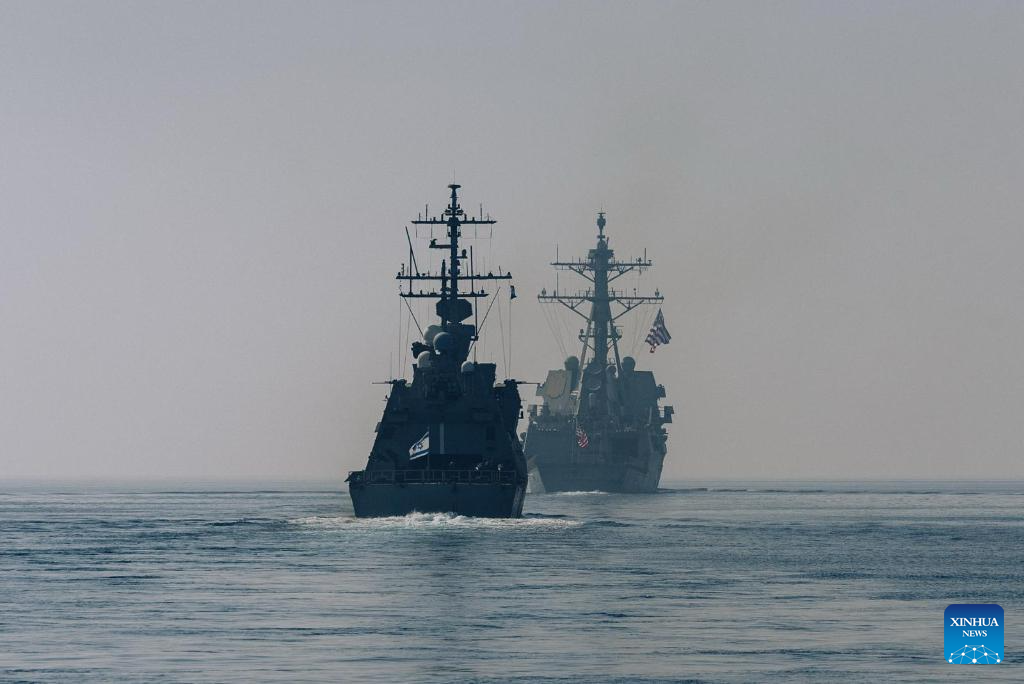
Israeli and U.S. naval forces participate in a joint drill in the Red Sea on Feb. 1, 2026. Israeli and U.S. naval forces held a joint drill in the Red Sea on Sunday, the Israeli military said Monday, highlighting strengthened maritime cooperation as regional tensions with Iran continue to rise. (Israel Defense Forces/Handout via Xinhua)
By:Rooble Mohamed
The recent joint naval exercise by Israel and the United States in the Red Sea carries significance well beyond routine military cooperation. Conducted along one of the world’s most strategically sensitive sea lanes, the drill highlights a convergence of security interests that now extends from the Eastern Mediterranean to the Bab al-Mandeb and the Gulf of Aden. Its implications touch regional deterrence, commercial shipping confidence, and—more quietly but importantly—the emerging geopolitical position of Somaliland.
At its core, the exercise reinforces freedom of navigation in a corridor that handles a substantial share of global trade. The Red Sea has become increasingly exposed to missile, drone, and small-craft threats, alongside long-standing piracy risks in nearby waters. By operating together in this environment, the Israeli Navy and the United States Navydemonstrate readiness to coordinate air-defense, surveillance, and maritime security tasks in a high-risk setting. For commercial operators, this kind of visible cooperation strengthens confidence that major naval powers retain both the capability and the political will to protect transit routes linking Europe, the Middle East, and Asia.
The exercise also serves a calibrated deterrent function. It signals to potential disruptors that attacks on shipping or naval units would encounter a coordinated response, while stopping short of overt escalation. This balance—assertive but defensive—has become a hallmark of naval signaling in contested waterways, where the objective is stability rather than confrontation.
Within this broader picture, the exercise has secondary but meaningful relevance for Somaliland, particularly in the context of Israel’s recent move toward recognizing the territory. Somaliland sits astride the Gulf of Aden approaches, close to the Bab al-Mandeb chokepoint, giving it outsized geostrategic value relative to its size. Enhanced naval activity by Israel and the United States in adjacent waters elevates the importance of reliable coastal partners and secure port infrastructure along the southern Red Sea and western Gulf of Aden littoral.
For Somaliland, this environment creates several potential benefits. First, increased international naval focus on the region reinforces the security of sea lines near its coastline, which is essential for port development and maritime trade ambitions. Second, closer alignment with Israel—now complemented by visible Israeli-U.S. naval cooperation—could translate into greater diplomatic attention and security engagement from Western partners who prioritize stability around Bab al-Mandeb. Even without formal basing arrangements, improved maritime domain awareness and information-sharing in nearby waters indirectly strengthen Somaliland’s own security posture.
There is also a signaling effect. Recognition by Israel, followed closely by a high-profile joint exercise in the Red Sea, subtly elevates Somaliland’s standing as a relevant actor in Red Sea security discussions. In a region where legitimacy and visibility matter, being adjacent to a maritime space increasingly patrolled and exercised by major navies can help Somaliland position itself as a constructive partner rather than a peripheral territory.
Taken together, the joint Israeli-U.S. naval exercise underscores a wider shift toward cooperative security in the Red Sea. It reassures global shipping, reinforces deterrence against maritime threats, and, in the evolving geopolitical landscape of the Horn of Africa, indirectly strengthens the strategic relevance of coastal actors like Somaliland at a moment when international recognition and partnerships are gaining momentum.
About the Author
Rooble Mohamed
Hargeisa, Somaliland
Maritime Security Expert and Political Analyst
The views expressed in this article are the author’s own and do not necessarily reflect the Horndiplomat editorial policy.
If you want to submit an opinion piece or an analysis, please email it to Opinion@horndiplomat.com
Horndiplomat reserves the right to edit articles before publication. Please include your full name, relevant personal information and political affiliations