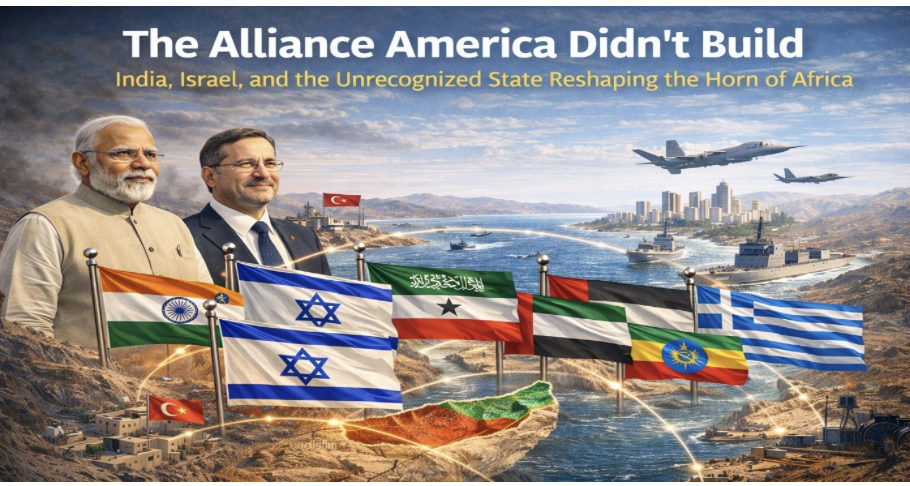
In late February 2026, Indian Prime Minister Narendra Modi and Israeli President Isaac Herzog both touched down in the region on February 25, 2026—Modi in Jerusalem for a two-day visit and Herzog in Addis Ababa for consultations with Ethiopian leadership. Viewed separately, these engagements appeared as routine bilateral diplomacy. Examined together—and situated within the broader strategic realignment underway in the Horn of Africa—they reveal the deliberate construction of a counter-alignment architecture that extends India’s Indo-Pacific strategy westward into the Red Sea corridor, with profound implications for regional power dynamics.
This emerging network, which connects India, Israel, Greece, Cyprus, the UAE, Ethiopia, and critically, Somaliland, into a functional security arrangement, represents a strategic pivot that challenges conventional understandings of Indo-Pacific geography. The February- 2026 diplomatic sequence demonstrates that New Delhi is constructing autonomous strategic capacity that operates independently of, yet complements, U.S. regional frameworks. For policymakers in Washington, Tokyo, and Brussels, this development demands attention: the counter-alignment offers both opportunity for burden-sharing and risk of strategic divergence if misinterpreted or resisted.
The Adversarial Context: Why the Counter-Alignment Emerged
The strategic logic driving this realignment reflects hardheaded assessments of emerging threats that have achieved operational maturity in the Horn of Africa. The Turkey-Pakistan-Saudi axis operating through Somalia’s governance vacuum has established drone infrastructure, intelligence fusion capabilities, and logistical networks that directly threaten Indian Ocean sea lines of communication and Israeli maritime access to the southern Red Sea.
I analyzed this threat convergence in “India vs Türkiye–Pakistan alliance: The battle for the Horn of Africa” (News.az, January 20, 2026, https://news.az/news/-india-vs-turkiye-pakistan-alliance-the-battle-for-the-horn-of-africa/), arguing that Turkish drone infrastructure, Pakistani intelligence externalization, and Saudi financing created permissive environment for power projection that constrained regional strategic freedom. This analysis, published before the Modi and Herzog visits, warned that the axis would “constrain Indian strategic freedom, compress Israeli security margins in the Red Sea, and destabilize Gulf security balances to the detriment of the UAE.”
Turkey maintains its largest overseas military base in Mogadishu, transforming Somalia from aid-dependent recipient into operational launchpad. Ankara has deployed Bayraktar TB2 drones, missile experimentation facilities, and long-range strike support systems that compress Israeli early-warning margins and threaten Indian naval mobility. The Bayraktar’s demonstrated effectiveness in Ukraine, Libya, and the South Caucasus has made it a preferred platform for power projection, and its presence in Somalia—unconstrained by NATO membership considerations—allows Turkey to test capabilities and doctrine that would face scrutiny elsewhere.
Pakistani military personnel embed in training programs, intelligence coordination units, and rapid-response exercises, gaining operational depth beyond South Asia and transforming Islamabad from bilateral adversary into networked threat. This externalization serves multiple purposes: it relieves pressure on Pakistan’s eastern border with India, provides operational experience in maritime environments, and establishes intelligence collection capabilities targeting Western naval movements and commercial traffic.
Saudi financing, while partially redirected by regional reconciliation efforts including the 2023 Iran-Saudi détente, sustains sufficient flow to maintain Turkish-Pakistani presence and ensure operational sustainability. Riyadh’s calculations appear driven by desire to maintain influence in Horn of Africa dynamics, counter Iranian penetration, and preserve options for future regional alignment shifts.
This convergence institutionalizes Turkey’s pro-Pakistan posture, extends Pakistani operational relevance into the Indian Ocean theater, and constrains strategic freedom for India, Israel, and the UAE. It also creates a permissive environment for Al-Shabaab and ISIS-Somalia that undermines regional stability and complicates counter-terrorism cooperation. The axis transforms the Horn of Africa from peripheral concern into central theater of strategic competition, elevating Pakistan from South Asian adversary into node of broader security network with reach into maritime chokepoints critical to global commerce.
Against this backdrop, the counter-alignment emerges as strategic necessity rather than aspirational construct. It represents a networked response to prevent uncontested adversarial dominance of maritime chokepoints that carry approximately 12 percent of global trade and substantial energy flows to Europe and Asia.
Modi’s Jerusalem Mission: Consolidating the Northern Tier
Modi’s February 25-26, 2026 visit to Israel established the technological and operational foundation upon which the broader counter-alignment rests. This was not ceremonial diplomacy but functional consolidation of capabilities essential for network activation.
The specific achievements validate assessments of India-Israel technological-strategic depth developed over decades of quiet cooperation. Missile defense systems integration—specifically Barak-8 naval and land-based variants—addresses the drone threat posed by Turkish unmanned platforms in Somalia. Electronic warfare and signals intelligence cooperation, leveraging Israel’s Unit 8200 capabilities and India’s growing indigenous capacity, enables real-time monitoring of adversarial communications across the Red Sea corridor. Cyber capabilities development protects critical infrastructure from Pakistani externalized operations, including potential targeting of port management systems and maritime logistics databases.
Joint research on advanced defense systems—hypersonic glide vehicles, directed energy, artificial intelligence applications—creates long-term technological interdependence that transcends transactional alliance. The February 2026 discussions reportedly advanced specific projects that had been in development since the 2020 normalization of relations between Israel and the UAE, suggesting that the India-Israel partnership now operates within broader regional frameworks rather than bilateral isolation.
Critically, the Jerusalem discussions operationalized Somaliland recognition strategy. Maritime security protocols for Berbera Port, including potential Indian naval logistics access; intelligence-sharing frameworks for Red Sea monitoring coordinated with Israeli and UAE assets; diplomatic timelines for coordinated recognition announcements; and joint infrastructure development at the Ethiopia-Somaliland corridor transformed theoretical counter-alignment into actionable planning. These were not aspirational commitments but operational preparations for southern tier extension, with specific benchmarks and responsibility assignments.
The Eastern Mediterranean dimension proved equally consequential. Trilateral maritime security agreements with Greece and Cyprus, energy cooperation frameworks addressing Eastern Mediterranean gas discoveries, and coordinated positions on regional security architecture created structural connectivity between Indian Ocean and Mediterranean operational theaters. This northern tier consolidation—technological, operational, and strategic—provided essential foundation for subsequent Horn of Africa activation and demonstrated that India’s westward pivot is structural rather than symbolic, representing permanent reorientation rather than tactical adjustment.
Herzog’s Addis Mission: Southern Tier Activation
Herzog’s February 2026 Ethiopia visit, occurring approximately days after Modi’s Jerusalem mission, represented deliberate southern tier extension. The temporal separation reflects operational sequencing: northern capabilities established before southern expansion, technological foundations laid before geographic activation, and diplomatic preparation completed before operational commitment.
The Ethiopia-Somaliland Memorandum of Understanding, concluded in January 2024 and operationalized through sustained bilateral engagement despite regional pressure and African Union criticism, provided legal framework for this extension. I defended this arrangement in “Ethiopia-Somaliland MoU: Pragmatic Maritime Solution, Not Diplomatic Setback” (Addis Standard, March 25, 2025, https://addisstandard.com/ethiopia-somaliland-mou-pragmatic-maritime-solution-not-diplomatic-setback/), arguing that the MoU creates “operational legitimacy for international investment in Somaliland port infrastructure” and “strategic depth reducing dependence on Djibouti.” Herzog’s mission operationalized this bilateral arrangement into multilateral strategic infrastructure.
The MoU’s specific provisions include Ethiopian commercial maritime access through Berbera, potential naval facility arrangements, and infrastructure corridor development connecting Addis Ababa to the coast. Herzog’s mission transformed this bilateral arrangement into multilateral strategic infrastructure through Israeli technical assistance for corridor security, port modernization, and intelligence cooperation along the Ethiopia-Somaliland axis. Israeli companies with experience in port security technology, surveillance systems, and logistics management are reportedly positioned for contracts that would embed operational presence with long-term durability.
The Berbera inspection component carried particular significance. This port—systematically superior to Assab alternatives in Eritrea due to democratic stability, pro-Western orientation, active infrastructure modernization through DP World investment, and strategic location at the Bab el-Mandeb entrance—provides the operational anchor that makes counter-alignment geographically coherent. I analyzed this comparative advantage in “Assab vs Berbera: Weighing Ethiopia’s Legal, Operational Options for Maritime Access” (Addis Standard, December 2, 2025, https://addisstandard.com/assab-vs-berbera-weighing-ethiopias-legal-operational-options-for-maritime-access/), demonstrating why Berbera’s democratic governance and pro-Western orientation make it “central operational node” for counter-alignment activities.
Unlike Eritrean options compromised by authoritarian governance, international isolation, and China-leaning orientation, Berbera offers reliable partnership for Western-aligned strategic purposes with governance predictability that reduces operational risk.
Herzog’s direct engagement with Berbera corridor planning, including inspection of port facilities and route security arrangements, signaled irreversible Israeli commitment to this operational hub. The six-week interval following Modi’s visit allowed coordination of Indian technological capabilities with Israeli operational presence, creating integrated rather than parallel engagement. This sequencing demonstrates deliberate network construction rather than coincidental bilateralism, with each mission preparing conditions for the next and cumulative effect exceeding sum of bilateral parts.
Somaliland: The Operational Pivot
Somaliland’s centrality to this architecture exposes both its strategic value and the contradictions of international diplomacy. Functionally, it possesses stable democratic governance with multiple peaceful transfers of power, effective territorial control including monopoly of violence throughout claimed territory, rule of law with independent judiciary and functioning civil service, and anti-terrorism cooperation that exceeds recognized states in the region. Diplomatically, it remains invisible—punished for successful self-determination while failed Somalia receives international support despite hosting Turkish drones, Pakistani intelligence, and terrorist networks.
I examined this governance differential in “How Somaliland Outsmarted Turkey in the Horn of Africa” (Horn Diplomat, January 11, 2026, https://www.horndiplomat.com/2025/01/11/how-somaliland-outsmarted-turkey-in-the-horn-of-africa/), demonstrating that unlike Somalia where Turkey operates freely through governance vacuums, Somaliland’s stable governance prevents adversarial penetration while enabling allied access.
The contrast is stark and growing more acute. Somalia’s federal government controls Mogadishu with international assistance but little else; Al-Shabaab operates freely in much of the south; Turkish and Pakistani presence proceeds without governance constraints. Somaliland, meanwhile, has prevented terrorist penetration, maintained border security, and developed institutional capacity that meets or exceeds many recognized states. Yet it lacks access to international financial institutions, development assistance, and security partnerships that could strengthen its position and, by extension, regional stability.
Geographic positioning at the southern Red Sea and Bab el-Mandeb chokepoint provides control of maritime artery connecting Europe and Asia through which approximately 30 percent of global container traffic passes. Recognition-ready status creates diplomatic opportunity without great power entanglement complications—Somaliland seeks partnership, not patronage, and offers reliable alignment rather than hedging behavior. Anti-terrorism reliability—active cooperation against Al-Shabaab and ISIS-Somalia, intelligence sharing, and territorial denial—contrasts with Mogadishu’s compromised security environment where terrorist taxation of commerce proceeds unchecked.
The February- 2026 sequence specifically advanced Somaliland’s integration into counter-alignment operations. Modi’s Jerusalem discussions established technological protocols for port security and maritime monitoring, including potential Indian naval presence. Herzog’s Addis mission extended operational commitment to corridor infrastructure, with Israeli technical assistance creating capabilities that would interoperate with Indian systems. Combined, these missions positioned Somaliland as functional node rather than theoretical possibility, creating facts on the ground that precede and may accelerate formal diplomatic recognition.
Israeli operational presence—technical advisors reportedly arriving by March 2026, intelligence cooperation protocols activated, infrastructure investment generating employment and stakeholder relationships—has generated “irreversibility” that transforms bilateral engagement into structural mutual dependence. I examined this dynamic in “Israel–Somaliland: Recognition & Irreversibility” (The Times of Israel, January 8, 2026, https://blogs.timesofisrael.com/author/gulaid-yusuf-idaan/), arguing that Israeli recognition creates structural precedent that “legitimizes subsequent Indian recognition” and makes counter-alignment activation “a matter of timing rather than possibility.”
Israeli withdrawal would now carry significant costs, both operational and reputational, creating commitment that transcends immediate transactional calculation.
Indian recognition preparations, signaled through explicit coordination on Berbera Port protocols and diplomatic messaging emphasizing “exploring all options for partnership with stable regional actors,” suggest follow-through that would legitimize the network through formal diplomatic architecture. For Washington, which maintains counterproductive insistence on Somali territorial integrity, these developments present opportunity disguised as complication: strategic influence through partner initiative rather than direct intervention, burden-sharing without alliance obligations, and regional stability without military commitment.
Implications for Indo-Pacific Strategy
The counter-alignment activated through February- 2026 sequencing extends India’s strategic horizon beyond traditional Indo-Pacific boundaries. For decades, New Delhi’s maritime strategy focused eastward—South China Sea, Malacca Strait, Quad partnerships with the United States, Japan, and Australia. The westward pivot into the Red Sea and Horn of Africa represents recognition that India’s economic growth, energy security, and geopolitical autonomy depend equally on securing western maritime approaches that carry hydrocarbons from the Persian Gulf and commerce to European markets.
I traced this pivot in “From Addis to Berbera: India’s strategic pivot in Horn of Africa” (Addis Standard, December 29, 2025, https://addisstandard.com/from-addis-to-berbera-indias-strategic-pivot-in-horn-of-africa/), arguing that Modi’s December 2025 Ethiopia visit “served as a precursor to India’s strategic engagement with Somaliland” and positioned the Horn of Africa “within India’s extended Indo-Pacific framework.”
This reorientation carries significant implications for U.S. Indo-Pacific strategy. Washington has sought to integrate India into broader regional architecture through the Quad, defense technology transfer, and strategic dialogue; the counter-alignment demonstrates New Delhi’s capacity for autonomous strategic initiative that complements rather than awaits U.S. coordination. This is not rejection of American partnership but expansion of strategic options that enhance India’s bargaining position and operational flexibility, creating multidirectional rather than unidirectional dependence.
The UAE’s role as financial-logistical hub, providing investment capital and diplomatic cover in Arab League contexts; Greece and Cyprus as Mediterranean connectors, enabling Eastern Mediterranean energy and security coordination; and Israel as technological enabler, offering advanced capabilities and intelligence integration—create network redundancy that reduces dependence on any single partner, including the United States. This distributed architecture offers resilience that hub-and-spoke alliance structures cannot match, but also complicates American efforts to coordinate regional strategy.
For China, the counter-alignment presents structured resistance to Belt and Road expansion. Djibouti, site of China’s first overseas military base established in 2017 and substantially expanded since, faces alternative port infrastructure at Berbera that reduces regional dependence on Beijing-controlled facilities. The Ethiopia-Somaliland corridor offers Ethiopia diversification from overreliance on Djibouti, where Chinese influence has grown concerning. The Turkey-Pakistan-Saudi axis, often viewed as complementary to Chinese interests in complicating Indian Ocean security, now encounters coordinated counter-presence that raises costs for uncontested power projection.
The Quad remains central to Indo-Pacific strategy, and Indian officials emphasize that counter-alignment activities strengthen rather than substitute for Quad partnerships. But the counter-alignment demonstrates that India’s strategic vision extends beyond Quad frameworks, constructing partnerships that address threats and opportunities outside traditional Indo-Pacific geography. This expansion creates both opportunities for burden-sharing and risks of strategic divergence if Washington fails to recognize and engage with initiatives that proceed without American leadership.
Trajectories and Thresholds
The counter-alignment establishes template for regional security architecture that transcends traditional alliance models. Functional network structure—interest-driven, operationally focused, non-institutional, adaptable—provides responsiveness that treaty-based blocs cannot achieve. This matters for durability: networks can adjust composition and emphasis as threats evolve, without institutional rigidities that constrain formal alliances through bureaucratic inertia and consensus requirements.
The trajectory points toward formalized Indian recognition of Somaliland as threshold achievement completing counter-alignment institutionalization. Technical preparation through February- 2026 missions establishes operational foundation; diplomatic announcement would provide legal framework for expanded cooperation, signal irreversible commitment to network architecture, and likely trigger recognition by other counter-alignment members including Greece, Cyprus, and potentially the UAE. This cascade would transform regional diplomatic geometry regardless of African Union or broader international acceptance.
Adversarial response remains uncertain. The Turkey-Pakistan-Saudi axis may intensify Somalia-based operations, accelerate drone deployments, expand intelligence cooperation, or attempt diplomatic counter-mobilization through African Union and Organization of Islamic Cooperation channels. Alternatively, recognition of counter-alignment coherence and associated costs may prompt recalculation of expansionist ambitions, leading to negotiated understandings or competitive restraint. Either response validates the architecture’s deterrent function: imposing costs and creating uncertainty that uncontested penetration would avoid.
For U.S. policymakers, the strategic choice involves whether to embrace, resist, or remain ambiguous toward partner initiatives that advance shared interests without U.S. direction. Embrace offers burden-sharing benefits and regional stability but requires abandoning diplomatic fictions regarding Somali territorial integrity. Resist risks pushing partners toward autonomous frameworks that exclude American influence. Ambiguity—quiet enablement through intelligence coordination, diplomatic cover, and strategic flexibility regarding Somaliland’s status—offers middle path but requires policy clarity that current Washington debates have not produced.
Conclusion: The Practical Architecture of Strategic Order
The Modi and Herzog missions of February- 2026 demonstrate that strategic order emerges not from institutional declaration but from accumulated operational commitments. The counter-alignment transforms from theoretical framework into practical reality through specific diplomatic acts: technological consolidation, corridor activation, port inspection, intelligence protocol establishment, and mutual commitment demonstration. Each step built upon predecessors; each created conditions for successors; cumulative effect exceeds sum of bilateral parts.
Somaliland’s unrecognized sovereignty becomes, in this architecture, source of strategic value rather than diplomatic liability. Its very ambiguity—functionally state-like, formally unacknowledged—permits flexible partnership unavailable to members of constrained international organizations. The counter-alignment leverages this ambiguity, converting governance stability into operational reliability without requiring resolution of status questions that would complicate rapid activation and potentially trigger destabilizing opposition.
The Horn of Africa and Red Sea corridor, long conceptualized as fragmented theater of humanitarian concern and piracy threat, emerges through February- 2026 sequencing as integrated strategic space. Mediterranean, Red Sea, and Indian Ocean operational theaters connect through continuous network architecture that enables coordinated response to crises spanning Suez to Hormuz, creating possibilities for regional order that neither great power unilateralism nor international institutionalism has achieved.
For India, this represents strategic maturation: construction of autonomous capacity that advances national interests while offering partnership to like-minded actors, demonstrating that middle power status need not mean middle power constraints. For the United States and its allies, it presents both opportunity and challenge—burden-sharing that reduces direct exposure and resource demands, but also strategic initiative that may not await Washington’s lead and may proceed in directions that complicate rather than serve American preferences.
The practical meaning of reordering security alignments is demonstrated: not theoretical aspiration but demonstrated capacity, not institutional declaration but operational presence, not symbolic partnership but functional interdependence that creates stakeholders with vested interests in network persistence. The February- 2026 sequence advances this reordering decisively, with effects that will shape regional dynamics for decades.
The question for policymakers is whether to enable, resist, or merely observe as capable partners construct security architectures that address threats Washington cannot afford to ignore, through means Washington cannot afford to provide, in regions where Washington cannot afford to be absent. The counter-alignment does not await American permission. It proceeds according to its own logic, timetable, and interests. The only choice is whether American engagement comes early enough to influence that construction, or late enough to accept its constraints.
About The Author
Gulaid Yusuf Idaan is a senior lecturer and researcher specializing in diplomacy, international law, and international relations in the Horn of Africa. His analysis has accurately forecasted regional diplomatic developments, including the February- 2026 counter-alignment activation. His work appears in Horn Diplomat, Addis Standard, The Times of Israel, Modern Diplomacy, and News.az. Full portfolio: https://muckrack.com/gulaid-idaan
The views expressed in this article are the author’s own and do not necessarily reflect the Horndiplomat editorial policy.
If you want to submit an opinion piece or an analysis, please email it to Opinion@horndiplomat.com. Horndiplomat reserves the right to edit articles before publication. Please include your full name, relevant personal information, and political affiliations.