
By Ahmed Abdulahi Duale
From the fifteenth to the twentieth century, colonialism in the Global South was characterized by direct invasion, coercive domination and violent extraction. Although formal colonial rule ended after the Second World War, new forms of external control continue in the twenty-first century through economic leverage, institutional penetration and strategic infrastructure control. These practices are less visibly violent but can be equally damaging to sovereignty and long-term development.
Since 2011, Türkiye has presented its engagement in Somalia as a comprehensive partnership combining humanitarian assistance, infrastructure reconstruction, education, healthcare, trade, security cooperation and institutional support, while respecting Somali leadership and national priorities (TRT World Research Centre PDF). However, the central question remains whether this engagement has genuinely supported Somalia’s recovery trajectory, or whether it reflects a softer and more institutionalized form of external domination.
Although Türkiye promotes its Somalia engagement as a holistic development model, humanitarian assistance has functioned not only as emergency relief but also as a strategic gateway for diplomatic and political influence. Highly visible infrastructure, health and education projects are closely tied to Turkish state and religious institutions, while security and administrative involvement amounts to de facto state-building without adequate transparency or public accountability. The portrayal of Somalia as a “laboratory” for Turkish development practice further raises ethical and reliability concerns (ResearchGate – The Turkish Way of Doing Development Aid).
Turkey’s humanitarian engagement is framed as rapid and compassionate. Yet prolonged reliance on externally managed emergency interventions has normalized a governance model in which relief substitutes for nationally anchored recovery systems. Rather than evolving into Somali-led resilience and preparedness frameworks, humanitarian mechanisms remain structurally external, reinforcing long-term dependency and limiting the institutionalization of domestic humanitarian governance (Middle East Institute). More than a decade after the launch of Turkish-led humanitarian and development initiatives, Somalia continues to experience chronic humanitarian crisis. In 2025 alone, approximately six million people are estimated to require humanitarian assistance (UNOCHA – Somalia), raising serious questions about the long-term developmental impact of these interventions.
The management of strategic national infrastructure by Turkish companies raises profound concerns regarding sovereignty, accountability and national economic autonomy. Aden Adde International Airport is operated by Favori LLC, a Turkish company with close political ties to President Erdoğan. The politically brokered contract has been associated with weak oversight, allegations of corruption, labor violations and financial opacity. Somali workers reportedly face unsafe conditions, unequal pay and restricted labor rights, while foreign employees are favored, illustrating deep ethical and power asymmetries (Nordic Monitor). Mogadishu Seaport, Somalia’s most important revenue-generating public asset, is operated by the Albayrak Group. While the arrangement may increase operational efficiency, it grants a foreign firm substantial control over a strategic national economic gateway. Reliance on foreign expertise risks constraining local capacity development, while contractual structures may prioritize corporate returns over long-term national development objectives (ADF Magazine).
Large-scale health infrastructure projects, particularly the Mogadishu Somalia–Turkey Training and Research Hospital (Recep Tayyip Erdoğan Hospital), represent visible investments in service provision. However, these facilities operate as semi-autonomous enclaves governed through Turkish managerial and regulatory frameworks that remain weakly integrated into Somalia’s national health system (Middle East Institute). Beyond service delivery, Turkish involvement extends into licensing, clinical protocols, training oversight and referral pathways. The licensing of Somali doctors under frameworks guided by the Turkish Ministry of Health, combined with routine medical referrals and health tourism to Türkiye, effectively externalizes core health governance functions. Rather than strengthening national regulatory authority, this model embeds long-term dependence on Turkish expertise, accreditation and infrastructure (Daily Sabah). As a result, healthcare provision becomes functional and visible in limited urban centres, while systemic challenges related to national coverage, financing, regulation and public-sector consolidation remain unresolved (Middle East Institute).
Capacity-building initiatives in medical and professional education have expanded access to training opportunities. Nevertheless, dependence on foreign curricula, accreditation systems and overseas training pathways constrains Somalia’s ability to independently define professional standards and reproduce its workforce at scale. Human capital formation remains externally mediated, limiting domestic institutional learning and policy autonomy (Middle East Institute).
Turkish Airlines’ expansion into Somalia reflects a government-backed strategy that integrates commercial operations with Türkiye’s broader diplomatic and economic agenda. As the primary daily international carrier connecting Mogadishu, the airline dominates national air connectivity in a context where Somalia lacks a national carrier, creating structural dependency and limiting Somali control over a strategic transport sector. Although connectivity has improved for passengers and diaspora travel, commercial benefits accrue primarily to the airline rather than to the Somali state. Somalia’s aviation sector remains dependent on foreign technical expertise, the Istanbul operational hub and international oversight of airspace. Delays in the implementation of the Turkish-funded Aviation Training Academy further restrict local capacity building (Somalia Investor).
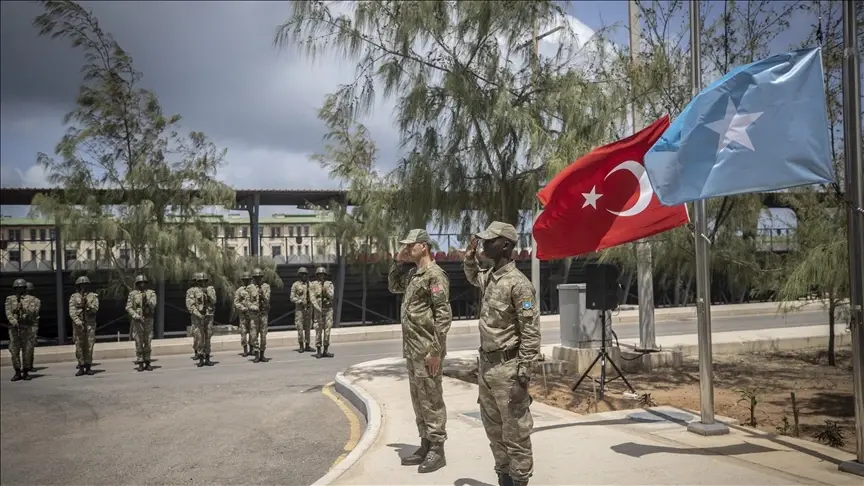
Turkey’s military footprint in Somalia, centred on Camp TURKSOM, extends beyond training and capacity-building. More than 15,000 Somali soldiers have been trained, embedding Turkish influence within the national security apparatus. This security presence operates in parallel with expanding Turkish commercial and resource interests, creating a dual-use model in which military engagement also protects and facilitates economic leverage. Unlike US-trained Danab forces, which have primarily focused on counter-terrorism operations, Turkish-trained Gorgor units have been deployed in internal political confrontations. In December 2024, federal forces including Gorgor units were involved in clashes with Jubaland regional forces in Ras Kamboni and were subsequently forced to withdraw into Kenya, where they were disarmed. This episode highlights how externally trained forces have been drawn into domestic political conflict rather than unified national security priorities. More recently, the deployment of Turkish fighter aircraft to Somalia and the appointment of a new army chief previously trained in Türkiye have intensified concerns regarding the independence and autonomy of the Somali armed forces, suggesting growing external influence over military leadership and strategic direction.
Turkey’s economic engagement increasingly prioritises strategic access to high-value sectors. The establishment of SOMTURK, controlled by OYAK – Türkiye’s military pension and investment fund – granted sweeping authority over Somalia’s fisheries sector, including licensing, vessel registration and enforcement. This arrangement places a major national resource under the control of a foreign military-linked institution with no prior fisheries management experience, bypassing Somali institutional development and community benefit (Nordic Monitor). This coupling of economic access with military and political backing exemplifies a neo-colonial pattern in which cooperation frameworks conceal underlying extraction and foreign profit.
The Türkiye–Somalia oil and gas agreement illustrates a highly extractive and asymmetrical partnership, in which Turkey secures up to 90% of production, broad operational control, tax exemptions, and international arbitration outside Somali courts, while Somalia retains only a marginal share of revenues. Such terms significantly weaken Somalia’s economic sovereignty and regulatory authority over its own natural resources, especially in a fragile post-conflict context with limited institutional capacity. The inclusion of Turkish security deployment to protect energy operations further embeds foreign strategic interests within Somalia’s resource governance, reinforcing a pattern that closely resembles neo-colonial resource control rather than a balanced development partnership (African Energy Council).
Although Türkiye avoids the explicit language of state-building, its involvement in health regulation, professional licensing, institutional design and operational management constitutes de facto governance. External actors exercise substantive influence over public sector rules, standards and institutional norms without a clear transition strategy toward Somali ownership (Middle East Institute). While partnership and solidarity are emphasized rhetorically, decision-making authority over strategic direction, regulation and implementation remains concentrated outside Somali institutions. Local leadership is acknowledged symbolically but constrained functionally, limiting Somali authorities’ capacity to assert ownership over policy design and sectoral priorities (Middle East Institute).
Compared to other countries where Türkiye maintains development and security partnerships, Somalia exhibits an unusually dense concentration of Turkish influence across humanitarian, military, economic, and institutional sectors. This exceptional presence creates a governance context in which external control over national assets and institutions is highly pronounced, setting the stage for strategic projects, such as the proposed spaceport, to operate under predominantly Turkish management rather than Somali leadership.
Finally, the proposed Somalia spaceport project illustrates a highly unequal strategic partnership. The initiative is explicitly designed to advance Türkiye’s national satellite launch capacity, strategic autonomy and security resilience. Somalia’s role is primarily geographical, offering equatorial positioning, low air and maritime traffic and open-ocean launch corridors. Technological capacity, launch systems, institutional leadership and operational control remain entirely on the Turkish side, while the project is overseen by Turkish ministries and the Turkish Space Agency. The land is allocated under a bilateral agreement and the core objective centres on Türkiye’s independent launch capability. This represents foreign-controlled strategic infrastructure located in Somalia rather than Somali-led technological development (TRT World).
Overall, Türkiye’s engagement in Somalia reflects a development and security partnership that is structurally shaped by asymmetric power, external control over strategic sectors, and limited Somali institutional ownership. While visible service delivery and infrastructure investments have addressed immediate needs, they have not translated into durable national capacity or autonomous governance. This is further exemplified by the Türkiye–Somalia oil and gas agreement, in which Turkey secures up to 90% of production and broad operational control, significantly weakening Somali economic sovereignty. Instead, the concentration of regulatory authority, security influence, and commercial access in Turkish state-linked institutions points to a contemporary form of neo-colonial engagement, in which cooperation frameworks coexist with deepening dependency and constrained sovereignty.
About the Author

By Ahmed Abdulahi Duale
Development Practitioner and Environmental Expert
Hargeisa-The Republic of Somaliland.
Twitter: @Axmeducaale1
yukraani05@gmail.com