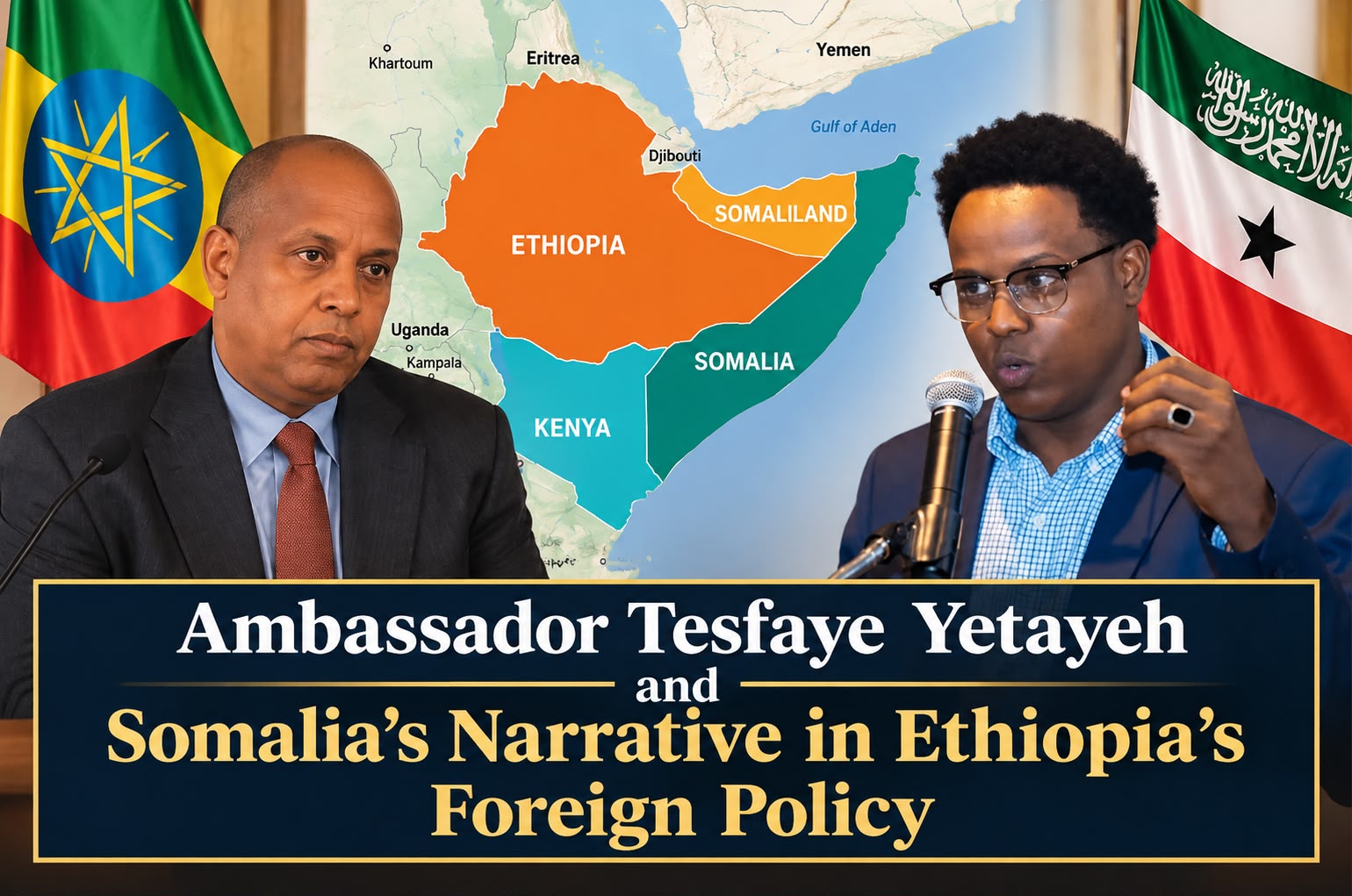
When I watched the interview with Ethiopia’s Ambassador to Israel, Tesfaye Yetayeh, on i24NEWS, I thought I was listening to an official from Somalia. The narrative matched almost exactly. The ambassador has effectively conceded the argument and begun recycling the core narrative and propaganda points that Somalia has advanced for nearly two years, recognize Somaliland and Al-Shabaab gets a freer hand. Ambassador Tesfaye Yetayeh told i24NEWS that the moment Addis Ababa takes that step, Mogadishu will demand Ethiopian troops leave Somalia, and the militants will then have an easier path into Somaliland and across the border into Ethiopia. The shift is hard to miss. Ethiopia signed a memorandum of understanding with Somaliland in early 2024 and presented it as a serious step toward sea access and closer regional integration. Somalia opposed the deal at the time by warning that recognition would strengthen Al-Shabaab and force Ethiopian troops out, the same argument the ambassador is now repeating. Two years later, one of Addis Ababa’s own diplomats is treating that objection as the main reason not to go further and even not to recognize Somaliland.
The worry about Al-Shabaab is legitimate. Ethiopia has fought the group for years and knows the cost. What is harder to accept is the way the ambassador folds Somalia’s threatened reaction into Ethiopia’s own decision. He presents the withdrawal demand as if it follows automatically from recognition, rather than as a separate choice Mogadishu would have to make and live with. Ethiopian forces are in Somalia because Al-Shabaab threatens both countries. If the Somalia government decides that punishing Ethiopia for a diplomatic step is worth weakening its own counterterrorism effort, that is a calculation it must own. It does not turn Ethiopia’s recognition into the direct cause of the resulting insecurity.
Somalia can oppose Somaliland’s recognition by Ethiopia. Ethiopia can still decide, on its own reading of interests, law, and regional security, whether recognition is worth the cost. A threat of retaliation matters; it should not become the whole analysis. Otherwise any government that can credibly threaten instability gains a veto over its neighbors’ foreign policy. That is the practical effect of the ambassador’s framing, a possible Somalia decision is treated as inevitable, the insecurity that might follow is laid at Ethiopia’s door, and Addis Ababa is urged to drop a policy it once called important before the threatened response even happens.
What the ambassador is forgetting is recognition could also improve Ethiopia’s security rather than degrade it. A closer relationship with a neighbor that has kept functioning institutions since 1991 would give Ethiopia a more reliable partner along its eastern border, better options for intelligence and border work, and another route into the Red Sea trade. Somaliland has largely kept Al-Shabaab from establishing the kind of territorial base it holds in parts of southern and central Somalia, and it has contributed to anti-piracy efforts in the Gulf of Aden. Those are not guarantees, but they are relevant facts when the discussion is about security consequences. Treating Somaliland only as a potential victim, rather than as a political actor with its own security capacity, leaves half the picture out.
Ethiopia’s troop presence in Somalia exists because the threat overlaps. Mogadishu has benefited from it. If Somalia later demands those forces leave because of recognition, it would be accepting real costs to its own security. A fuller assessment would ask whether Mogadishu would actually pay those costs, whether cooperation could continue under other arrangements, and whether recognition must collapse existing partnerships. The ambassador’s comments leave most of that unexamined.
There is a further problem with making the continuation of Ethiopian deployments the decisive factor. African Union forces were never meant to stay in Somalia forever. Their role has been to buy time for Somalia institutions to take over. Ethiopia needs a plan for a reduced or ended military role regardless of what happens with Somaliland. If its security depends on deployments that cannot last indefinitely, the shortfall is in long-term strategy, not in the recognition question. Closer ties with Somaliland could be one way to diversify the partnerships that matter along Ethiopia’s eastern approaches.
The 2024 memorandum was presented as a concrete step toward reducing Ethiopia’s dependence on external ports. Somaliland saw it as progress on recognition. Somalia treated it as a violation of sovereignty and ran a sustained campaign against it, including warnings that Ethiopian forces could be expelled. By December 2024 the two governments signed the Ankara Declaration under Turkish mediation. Tensions eased, but the original arrangement was left in an unclear status. Supporters of the memorandum called the Ankara process practical diplomacy. Critics saw it as Ethiopia stepping back once opposition appeared. The ambassador’s later comments raise the question of whether Mogadishu’s security argument has simply been absorbed into Addis Ababa’s own reasoning.
The contrast with the Meles years is hard to miss. In late 2006, as tensions with the Islamic Courts Union rose, the Courts’ security chief, Yusuf Mohamed Siad Indha’ade, publicly called for foreign fighters to join the fight and carry it to Addis Ababa. Meles did not treat the prospect of retaliation as a reason to drop his government’s objectives. Ethiopian forces intervened and entered Mogadishu by the end of December. The intervention carried heavy costs and arguably helped create conditions in which Al-Shabaab later expanded; willingness to act is not the same as sound strategy. Still, the government assessed the threat and accepted responsibility for the consequences. The present question is not whether Abiy Ahmed’s government should repeat a military campaign. Recognition is a diplomatic step. The question is whether Addis Ababa can separate the possibility of retaliation from the independent case for a policy it previously treated as strategically useful.
Somaliland is not simply contested ground between Addis Ababa and Mogadishu. It has maintained its own security forces, intelligence structures, and administration for more than three decades. Not to mention it’s a partially recognized country now, this should be relevant to Ethiopia’s calculations now. Its location makes cooperation on border management and monitoring of extremist movements potentially useful. Any serious review of recognition has to weigh those possible gains against the risks.
The ambassador’s warning largely skips that side. Somaliland appears mainly as a place Al-Shabaab might attack, not as an actor that has already limited the group’s reach on its own territory. Formal recognition would not eliminate threats, but it could put existing practical cooperation on a firmer political footing for intelligence, border security, and efforts to keep extremist groups from exploiting gaps.
Recognition could also turn limited practical ties into a more substantial partnership. That would give Ethiopia additional diplomatic presence, commercial options, and influence in the Horn and Red Sea region. Realizing it would require investment and sustained political work; the potential is still material for a landlocked country whose economy depends on reliable access to markets. The relationship would be with an administration that has shown institutional continuity and a direct interest in secure borders and trade routes.
Somalia’s counterterrorism arrangements are more complicated than official accounts usually suggest. Former militants have entered government posts, clan networks overlap between state institutions and the insurgency, and informal political accommodations have developed over years of conflict and dependence on outside support. Mukhtar Robow’s 2022 appointment as religious affairs minister, after he left Al-Shabaab, was presented by some as a step toward reconciliation and by others as inadequate accountability for his earlier role. A later appointment of another former Al-Shabaab figure to a senior post in the same ministry added to the debate. These moves do not prove ongoing operational ties, but they highlight the need for credible vetting and clear safeguards.
Similar issues appear in intelligence institutions. UN monitoring reports have examined political interference and relationships involving security officials and individuals linked to militant groups. The broader question is whether security agencies can keep clear boundaries between state authority, political networks, and armed groups. Clan structures complicate the picture further. Al-Shabaab has used clan grievances and local networks; government institutions are also shaped by them. Shared clan ties do not equal support for terrorism, Somalia communities have fought the group and suffered from its violence but they create openings for informal accommodation that the state has to manage.
Prolonged reliance on external funding raises questions about sustainability and incentives. Assistance has supported operations against Al-Shabaab, yet long-term dependence can create its own dynamics. That is a legitimate issue for donors. It does not, without further evidence, prove that the government deliberately preserves the insurgency. Al-Shabaab has survived through coercion, recruitment, local grievances, taxation, and weaknesses in governance. Its endurance cannot be reduced to the diplomatic choices of neighbors, and renewed violence cannot be attributed automatically to recognition of Somaliland. If Mogadishu claims recognition will strengthen the group, it should spell out the mechanisms and why those risks cannot be managed without ending cooperation. Ethiopia should test those claims the same way it would test any other major security assessment.
Somalia’s external partnerships matter in the same calculation. Mogadishu has sought support from countries whose relations with Ethiopia have involved rivalry or competing interests such as Egypt and Eritrea. Those partnerships are not illegitimate, but Ethiopia cannot ignore the possibility that outside actors will use influence in Somalia to strengthen their own position in the Horn at Addis Ababa’s expense. Those effects could outlast the immediate argument over Somaliland. A serious Ethiopian assessment has to compare the risks of recognition with the risks of competitors consolidating influence along approaches that matter to Ethiopia.
Israel’s recognition of Somaliland in December 2025 moved the issue into a new setting. Israel became the first UN member to formally recognize it, drawing condemnation from Somalia and criticism from several regional and international actors. Al-Shabaab also opposed the step. Israel proceeded and has developed cooperation, including on security. The comparison has limits, Ethiopia shares a border and has direct interests in the fight against Al-Shabaab but it shows that Somalia’s objections and the possibility of extremist threats do not automatically block another government from reaching a different conclusion. Israel assessed its interests and and recognized Somaliland. Ethiopia has to make its own assessment; it should not treat a threatened Somalia reaction as an automatic bar.
For the current government, the Somaliland question tests whether stated goals on maritime access and regional integration can be pursued with any consistency. The 2024 memorandum suggested a willingness to change the relationship. The confrontation that followed showed the costs. The Ankara Declaration offered another framework but left the original arrangement uncertain. The ambassador’s comments now indicate that the risk of Somalia retaliation remains central. The open question is whether Ethiopia has a coherent policy that joins its economic aims, security requirements, and diplomatic commitments.
The ambassador’s warning matters less because it reveals a previously unseen danger than because it accepts Somalia’s preferred sequence without pressing hard on the assumptions. Recognition leads to a withdrawal demand; withdrawal helps Al-Shabaab; Ethiopia faces greater danger. Each step is possible. None is automatic. Somalia would have to choose a course that could damage its own security. Ethiopia and others would have options to respond. Somaliland’s institutions could play a role. A complete assessment has to include those possibilities instead of treating the worst case as the natural result.
The issue is responsibility and independent judgment. Somalia can oppose recognition and defend its claims. Ethiopia can decide whether recognition serves its interests while meeting its legal obligations and considering regional peace. Neither side escapes the consequences of its choices. If Mogadishu weakens counterterrorism cooperation over a diplomatic disagreement, that decision stands on its own. If Addis Ababa concludes the costs of recognition are too high, it should show the evidence. What is harder to defend is a policy in which another government’s threatened response replaces Ethiopia’s own assessment.
The 2006 intervention showed both determination and the risks of miscalculation. The 2024 memorandum showed that ambitious diplomacy requires preparation for opposition. Israel’s 2025 recognition showed that blackmail and extremist threats do not necessarily stop a government from acting on what it considers important. The common requirement is a coherent reading of interests, risks, and alternatives.
The ambassador’s statement leaves that reading incomplete. Al-Shabaab is a real threat, and a breakdown in security cooperation would carry serious costs. A possible Somalia demand for troop withdrawal cannot, by itself, settle the recognition question. Treating it as decisive gives Mogadishu influence over Ethiopian diplomacy that goes well beyond the immediate dispute.
There is a stronger case for turning the ambassador’s starting assumption around. Instead of treating recognition mainly as something that would make Ethiopia less secure, Addis Ababa should look at whether it could actually improve security, support economic development, and give Ethiopia more influence over what happens in the Horn and the Red Sea. A closer partnership with Somaliland could help with more options for sea access, trade routes, intelligence sharing, and a security setup that does not depend on one set of arrangements. These are not minor issues for a landlocked country that needs reliable access to markets.
The ambassador’s comments also leave out an important part of the picture. If the worry is that recognition could create more room for Al-Shabaab, the same assessment should ask whether deeper ties with Somaliland might reduce other risks. Would closer intelligence cooperation make it easier to track extremist groups? Could a clearer security relationship improve control along the border? Could more economic cooperation strengthen the institutions that have so far kept militants from gaining ground? Recognition is not the only way to pursue these goals, and it could create its own problems. Still, any serious look at the security effects has to weigh possible gains as well as possible costs. Treating Somaliland only as a place Al-Shabaab might attack ignores the institutions that have already limited the group’s reach there.
Recognition carries risks. Most decisions of this scale do. The risks still have to be weighed against the potential gains and against the costs of continued hesitation. Somalia’s threatened response should not eclipse Somaliland’s security record, Ethiopia’s maritime aims, or the implications of Mogadishu’s ties with Ethiopia’s competitors. Ethiopia also should not build a lasting policy around military arrangements in Somalia that cannot be expected to continue indefinitely. The more durable approach is to prepare for changes in regional security structures while building partnerships that strengthen Ethiopia’s capacity to protect its own interests.
Ethiopia has to decide what it wants from Somaliland, what costs it will accept, and how it intends to maintain regional security whatever Somalia does. Until those answers are clearer, the debate will keep turning on other governments’ threats rather than on Ethiopia’s own choices.
About the author
Ibrahim Muse Baqardhe is a educated political analyst and economics, with interest in Politics, Economics, Human rights and Diplomacy. He is the Chair of UWC Somaliland National Committee and former Research Assistant at UNRWA in Beirut, Lebanon.
The views expressed in this article are the author’s own and do not necessarily reflect the Horndiplomat editorial policy.
If you want to submit an opinion piece or an analysis, please email it to Opinion@horndiplomat.com
Horndiplomat reserves the right to edit articles before publication. Please include your full name, relevant personal information and political affiliations