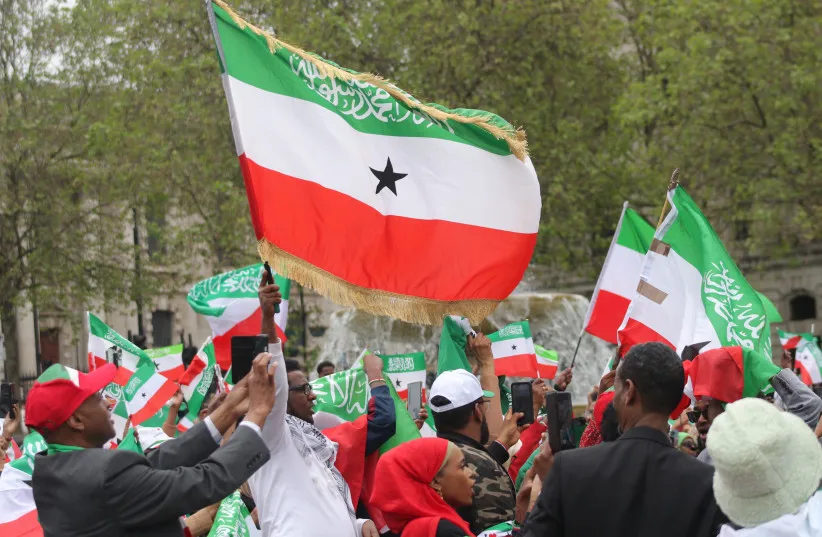
An illustrative image of a Somaliland flag being held. (credit: SHUTTERSTOCK)
By Dr. Jamal Ali Hussein
A new study titled “Peacebuilding vs. State-Building: Collective Action and Divergent Paths in Somaliland and Somalia,” authored by Dr. Jamal Ali Hussein of the Johns Hopkins University School of Advanced International Studies (SAIS) and published in the Cornell International Affairs Review (Spring 2026, Volume 19, Issue II), examines why Somaliland and Somalia have followed sharply different political trajectories since the collapse of the Somali state in 1991.
The study argues that the fundamental difference lies in the sequencing of peacebuilding and state-building. According to the research, Somaliland first pursued locally led reconciliation through traditional elders, clan conferences, and community-based political settlements before constructing formal state institutions. This bottom-up approach fostered trust, legitimacy, and relatively stable democratic governance.
In contrast, Somalia’s post-1991 reconstruction relied heavily on externally driven state-building efforts while unresolved political conflicts and elite rivalries persisted. The study contends that this approach contributed to institutional fragility, recurring instability, and weak governance despite decades of international support.
Drawing on collective action theory and the work of Nobel laureate Elinor Ostrom and political economist William D. Ferguson, the research concludes that sustainable governance depends on local ownership, inclusive political settlements, and institutions built upon social consensus rather than externally imposed frameworks.
The study concludes that lasting peace should precede state-building, arguing that Somaliland’s experience demonstrates how grassroots reconciliation and locally negotiated governance can provide a stronger foundation for long-term stability than externally designed political institutions. The findings contribute to broader debates on post-conflict reconstruction and offer lessons for fragile states around the world.