By: Ibrahim Muse Baqardhe
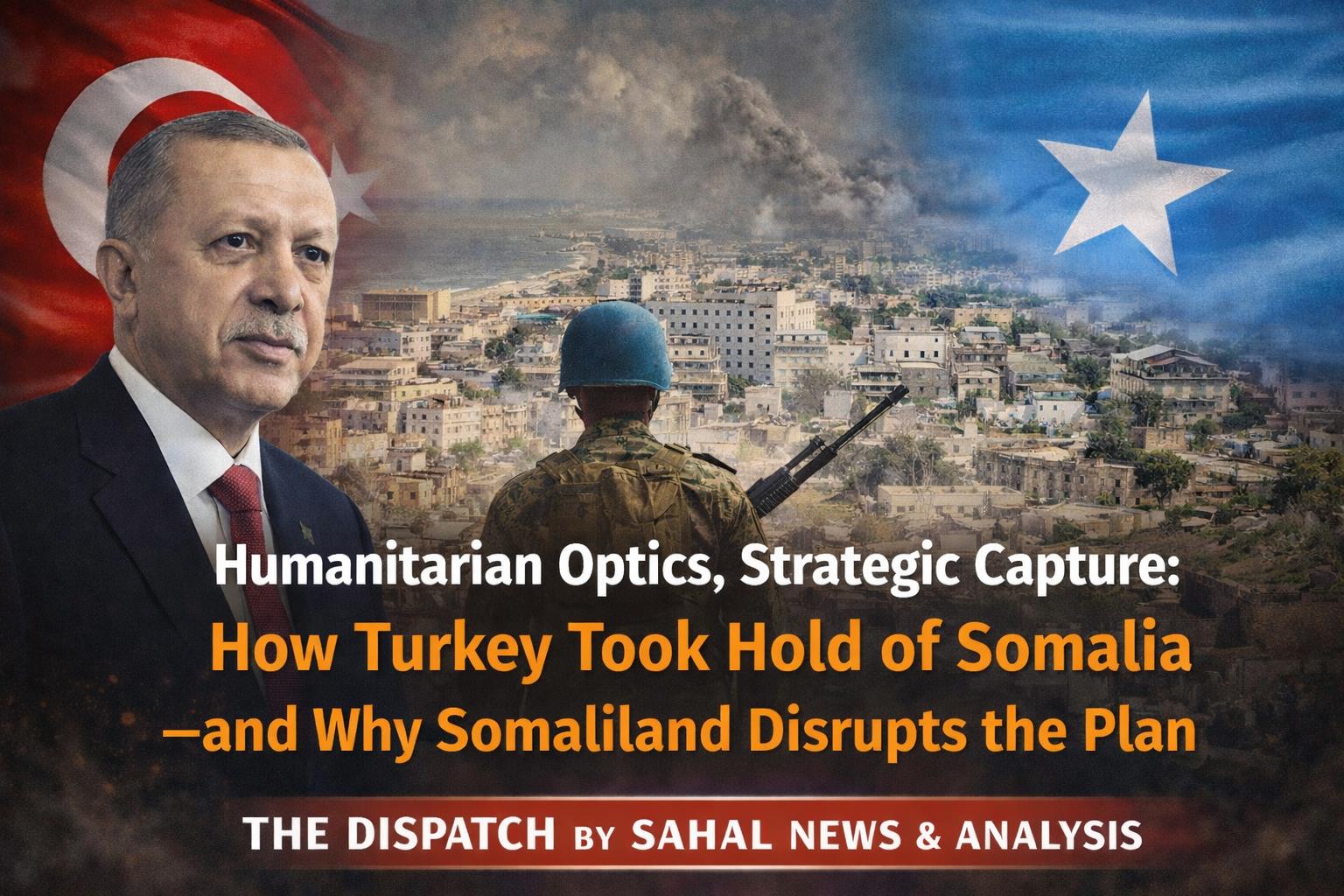
More than a decade has passed since Turkish President Recep Tayyip Erdoğan arrived in Mogadishu at the height of one of the worst famines in Somalia’s modern history (Source: https://www.bbc.com/news/world-africa-14588960). His visit, heavy with symbolism, was framed as a humanitarian rupture from Western indifference. Erdoğan announced Turkish Airlines flights to Mogadishu, the renovation of Digfeer Hospital, and the construction of what would become Turkey’s largest embassy anywhere in the world. For a country long abandoned by donors and paralyzed by insecurity, the optics were powerful. Erdoğan was celebrated across Somalia as a leader willing to walk where others would not. Yet what appeared to be a spontaneous act of compassion was, in reality, the visible culmination of a long-planned strategic project.
Erdoğan’s interest in Somalia did not begin in 2011. As early as 2007, he had met with the president of the Transitional Federal Government, Abdullahi Yusuf, requesting a detailed list of Somalia’s needs. These early efforts stalled, largely because Somalia’s institutions were too fragmented to offer meaningful access or guarantees. The turning point came with the rise of President Sharif Sheikh Ahmed in 2008. Between 2009 and 2011, Sharif visited Turkey three times, gradually deepening ties that culminated in a military cooperation agreement. Officially, the pact was about security assistance; in practice, it opened the door to a far broader Turkish presence.
By the time Erdoğan landed in Mogadishu in August 2011, Somalia was reeling. An estimated 250,000 people had already died of starvation. The visit took place when Somalia’s traditional donors were scrambling to respond to a humanitarian catastrophe they had largely failed to prevent. The timing was not incidental. Since declaring 2005 the “Year of Africa,” Erdoğan had systematically pursued Muslim-majority African states weakened by conflict, locked out of global financial systems, battered by climate shocks, and neglected by the West. Somalia, fragile and desperate, fit this strategy perfectly.
What followed over the next decade was a transformation of Turkey’s role in Somalia from benefactor to power broker, and ultimately to something far closer to a patron exercising parallel sovereignty. Economic control was the first pillar. In 2011, management of the Port of Mogadishu was handed to the Turkish conglomerate Albayrak Group. Initially, revenue was split with Somalia retaining a nominal majority share. Over time, however, the terms shifted decisively in Turkey’s favor. Albayrak gained authority over tariffs, procurement, and expansion, while Somalia’s share of port revenues reportedly fell as low as 16 percent. Rather than strengthening Somalia’s fiscal capacity, the port became a conduit for Turkish goods, reshaping trade patterns and turning Somalia into a captive market.
A similar arrangement governs Aden Adde International Airport, operated by Favori LLC, another Turkish firm. With more than half of airport revenues flowing to the operator, Turkey effectively controls Somalia’s main air gateway, from passenger fees to cargo logistics. These concessions had immediate consequences. Prior to Turkish involvement, Somalia’s trade with Turkey was modest. After Turkish firms took control of key infrastructure, Turkish exports surged dramatically while Somalia exports stagnated, creating a structural trade imbalance that drained hard currency from an already impoverished economy.
Control over infrastructure soon expanded into control over natural resources. In 2024, Somalia signed hydrocarbons agreements granting the Turkish Petroleum Corporation exclusive rights to explore and extract oil and gas both onshore and offshore. The reported terms are stark: Turkey is entitled to recover costs and retain up to 90 percent of revenues, while Somalia receives a royalty far below international norms. Cost-recovery clauses allow Turkey to deduct exploration, security, and infrastructure expenses before any meaningful profit sharing occurs, effectively postponing Somali benefit indefinitely. What is presented as partnership functions instead as long-term resource capture.
The pattern repeats itself in Somalia’s fisheries. Agreements allowing Turkish industrial fleets access to Somali waters have displaced local fishermen and accelerated depletion of fish stocks, transferring food security and export revenue away from coastal communities and into Turkish supply chains. Together, hydrocarbons, fisheries, ports, and airports form an interlocking system of economic dependency that leaves Somalia formally sovereign but materially constrained.
Economic dominance has been reinforced by military control. At Camp TURKSOM, Turkey’s largest overseas military base, more than 15,000 Somali troops have been trained under Turkish doctrine. Additional agreements grant Turkey rights to protect strategic assets, patrol Somalia’s maritime zones, and participate in airspace management. Somalia’s armed forces, infrastructure, and territorial waters are thus secured not by national capacity but by foreign oversight. The result is a dual system of authority, Somalia sovereignty on paper, Turkish control in practice.
This arrangement serves a purpose far beyond Somalia itself. The country’s long coastline and proximity to the Red Sea place it at the heart of one of the world’s most critical maritime corridors. From Somalia, Turkey can project power into the Gulf of Aden, monitor global shipping lanes, and extend its strategic reach across the Horn of Africa. The model is familiar security assistance followed by economic penetration and institutional capture mirroring Turkish operations in Libya and northern Syria.
Yet even Ankara’s own officials now implicitly acknowledge the limits of this strategy. In a recent interview with TRT, Turkish Foreign Minister Hakan Fidan openly conceded that “Somaliland controls the Gulf of Aden, which means controlling Bab al-Mandab,” (Source: https://youtu.be/l3n-wWWZgrQ?si=rBHJYm-_EhjjXXrM). a striking admission that the decisive maritime chokepoint Turkey seeks to influence does not, in fact, lie under Mogadishu’s authority. Fidan went further, warning that “recognition of Somaliland creates a direct counterweight to Turkey’s agenda and threatens to disrupt the continuity of Turkish influence along the Red Sea corridor.” What this reveals perhaps unintentionally is that the Republic of Somaliland already exercises full control over its maritime territory at the southern entrance of the Gulf of Aden and Bab al-Mandab, and that Turkey’s Somalia-centered strategy is structurally incapable of securing the very corridor it claims to anchor.
It is within this strategic architecture that Turkey’s hostility toward the Republic of Somaliland must be understood. The Republic of Somaliland represents a fundamentally different model, a self-governing country that maintains security without foreign troops, manages its own ports, and engages international partners without surrendering sovereignty. Its existence challenges Ankara’s preferred framework of leverage through fragility. A recognized Republic of Somaliland, particularly one establishing ties with Israel and other global actors would fracture Turkey’s monopoly over access and influence in the Horn, exposing Somalia not as an inevitability, but as a choice.
Yet in treating the Republic of Somaliland solely as a threat, Ankara may be making a profound strategic miscalculation. Turkey’s fixation on preserving dominance in Mogadishu blinds it to an alternative path one that could serve Turkish interests far more sustainably if Ankara were willing to abandon its extractive approach. The Republic of Somaliland does not require guardianship, nor does it offer concessions born of desperation. What it offers instead is stability, institutional continuity, and a political culture capable of sustaining long-term partnerships rooted in reciprocity rather than dependency.
It is precisely for this reason that the United Arab Emirates chose a different route: rather than attempting to enter Somaliland through indirect channels or political maneuvering, Abu Dhabi engaged the Republic of Somaliland directly, committing hundreds of millions of dollars through DP World to develop Berbera Port and related infrastructure (Source:https://www.reuters.com/article/world/multi-million-dollar-deal-for-somalilands-historic-port-sparks-land-rush-idUSKBN17624A/). That decision reflected a recognition of political reality, one that prioritizes durability over leverage. This is the path Turkey might have taken, but chose not to. By ignoring the Republic of Somaliland in favor of a strategy centered on access through fragility, Ankara has locked itself into an approach that may deliver short-term influence but is structurally unsustainable over the long term.
A recognized Somaliland could, in fact, be strategically advantageous for Turkey. Berbera’s port, situated along the same vital Red Sea corridor Ankara seeks to influence, offers a secure gateway that does not require permanent military oversight or political manipulation. Somaliland’s security apparatus is domestically controlled, its governance predictable, and its population broadly supportive of international engagement conducted with respect. Unlike Somalia, where foreign involvement must be underwritten by security guarantees and asymmetric contracts, Somaliland can accommodate relationships based on mutual interest, transparency, and shared benefit.
Turkey ignored Somaliland’s people and their cause for 35 years, but now the Turkish government has suddenly “discovered” the region’s strategic importance. Even more troubling is that this recognition has manifested as hostility rather than partnership. A simple truth remains, this is Somaliland’s land. Somalia has neither the legitimacy nor the authority to invite foreign powers into the Somaliland land and sea but the Republic of Somaliland possesses both the legitimacy and the capacity to engage partners on its own terms. As Khadar Hussein Abdi, Somaliland’s Minister of the Presidency, said: “Turkey was the first Muslim country to recognize Israel, and its relationship with Israel has not changed since then. So what, then, is Turkey telling us today?” (Source: https://x.com/khadarlooge/status/2009978723823759436?s=46).
The contradiction is stark. Turkey has no problem engaging Israel, a country with which it maintains formal diplomatic relations, yet it opposes the people of Somaliland in their quest for recognition and sovereignty. If Turkey’s strategy is truly about supporting Muslim countries and promoting their security and prosperity, then Somaliland a functioning, stable, Muslim-led republic should naturally fall within that mission. Instead, Ankara frames Somaliland as a threat, disregarding the very principles it claims to champion.
Turkish Foreign Minister Hakan Fidan recently told TRT that the Islamic world has “awakened from a 100-year deep sleep,” emphasizing that countries in the region are increasingly aware of their collective strength. Yet this rhetoric is being deployed selectively. In the case of Somaliland, religious solidarity is invoked not to support Muslim self-determination, but to block international recognition turning faith into a facade for strategic competition. In reality, Somaliland poses no inherent threat unless Ankara continues to view it through the lens of rivalry rather than partnership, a misreading that risks backfiring if Turkey does not acknowledge the Republic’s legitimacy and inevitable global recognition.
The obstacle, therefore, is not Somaliland’s posture but Turkey’s approach. Ankara’s Somalia strategy relies on extraction disguised as partnership, on leverage derived from fragility rather than consent. That model cannot function in Somaliland, where institutions are resilient enough to resist capture. Rather than adapting, Turkey has chosen to oppose Somaliland’s recognition altogether, a strategy that risks isolating Ankara from an emerging geopolitical reality.
That reality is this, The Republic of Somaliland is no longer a provisional entity awaiting validation. It is a functioning polity with defined territory, effective security, and growing international engagement. Recognition by Israel has already punctured the fiction that Somaliland can be indefinitely ignored, and it is unlikely to remain an isolated case. As regional and global actors recalibrate their Red Sea strategies, the appeal of a stable, cooperative partner outside Mogadishu’s dysfunction will only grow.
By continuing to treat The Republic of Somaliland as an obstacle rather than an opportunity, Turkey risks strategic self-sabotage. Efforts to suppress Somaliland’s international standing will not preserve Turkish influence in Somalia; they will instead accelerate the emergence of alternative hubs beyond Ankara’s control. In time, Turkey may find itself entrenched in an increasingly fragile Mogadishu while excluded from partnerships formed on firmer political ground elsewhere in the Horn.
Today, Somalia bears the hallmarks of a modern neo-colony. Its ports, airport, hydrocarbons, fisheries, and military institutions are deeply entwined with Turkish control. Revenue flows outward, strategic decisions are filtered through Ankara, and aid serves as the moral cover for extraction. Hospitals, scholarships, and humanitarian rhetoric remain highly visible, but they mask a deeper reality of subordination.
Today, Turkey faces a clear strategic choice. It can either continue its current approach, ignoring the Republic of Somaliland’s strategic value and potential as a partner, or persist with its exploitative strategy in Somalia, where authority is easier to assert and economic and political control more straightforward. While Somalia may appear more malleable in the short term, this path carries significant long-term risks. The Republic of Somaliland is actively engaging other international partners, including Israel, and its growing recognition will disrupt Turkey’s influence in the Horn of Africa.
A wiser strategy for Ankara would be to acknowledge Somaliland’s reality and explore a partnership based on mutual respect. Somaliland has consistently demonstrated political maturity, institutional stability, and a willingness to engage with all countries, provided its sovereignty is respected. Short-term gains extracted from Somalia will ultimately be unsustainable, while constructive engagement with Somaliland offers Turkey a durable foothold in the region, one built on partnership rather than dependency. Respecting Somaliland’s independence is not a radical demand; it is a path already taken successfully by other international actors.
Somaliland’s pursuit of recognition is therefore not merely diplomatic; it is an assertion of agency in a region long shaped by external designs. In a Horn of Africa once again becoming a chessboard for global and regional powers, the contrast is stark. Mogadishu embodies dependency institutionalized. Hargeisa insists on sovereignty without permission. History, in time, will be clear about which path preserved dignity and which quietly surrendered it.
About the author
Ibrahim Muse Baqardhe is a educated political analyst and economics, with interest in Politics, Economics, Human rights and Diplomacy. He is the Chair of UWC Somaliland National Committee and former Research Assistant at UNRWA in Beirut, Lebanon.
The views expressed in this article are the author’s own and do not necessarily reflect the Horndiplomat editorial policy.
If you want to submit an opinion piece or an analysis, please email it to Opinion@horndiplomat.com
Horndiplomat reserves the right to edit articles before publication. Please include your full name, relevant personal information and political affiliations