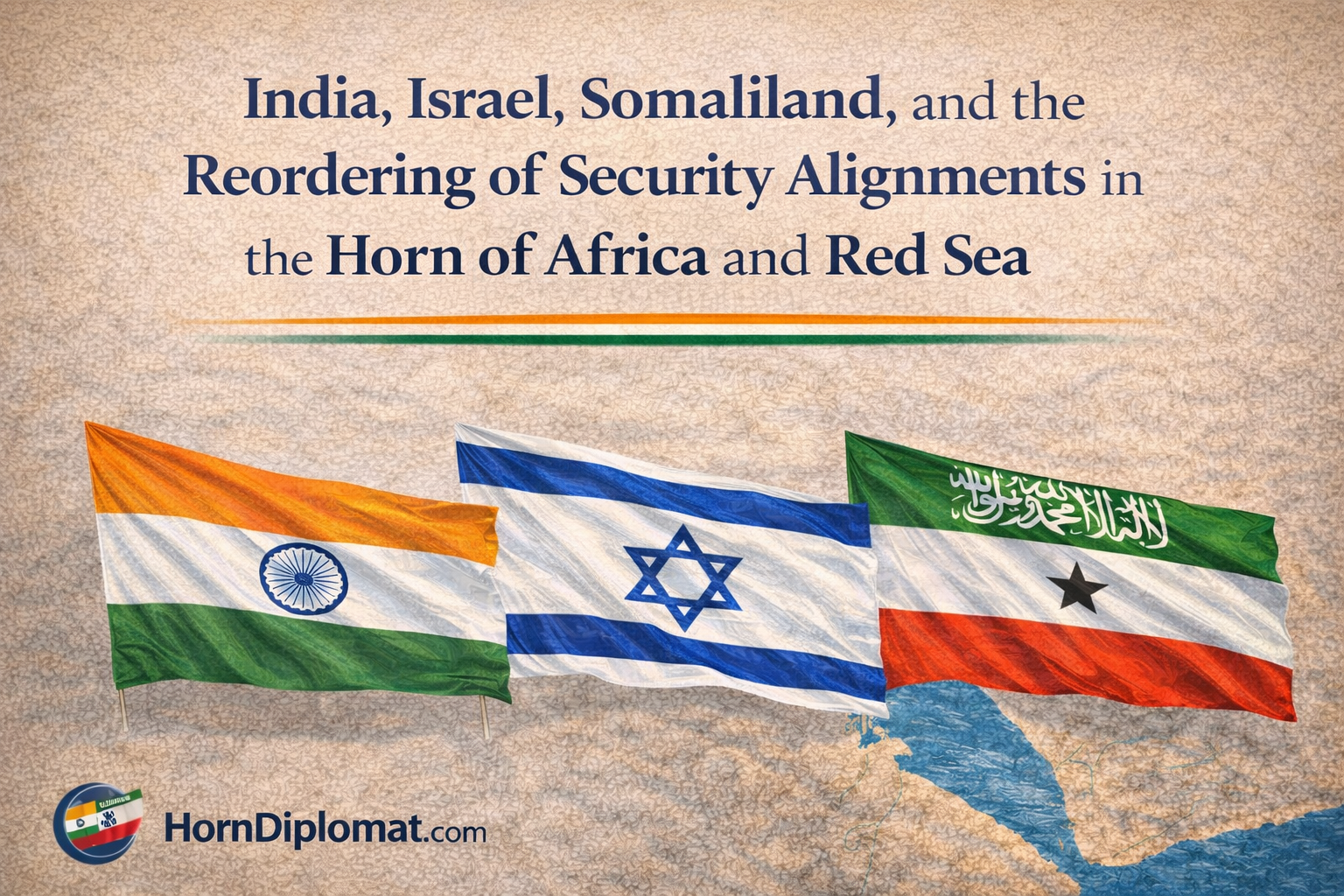
India’s recognition of Somaliland emerges as a central strategic imperative in the Horn of Africa and Red Sea region. By formally recognizing Somaliland, India can anchor a counter-alignment with Israel, the UAE, Ethiopia, and the United States, thereby stabilizing critical maritime chokepoints, preserving regional balance, and countering the operational reach of the Turkey–Pakistan–Saudi alliance. This recognition is not symbolic; it integrates India into a network of stable partners, ensuring influence, intelligence coordination, and operational access in a region increasingly shaped by fragile states and external power projection. In addition, India’s recognition signals a shift in regional perception of sovereignty, reinforcing Somaliland’s status as a reliable state actor and enabling structured partnerships across trade, maritime security, and counterterrorism frameworks.
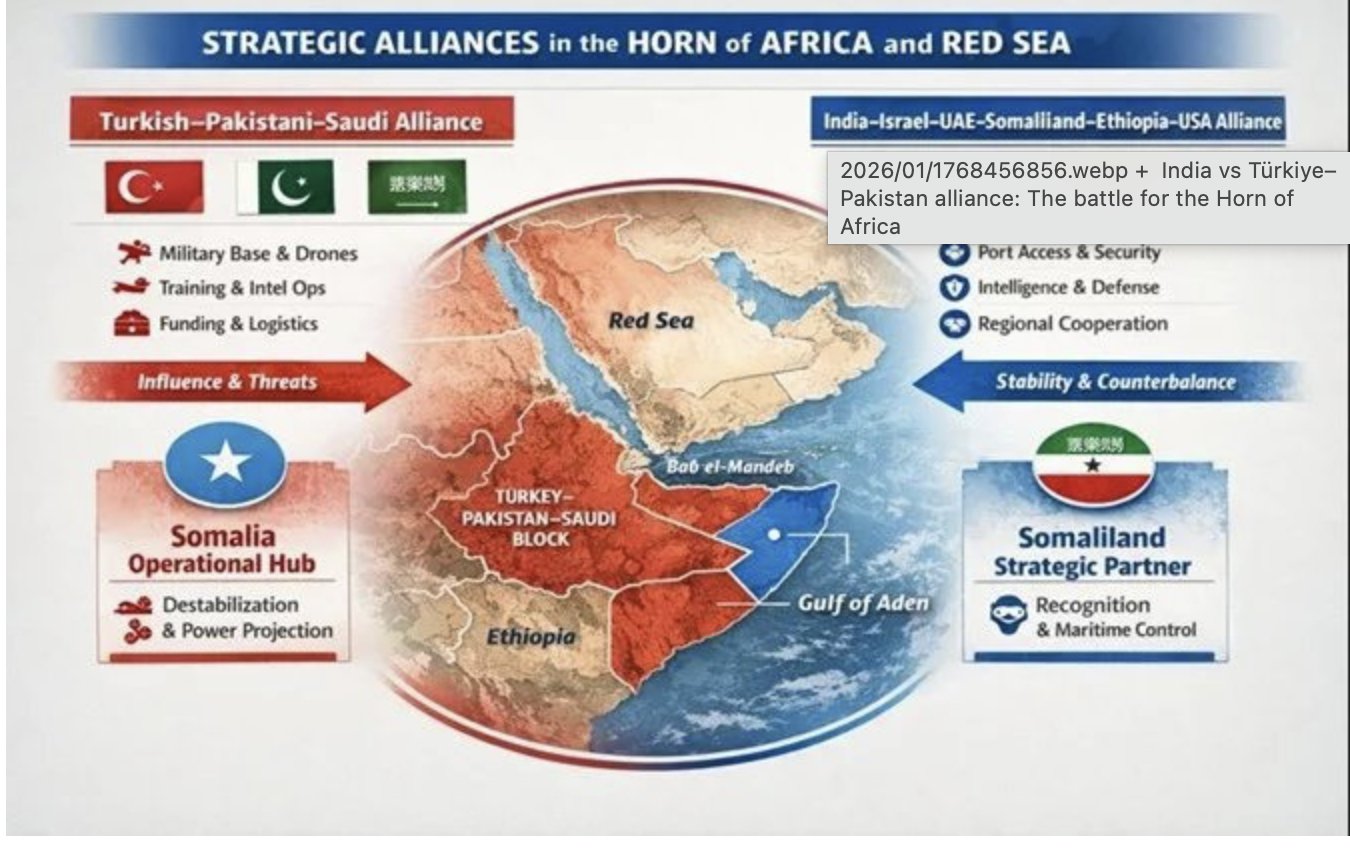
Turkey, Pakistan, and Saudi Arabia in the Horn of Africa Three regional powers—Turkey, Pakistan, and Saudi Arabia—are drifting toward convergence within a security framework that reflects elements of NATO-style collective defense logic. Although frequently described as a NATO-like arrangement, this convergence is better understood as a flexible, interest-driven hedging structure shaped by declining confidence in traditional security guarantors, opportunistic regional power projection, and the strategic exploitation of weak or collapsed states. Somalia has emerged as the principal theater where this convergence is being operationally tested, posing direct threats to the security interests of India, Israel, and the United Arab Emirates (UAE). This convergence elevates the strategic challenge for India by transforming Pakistan from a primarily bilateral adversary into a node within a broader security network. Turkey’s involvement institutionalizes its pro-Pakistan posture and extends Pakistan’s operational relevance beyond South Asia, while Saudi Arabia’s participation provides the financial and logistical depth necessary to sustain long-term deployments. Collectively, this configuration constrains Indian strategic freedom, compresses Israeli security margins in the Red Sea, and destabilizes Gulf security balances to the detriment of the UAE.
Turkey’s Operational Footprint Turkey’s presence in Somalia represents a deliberate effort to convert a failed state into a forward military platform. Ankara has established its largest overseas military base in Mogadishu, transforming Somalia from an aid-dependent recipient into an operational launchpad. Turkish activities extend well beyond troop deployment and training to include drone integration, missile-related experimentation, intelligence fusion, and long-range strike support systems. Turkey also engages in port development and humanitarian programs as dual-use platforms for influence, embedding military and civilian capabilities into Somalia’s infrastructure. Somalia’s permissive governance environment allows Turkey to test and refine capabilities that would face political or legal constraints in more regulated theaters. Geographically, these deployments place Turkish forces along the Red Sea, the Bab el-Mandeb Strait, and the Gulf of Aden—chokepoints critical to global trade and energy flows. This positioning enables Turkey to exert indirect pressure on Israeli maritime access to Eilat and threatens Indian sea lines of communication linking the Indian Ocean to Europe. For Israel, Turkish military infrastructure in Somalia reduces early-warning depth and complicates freedom of navigation in the southern Red Sea. For India, it introduces a hostile presence near maritime arteries vital to trade, energy security, and naval mobility. Turkey’s actions also signal Ankara’s intent to position itself as a regional arbiter in the Horn of Africa, projecting influence into both African and Middle Eastern theaters.
Pakistan’s Strategic Role Pakistan’s role in Somalia is operationally complementary rather than territorial. Islamabad embeds military personnel in training programs, intelligence coordination units, and rapid-response exercises, allowing Pakistan to gain operational depth outside South Asia. This externalization of Pakistani military activity directly affects India’s security calculus by shifting the rivalry from a geographically bounded confrontation to a dispersed, networked challenge. Pakistani involvement enhances Turkish operational effectiveness and raises the risk that Islamabad, shielded by coalition backing, may act more assertively under an expanded deterrence umbrella. Pakistan’s engagement is not limited to military training; it also includes cyber operations, logistics coordination, and intelligence-sharing networks with local militias. These activities expand Pakistan’s influence in Somalia, providing experience in overseas deployments that could later be applied to Indian Ocean contingencies. By institutionalizing its presence within a multi-national coalition, Pakistan gains legitimacy and operational leverage it would otherwise lack in its South Asian confrontations with India.
Saudi Arabia’s Support and Strategic Hedging Saudi Arabia sustains this alignment through financial support, logistics, and access to southern Somali ports and supply routes. Riyadh’s role is driven by strategic hedging: decreasing confidence in exclusive U.S. security guarantees and the desire to preserve regional influence without direct military overextension. By underwriting Turkish–Pakistani operations, Saudi Arabia enables sustained presence while maintaining plausible deniability. However, this support also deepens rivalry with the UAE and links Gulf security dynamics to South Asian and Eastern Mediterranean rivalries. Saudi Arabia’s involvement provides the coalition with an economic and diplomatic backbone. It finances infrastructure, sustains extended deployments, and mediates operational coordination, allowing Turkey and Pakistan to focus on tactical and operational objectives. Riyadh’s broader goal is to project influence across the Red Sea corridor, maintain leverage over Horn of Africa ports, and hedge against uncertainties in U.S. Middle East policy.
Somalia as Strategic Terrain Somalia’s failed-state condition is central to this convergence. Governance vacuums allow Turkey and Pakistan to integrate systems, test doctrines, and coordinate operations at minimal political cost. Somalia is therefore not merely unstable; it is being strategically instrumentalized as a launchpad for projecting Turkish–Pakistani–Saudi influence across the Red Sea–Indian Ocean nexus. The lack of centralized control allows the coalition to establish semi-permanent operational zones, integrate air and maritime surveillance, and conduct joint military exercises that strengthen interoperability while minimizing international scrutiny.
Strategic Threats to India, Israel, and the UAE For Israel, Turkish drone and missile-support infrastructure in Somalia poses a direct challenge to freedom of navigation in the southern Red Sea and undermines the security of the Eilat port. The proximity of these deployments compresses early-warning margins and increases the risk of coordinated pressure from multiple theaters. For India, the implications are broader and structural. The Red Sea and the Gulf of Aden are indispensable to Indian trade, energy imports, and its role as a net security provider in the Indian Ocean. Pakistani participation enhances Turkish operational reach, while Saudi logistical backing ensures sustainability. Together, these elements constrain India’s strategic maneuverability and risk altering deterrence dynamics by embedding Pakistan within a wider security framework. For the UAE, a Saudi-backed alignment incorporating Turkey and Pakistan is deeply destabilizing. It marginalizes Abu Dhabi within a reconfigured regional security architecture and institutionalizes cooperation with Turkey, a direct Emirati rival. The alignment also targets Israel, a core UAE partner, forcing Abu Dhabi toward deeper strategic convergence with Israel and India. The likely outcome is intensified Gulf fragmentation and competing Saudi- and UAE-centered security axes.
Impact on the United States and Strategic Alignment The formation of this alliance constitutes a severe strategic setback for the United States, systematically eroding the pillars of its influence in the Middle East. It directly undermines Washington’s core diplomatic leverage, as Saudi Arabia and Turkey would no longer depend solely on American security guarantees, freeing them to defy U.S. policy on oil production, human rights, and regional conflicts. The pact accelerates the strategic decoupling of Gulf states from the U.S., facilitating a rapid pivot toward China for arms sales, critical infrastructure, and yuan-based oil trading that threatens the petrodollar system. It dangerously legitimizes Pakistan’s nuclear arsenal as a regional security tool, potentially sparking a proliferation cascade. Ultimately, the alliance marginalizes U.S. Central Command and signifies the definitive end of American unipolarity in the region, leaving Washington with a menu of bad options that all accelerate its strategic decline. However, the United States has a viable counterbalance through strategic alignment with India, Israel, the UAE, Somaliland, and Ethiopia. By reinforcing security, intelligence, and economic ties with these states, Washington can anchor its influence in a stable, cooperative network within the Horn of Africa and Red Sea corridor. This alignment strengthens U.S. maritime access, preserves freedom of navigation, and counters the operational reach of the Turkey–Pakistan–Saudi coalition. The U.S. role ensures that deterrence is credible, intelligence flows remain secure, and logistical hubs in Somaliland and Ethiopia are leveraged for sustained regional influence.
India–Israel–Somaliland Counter-Alignment In contrast, a counter-alignment anchored by India, Israel, the UAE, Greece, Cyprus, Ethiopia, and Somaliland demonstrate strategic coherence. India–Israel relations are technologically and operationally deep, encompassing missile defense, drones, electronic warfare, cyber capabilities, and joint development of advanced systems. The UAE provides financial depth, logistical access, and intelligence integration. Greece and Cyprus enable Eastern Mediterranean coordination, while Ethiopia contributes regional depth. Somaliland occupies a central position within this framework. With stable governance, effective territorial control, and a strategic location at the southern entrance to the Red Sea, Somaliland offers a reliable operational anchor immune to the governance vacuums exploited in Somalia. By formally recognizing Somaliland, India solidifies this counter-alignment, enhancing operational coordination, access to ports, and regional influence while providing a credible alternative to Somalia-based Turkish–Pakistani operations.
India’s Recognition of Somaliland: The Ethiopia–Somaliland–India Strategic Link India’s recognition of Somaliland must be understood within the broader regional geometry involving Ethiopia. India already maintains strong diplomatic, economic, and development relations with Ethiopia, one of the Horn of Africa’s most influential states. Ethiopia, in turn, maintains deep political, economic, and security ties with Somaliland, relying on Somaliland’s ports and stability for access to maritime trade. This Ethiopia–Somaliland linkage creates a natural strategic corridor connecting inland regional depth with coastal stability. By recognizing Somaliland, India would not be creating an isolated bilateral relationship but integrating itself into an existing Ethiopia–Somaliland ecosystem. This triangular alignment allows India to anchor its Horn of Africa engagement in stable partners rather than relying on the volatile Somali federal environment currently exploited by Turkey, Pakistan, and Saudi Arabia. Recognition would enable India to coordinate maritime security, intelligence sharing, and logistical access through Somaliland in cooperation with Ethiopia. This would directly counter the Turkey–Pakistan–Saudi alignment by denying it uncontested operational space and by anchoring Indian influence at the southern entrance to the Red Sea. It would also facilitate deeper coordination with Israel and the UAE, both of which regard Somaliland as a stable and reliable partner.
Strategic Implications By exploiting Somalia’s governance collapse, Turkey, Pakistan, and Saudi Arabia have constructed a permissive operational environment that threatens Indian, Israeli, and Emirati interests. In contrast, Somaliland—linked to Ethiopia and open to structured cooperation—offers a stable alternative around which a coherent counter-alignment can form. India’s recognition of Somaliland is therefore not symbolic. It is a strategic correction that aligns India’s Horn of Africa policy with its existing partnerships, strengthens deterrence against a multi-actor security convergence, and constrains the reach of a fragmented but operationally disruptive alliance centered in Somalia. Through strategic coordination with India, Israel, the UAE, Somaliland, and Ethiopia, the United States can preserve influence, project credible deterrence, stabilize maritime corridors, and maintain regional balance, effectively countering the Turkey–Pakistan–Saudi alliance and mitigating the acceleration of U.S. strategic decline.
Conclusion India’s recognition of Somaliland is a strategic imperative. It denies Turkey and Pakistan uncontested access to the Horn of Africa, secures critical maritime chokepoints, reinforces partnerships with Ethiopia, Israel, and the UAE, and restores balance to a rapidly shifting regional security environment. In an era defined by fragile states and contested sea lanes, Somaliland represents both a stabilizing anchor and a decisive strategic lever for India and its partners across the Horn of Africa, the Red Sea, and the wider Indian Ocean.
About the Author Gulaid Yusuf Idaan is a senior lecturer and researcher specializing in diplomacy, international law, and international relations in the Horn of Africa. He holds multiple Master’s degrees and publishes extensively on state recognition, geopolitics, governance, and regional security, linking academic analysis with policy-relevant insight.
The views expressed in this article are the author’s own and do not necessarily reflect the Horndiplomat editorial policy.
If you want to submit an opinion piece or an analysis, please email it to Opinion@horndiplomat.com
Horndiplomat reserves the right to edit articles before publication. Please include your full name, relevant personal information and political affiliations