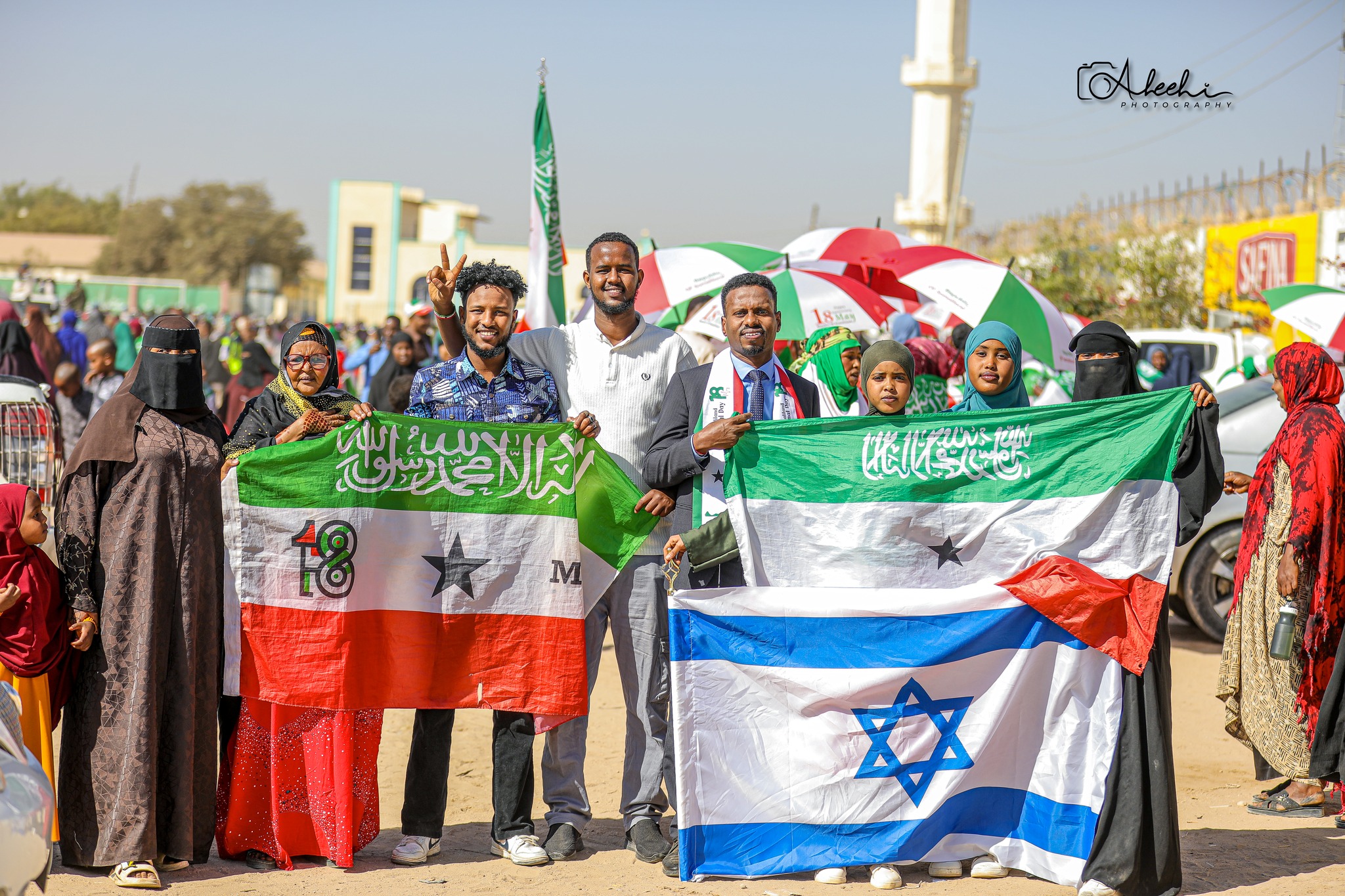
When Ethiopia and Somaliland signed a memorandum of understanding (MoU) in January 2024, Mogadishu’s political elite responded with remarkable speed and coordination. What followed was not a conventional diplomatic rebuttal, but a full-spectrum political campaign, one that relied on familiar narratives and targeted mobilisation.
The question now is whether that same playbook can be deployed again, this time to counter emerging relations between Israel and Somaliland.
A Familiar Pattern
The response to the Ethiopia-Somaliland MoU revealed a consistent strategy. The agreement was framed as an existential threat to Somalia’s sovereignty, with warnings of territorial conquest and regional destabilisation. Anti-Ethiopia narratives circulated widely across public forums, social media spaces, and diaspora networks.
Notably, the territory said to be “defended” was Somaliland, an entity that the campaign itself refused to acknowledge by name. Instead, references reverted to pre-1990 administrative labels such as “northwestern Somalia,” despite the fact that Somalia’s own federal system has since replaced those divisions, and Somaliland is not part of that framework.
This refusal to recognise political realities on the ground was paired with selective moral language. Somaliland’s record of peace, democratic elections, and internal stability, often acknowledged internationally, was either dismissed or ignored. Ethiopia, meanwhile, was portrayed as an imperial power poised to overrun Somalia, even as instability in the Horn of Africa was presented as a future risk rather than a long-standing condition.
For international audiences, the framing shifted. The language of sovereignty, territorial integrity, and international law took centre stage. After decades of aid dependence, Somalia’s elite have become adept at speaking the moral and political language that donors and international partners respond to. The MoU was depicted as a trigger for extremism and regional instability, despite the region’s already entrenched instability.
The campaign worked. Turkey brokered talks, Ethiopia froze the MoU, and Mogadishu claimed a diplomatic victory.
What the Campaign Revealed
That episode had consequences beyond the MoU itself. For Somalilanders who still hoped for a negotiated political settlement with Somalia, the campaign was clarifying. It suggested that Mogadishu’s elite were not prepared for any arrangement that might dilute the concentration of power, resources, access, and diplomatic privilege that has accrued in the capital since state collapse.
Over time, Somalia’s fragmentation has allowed elites outside Mogadishu to retreat to their strongholds. But Mogadishu’s elite have retained disproportionate control over national assets, international platforms, and state recognition, resources that, in a functional state, would be shared by millions. From that perspective, political pluralism is not merely inconvenient; it is threatening.
The irony is that the MoU episode could have been a turning point, an opportunity for Mogadishu’s elite to reassess their approach, engage more constructively with federal member states and Somaliland, and address the concentration of power that has hollowed out the state.
A Second Test: Israel and Somaliland
Today, a similar mobilisation appears to be taking shape around Israel-Somaliland relations. The rhetoric echoes earlier patterns: Israel is described as an “isolated and genocidal state,” Somaliland is again reduced to a “region,” and appeals to Somali unity are revived with urgency. A unity that the Mogadishu elite mobilise when they feel threatened, even though they show little commitment to it otherwise.
Yet this case is different. Israel is not Ethiopia. It is a key Western ally with significant diplomatic reach, military capacity, and intelligence networks. Some voices within Somalia’s diaspora, many of whom hold Western citizenship, appear to recognise this difference, adopting a more cautious tone.
That caution raises an uncomfortable question. Can political actors who have sworn legal allegiance to Western states plausibly lead a campaign that challenges what may be perceived as Western strategic interests? And after years of scrutiny around aid capture and governance failures, will they be willing to escalate a confrontation that could invite closer attention from the very governments that naturalised them. Especially when segments of the Somali diaspora in the United States are confronting public allegations and investigations related to fraud.
Whether the MoU playbook can be reused against Israeli-Somaliland relations remains uncertain. What is clear is that the context has changed, the actors are different, and the costs of escalation may be higher.
The real question is not whether Mogadishu’s elite can mobilise again, they almost certainly can, but whether they will succeed this time.
Time will tell.
Zaki Mohamed is a Somaliland-based journalist covering politics and regional dynamics in the Horn of Africa.
zaakim.zaaki@gmail.com
The views expressed in this article are the author’s own and do not necessarily reflect the Horndiplomat editorial policy.
If you want to submit an opinion piece or an analysis, please email it to Opinion@horndiplomat.com. Horndiplomat reserves the right to edit articles before publication. Please include your full name, relevant personal information, and political affiliations.


 in January 2024, Mogadishu’s)