


By: Somaliland Societies of Europe
- The Somaliland Societies in Europe (SSE) extends its felicitations to all the Republic of Somaliland nationals at home and abroad on the occasion of the 59th Anniversary of the independence and birth of the sovereign State of Somaliland on 26 June 1960 (Independence Day). Ever since the re-birth of the State of Somaliland as the Republic of Somaliland on 18 May 1991 (Re-acquisition of Independence Day), 26 June and 18 May have been considered as national days meriting statutory holiday status for celebrations and commemorations, and both will continue to be so marked for their importance to the national identity, independence and territorial integrity of the Somaliland people and country. Both days have special significance to the nation and, in effect, reflect the two sides of the same coin that cannot be separated.
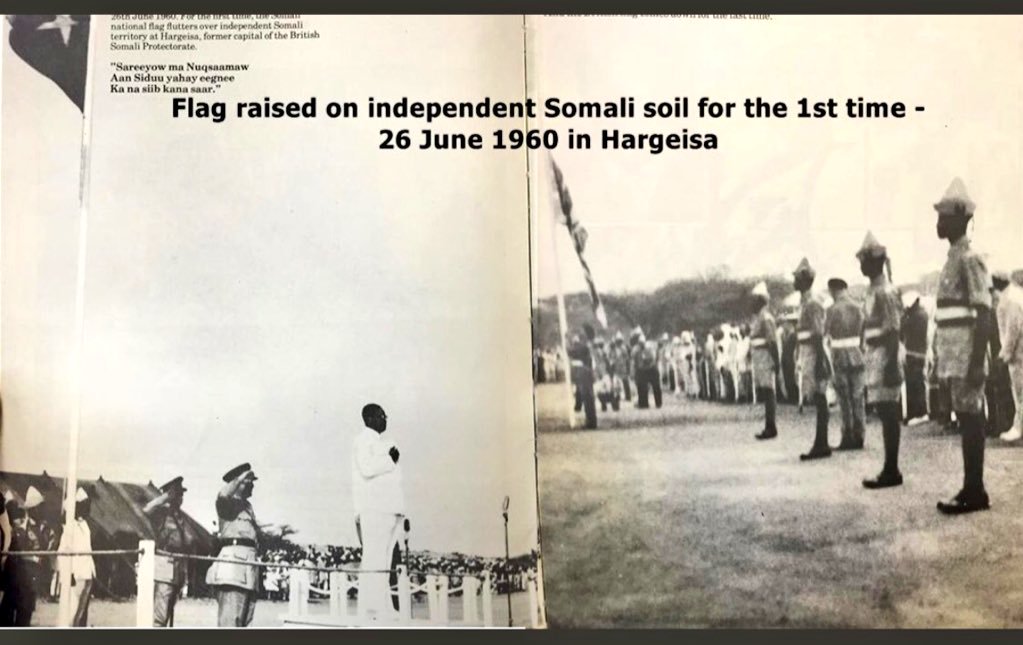
- It is ironic to see some of the various Somalian governments formed after 2001, including the current one, holding evening events for 26 June primarily not for the independence of the State of Somaliland, which they still insultingly refer to as the independence of the ‘Northern Regions’ (Gobollada Waqooyi), but for the fact that their 1956 designed 5 star blue flag1 was flown on that day in Hargeisa. That flag was furled at Hargeisa simply because of Somaliland’s yearning, at that time, for re-acquisition of the Haud and Reserved Area and the (then) hope of the realisation of the ‘dream’ of a union of, not just Somaliland and Somalia, but also of the other three Somali inhabited territories2, which are all depicted in the 5 star of that flag. 26 June 1960 stands for much more than a flag hoisting. It stands for, as we highlight in this press release (and more discursively in a forthcoming SSE Statement), the historical and legal significance and the enduring legacy of Somaliland’s sovereignty.
Somaliland territory and its people
- 26 June 1960 was the culmination of the colonial state which, like many other African countries, was formed in the 1880s3 as British Somaliland Protectorate. The General Act of Berlin process related primarily to the creation of European colonies and protectorates in territories on the African coasts4, and so, as in many protectorates, the protection treaties were purposely made with the coastal Somali clans and with the other littoral based sub clans. The protection was extended to other in-land areas as soon as the expanse of the territory considered to be within the ‘area of influence’ of one of the Berlin process Powers is agreed with other ‘neighbouring’ Powers ( such as France5 and Italy 6 in the case of Somaliland) and the concept of cession and prerogative and other legal instruments7 were also used. This meant that regardless of the 1880s protection agreements with the Somali coastal clans, all the inhabitants of the Protectorate within the boundaries which were delineated between 1889 to 18978 acquired the status of British Somaliland Protected persons. Likewise, and contrary to some misrepresentation9, the Royal Somaliland Proclamation of the end of protection or independence did not simply address the protection treaties but also covered the other means by which the protection was extended to the whole of Somaliland, and Conference of Elders requested by the British to be held in May 196010 was indeed attended by all the traditional elders from the six principle districts of the country.
The sovereign State of Somaliland
- In the colonial period, ‘the territories as colonially defined acquired a personality and integrity of their own, and upon independence formed the framework of the new nations for the purpose of identity and sovereignty’11. On 26 June 1960 that framework of the sovereign State of Somaliland was built:
- The Constitution of Somaliland12 came into operation just before 26 June 1960. It defined the territory of Somaliland, as being that of Somaliland Protectorate (s. 2). It set out the three branches of the state – the Executive (Council of Ministers headed by a Prime Minister, who was Mohamed Ibrahim Egal), the Legislature (elected in February 1960) and the Judicature.
- The Somaliland Nationality and Citizenship Ordinance 1960 defining the Somaliland nationality13 came into force on 26 June 1960.
- The country had its own laws14, Army (the Somaliland Scouts), Police Force, Rural Ilalos, Prison Service and a small but efficient civil service.
- Like all other protectorates or colonies that became independent during the decolonisation era, Somaliland independence as a sovereign state was acknowledged by many countries (numbered over 30)15. As a fully fledged new state under international law16 it did not require exchange of diplomatic relations with other states (for which there was no time because of the shortness of the period of the State of Somaliland in the light of the proposed union with Somalia ) to be considered a subject of international law17. The acknowledgments were mainly congratulatory through telegrams, but also in the case of the United Kingdom through entry into international agreements with Somaliland as two states, which were (and are still) registered with UN under Article 102 of the UN Charter. These Agreements were specifically confirmed in both versions18 of the Act/law of Union of Somaliland and Somalia which both confirm Somaliland and Somalia as independent states.
The Lasting Legacy of 26 June 1960
- Although the precipitate and unplanned union with Somalia, after the latter’s own independence, ended the State of Somaliland, 26 June is not simply a historical date as it has left lasting effects, such as:
- The boundaries of Somaliland on independence continue to exist (in line with international practice) and even the former international boundary between Somaliland and Somalia continued to be an administrative border between the so called northern and south regions of the new Somali Republic. The differing laws, electoral constituencies and the earlier 1960s other differences in taxation and duties etc necessitated the retention of the boundary as an administrative boundary. Despite the military dictatorship’s tinkering with border, mainly for the benefit of Garoe, it can still be seen as largely reflecting that previous international boundary19 right up to the collapse of the Dictatorship state in January 1991.
- The people of Somaliland, who share ethnicity wither other Somalis, may have lost their Somaliland nationality (as did the Somalians20), but they have retained their national origin21 as ‘rer Somalileyn’ or, as nowadays termed Somalilander22. It is a distinct identity that goes back to the 19th
- For any Somalians who talk about the Gobollada Waqooqi (Northern Regions), 26 June, should remind them that two states and not two regions formed the defunct union. Neither was there as a country/state called ‘Somalia’23 which the colonialists divided up in the 19th
- Above all any independence gained is never forgotten, and specially more so when it was given up so easily for an unattainable dream. 26 June will, therefore, also always remind Somalilanders the preciousness of what they have lost once and, together with 18 May (the re-acquisition of independence) serve as a warning of never again!
- The Flag of Somalia (Bandiera della Somalia) was adopted under Ordinance No. 17 of 6 September 1954 – http://www.somalilandlaw.com/Somalia_Flag_Ordinance_1954.pdf. The Emblem of Somalia (Emblema della Somalia) was adopted under law No. 11 of 10 October 1956 – http://www.somalilandlaw.com/Somalia_Emblem1956.pdf.
- On this 28th year of the re-birth of the independent state of Somaliland, the ethnic Somali ministers and governments of two of these three other territories based at their capitals of Djibouti and Jigjiga have mutual beneficial links with the Somaliland ministers and government based at Hargeisa
- Article XXXIV of the General Act of Berlin (26 February 1885) imposed a duty of notification on any ‘power which henceforth takes possession of a tract of land on the coasts of the African Continent outside of its present possessions, or which, being hitherto without such possessions, shall acquire them and assume a protectorate …ʼ. In respect of Somaliland, the British official notification to the Berlin General Act Powers on 20 July 1887 informed them that by Agreements with certain tribes on the Somali Coast, a British Protectorate had been established from ‘Ras Jiburti (or Ras Djiebouti) on the southern coast of the Bay of Tajourah to Bunder Ziadeh, in the 49th meridian of east longititude (Greenwich)ʼ
- Malcolm Shaw, Title to Territory in Africa, (Clarendon Press 1986) 49.
- In an Exchange of Notes on 2nd – 9th February 1889 (known as the Waddington and Marquis of Salisbury Agreement) , Britain and France defined their ‘respective spheres of influenceʼ on the Somali Coast. Para 2 confirmed that ‘The Government of the French Republic recognise the Protectorate of Great Britain over the coast to the east of the above line as far as Bender Ziadeh, as well as over the inhabitants, tribes, and fractions of tribes situated to the east of the same lineʼ.
- On 5 May 1894 an Agreement (The Ford-Crispi Agreement) was signed between Britain and Italy for defining their respectiveʼ areas of influence. which confirmed the Bunder Zaida and
49th meridian boundary and delineated the rest of the boundary between Somaliland and Italian Somalia.
- In the case of Somaliland (and other British protectorates) the exercise of the prerogative power and legislation by the assertion of ‘treaty, grant, usage, sufferance and other law means [such as the Foreign Jurisdiction Act 1890]ʼ were used. For example, the 1899 Somaliland Order in Council, which was one of the earliest ‘constitutional instrumentʼ of the Protectorate, stated that the limits of the Order ‘are the territories comprised in the Somaliland Protectorate, which includes the territories bounded on the north by the Gulf of Aden, on the east and south by the territories under the Protectorate of Italy, and on the west by the territories of the Emperor of Ethiopia, and the French Protectorate of Jibutiʼ.
- The Anglo-Ethiopia Treaty (Rodd-Menelik) dated 14 May 1897.
- For example, this article titled ‘Political Identity in Somalilandʼ dated 07/07/18 published at this link: https://www.hiiraan.com/op4/2018/july/158960/political_identity_in_somaliland.aspx
- A Council of Elders representing all the six principal districts (and not just the treatiesʼ signatory clans/sub-clan10) so met on 24 – 25 May at Hargeisa (Godirka) where they endorsed the independence/end of protection. I M Lewis commented wryly that it was of particular interest that ‘the British government should have felt it appropriate and necessary to make this stipulation: earlier British governments had shown little scruple in acting unilaterally against intention and content of these same treatiesʼ – I M Lewis, The Modern History of Somaliland (Weidenfeld and Nicolson 1965) 164.
- Malcolm Shaw, Title to Territory in Africa, (Clarendon Press 1986) .
- Ordinance No. 15 of 1960. Section 3 of the Ordinance stated that ‘any Somali who does not then possess any other nationality or citizenship and who – (a) who was born in the Territory of Somaliland, or (b) whose father (or in the case of an illegitimate child whose mother) was born in the said Territory, shall become a citizen of Somalilandʼ. http://www.somalilandlaw.com/ pdf
- For example, the United States congratulatory telegram ‘on the occasion of the independence of that nation on 26 June 1960ʼ and addressed to the Council of Ministers (Cabinet) stated: ‘Your Excellencies, I extend my best wishes and congratulations on the achievement of your independence …ʼ SoS C A Herter.
- A 13 July 1960 report titled ‘Report on the on the Horn of Africaʼ (NSC 5903) states ‘that formal recognition was not extended because of Somalilandʼs period of independence was to be of such short duration …ʼ
17 Lowe and Walbrick(international law experts) wrote:
‘When new states emerged within the territorial boundaries of the administrative unit of the
departing imperial power upon grant of independence … [r]ecognition, by States interested,
of the newly independent State was generally accorded in formal ways, such as by
representation at the independence ceremonies or by the extension of congratulations. If they made applications for membership of the United Nations, these new States were routinely admitted”. [A V Lowe and Colin Walbrick (eds), Current Developments: Public International Law, International & Comparative Quarterly (1992) Vol 41, Issue 2, p 473] [Italics and underling added.]
18 Copies of both versions available here:
http://www.somalilandlaw.com/The_Union_of_Somaliland___Somalia_Law_SL_Gazette1.pdf
http://www.somalilandlaw.com/Act_of_Union_Law_No._5_of_31__January_1961.pdf
- This is explored in more detail in a forthcoming study titled ‘Somaliland and Somalia Boundary – Historical and Legal Perspectivesʼ.
- The Somalia Citizenship Law was the Cittadinana Somala, Legge 12 Febbraio 1960, n. 9. http://www.somalilandlaw.com/Citizenship_Law_Somalia_IT_Feb_1960.pdf
21The concept of ‘national originʼ is well known in international law and courts in various jurisdictions have defined it, as being a distinct identity different from nationality. Unlike nationality, it cannot be changed and even the states on which its based no longer exist as states, the people who acquired that identity still retain their national origin.
- This is also, since May 1991 considered ,also to be a nationality or Citizenship, regardless of the non-recognition of the Somaliland Republic.
- The term ‘Somalilandʼ (be it British or French etc.) was coined before the term ‘Somaliaʼ was used by the Italians for their colony.